The base manager motored out in his dinghy to watch. Mike Crosby raised the main, put the boat through a few maneuvers and kept his eyes where they needed to be. Then, without ceremony, the dinghy line slipped. The manager peeled away toward the harbor.
“He was like, ‘All right, looking good. Have a great trip,’” Crosby recalled. “I looked at my wife and my parents, who were my crew, and I said, ‘Oh, OK, we’re doing this. He left.’”
It was his first bareboat charter as captain. Nobody handed him that moment. He had spent years earning it.
It all started with a single yes. A friend had chartered a catamaran in the British Virgin Islands and needed crew. Crosby, a restaurant owner from the Midwest with zero sailing experience, said yes, and that one decision would pull him through nearly two decades of self-administered education: from passenger to helmsman to bareboat captain to charter owner, one hard-learned lesson at a time.
When Crosby first stepped aboard, something clicked.
“The second we got down and got on the boat, my brain was already spinning,” he said. “As soon as we left the dock and started sailing, I looked at my wife, Cyndi, and said, ‘All right, we’ve got to figure out how to do this on our own. I don’t want to have to wait to be invited back.’”
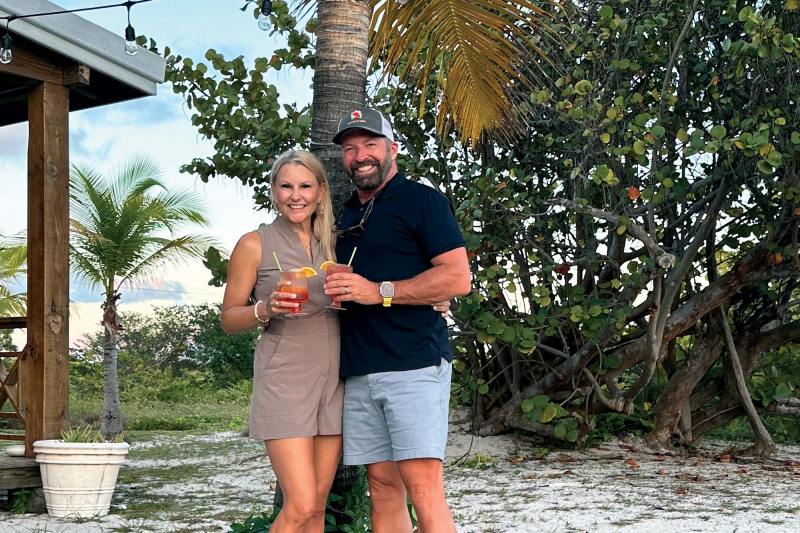
He got invited back. And he made the most of it, helming at every opportunity aboard boats that ranged from 44 to 58 feet. He devoured YouTube sailing channels. SV Delos was an early staple, not just for inspiration but also to study how skippers actually operated. He picked up a copy of Sailing for Dummies. He took notes.
But there was a ceiling to what he could absorb from the helm of a large catamaran. Big cats are comfortable, capable and, in a meaningful way, deceptive. “The helm can be fairly dead on big cats,” Mike explained. “You really don’t know how the weather’s affecting it. You can’t tell if your sails are properly trimmed and the boat is balanced.”
The real education came from an unlikely classroom: a 28-foot monohull on a lake.
A friend was selling the boat. Mike bought it for one reason: to learn what the big cats had been hiding from him. The lake delivered the lesson immediately and without mercy. “When I first got out there with full sail up, anytime a puff came across the lake, I’d get that weather helm and broach right into the wind,” he said. “I didn’t understand the dynamics. I thought I had a bad boat.”
He didn’t have a bad boat. He had a teacher.
The monohull taught him to reef without ego. It’s worth pausing on that. Mike admitted he had absorbed a quiet misconception, one that probably lives in more sailing brains than care to admit it. “In my head, I always thought that reefing was something only conservative sailors do,” he said. “It was almost an emasculating thing. I quickly understood it has nothing to do with that. A properly trimmed boat is actually going to go faster and be more comfortable when it’s reefed for the conditions.”
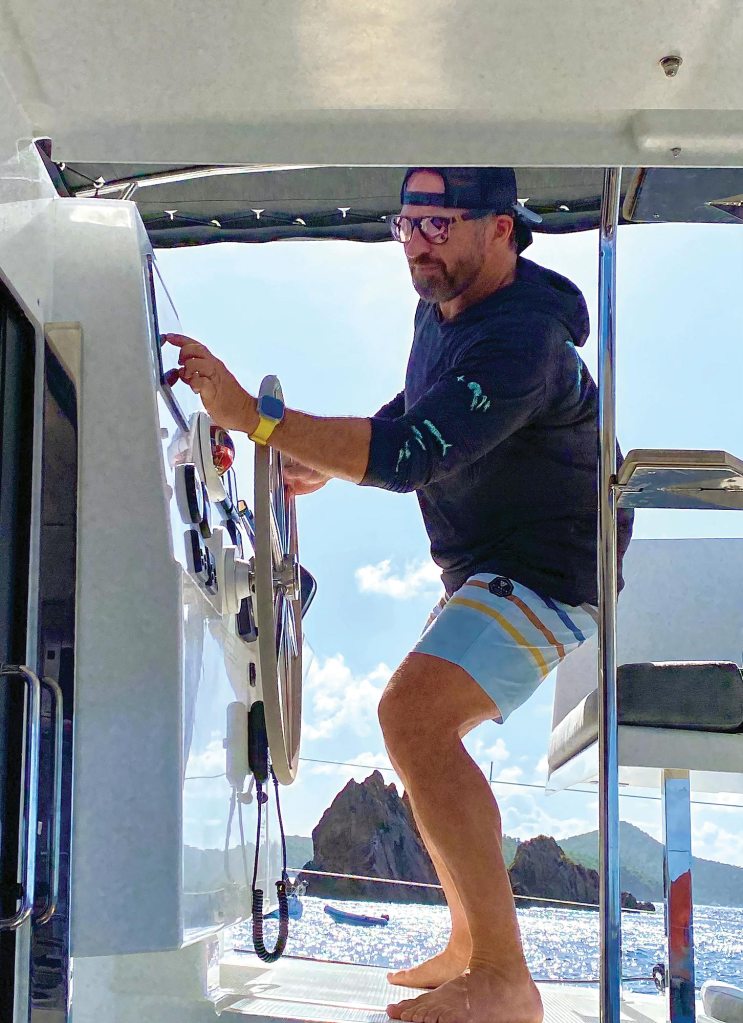
The lake also taught him to think ahead. Sailing, Mike noted, is often described as hours of boredom punctuated by moments of terror. The monohull compressed that cycle into something he could actually practice. Squalls arrive. Boats converge. Lines get disorganized. “You don’t have anything set up on the deck for that,” he said. “And then all of a sudden it’s happening.” The cat, he came to understand, had been absorbing those moments quietly, masking the feedback. The monohull didn’t hide anything. That was the point.
When he felt ready to pursue a first bareboat charter as captain, he discovered that confidence and credentials are not the same thing. The base manager at his charter company in the BVI had a different checklist. He wanted a high enough credit-card limit to cover the insurance deductible. He wanted an ASA 105 coastal navigation certification. Mike took the course, found it genuinely useful—particularly for chart plotters, tides and dead reckoning—but came away with a clear hierarchy in his mind about how sailors actually learn.
“If I had to have a choice between someone who’s never taken the courses but has sailed for five years, or someone who’s taken every class and never sailed, I know which boat I’m getting on,” he said.
He passed the base manager’s checkout. The dinghy slipped the line. They were doing it.
Mike and Cyndi kept going back. Over nearly two decades of chartering the BVI, the islands became something closer to a second home than a vacation destination, not just because the sailing was good, but because each island has its own distinct personality. Anegada rewards the effort of getting there: Pomato Point, just outside the main anchorage, requires the right wind and conditions, but when it delivers, it’s white sand and flat water with nobody else around. Benures Bay, tucked behind Norman Island, is the one they always forget how much they love until they’re back in it—quiet, off the radar, with a St. John sunset that fills the whole western sky. North Sound on Virgin Gorda is where Mike goes when someone gives him three days and one destination: anchor off Prickly Pear; dinghy in to Saba Rock or the Bitter End; catch a cab to the Baths or CocoMaya for dinner on the beach; and save the trip to Hog Heaven, for barbecue with what might be the best view in the Caribbean, for the last night.
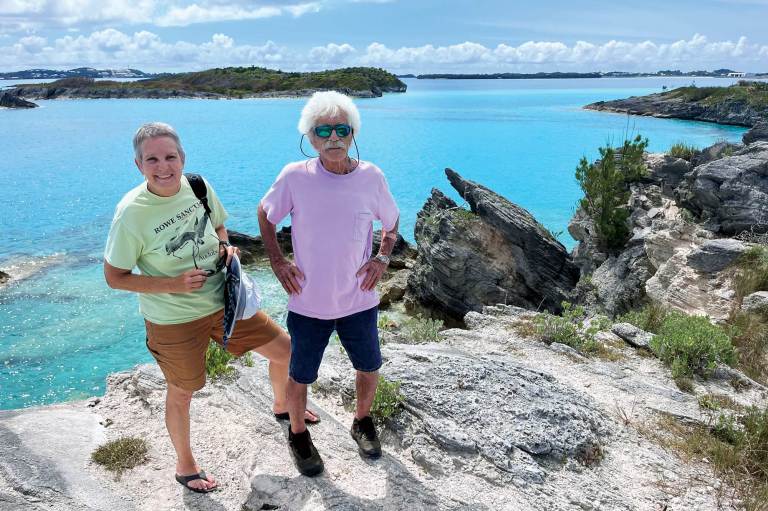
They built a network of people across nearly every island—restaurant owners, base staff, fellow cruisers—that the Crosbys have long since stopped calling acquaintances. “We call them family,” Cyndi said. “We check in with them every time we return. It’s not just a vacation anymore. It’s personal.”
And, almost inevitably, the question surfaced: Why are we chartering someone else’s boat?
It surfaced most clearly at the Annapolis Sailboat Show in 2021. They’d walked through a few boats, circled the same Fountaine Pajot models they’d been eyeing for years. Cyndi turned to Mike and asked, “What are you waiting on?”
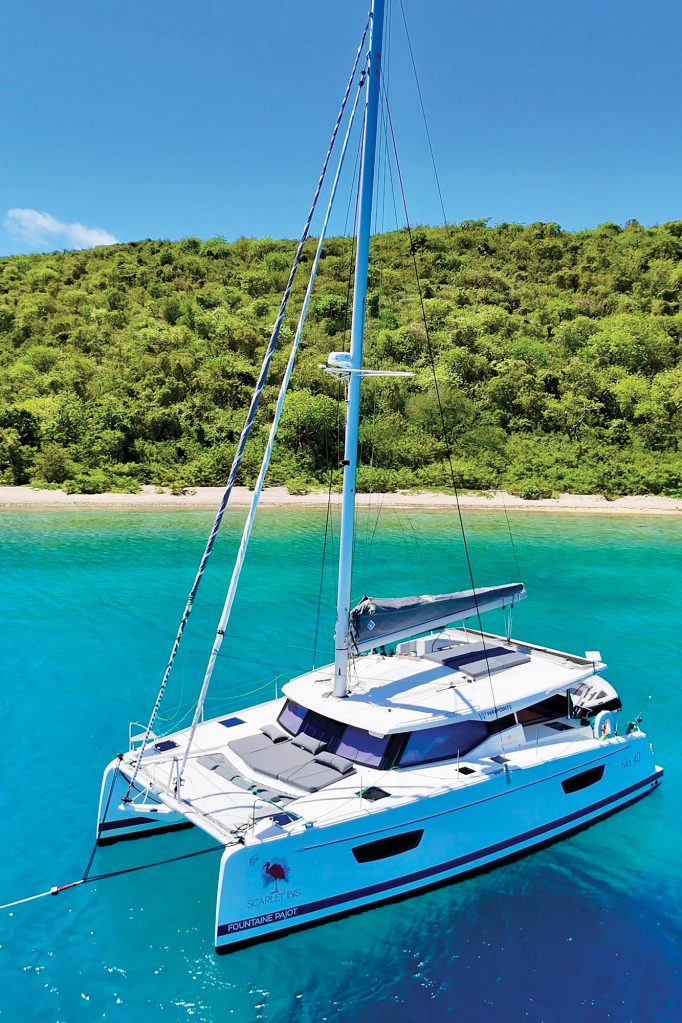
That day, they signed a contract for a Fountaine Pajot Isla 40.
“It’s like having kids. You’re never really ready,” Mike said. “You just do it.”
The original plan was private ownership. But the Fountaine Pajot dealer connected them with Waypoints, a charter management company operating in the BVI. And here is where Mike’s story pivots from personal journey to useful instruction.
The key, he will tell you without hesitation, was trust. Not in the charter model, but in a specific person. Anthony, the base manager at Waypoints, was someone Mike had chartered through for years at another company. When Waypoints brought him on as a partner, the decision became straightforward. “I just know it’s going to be taken care of better than I could take care of it from 2,000 miles away,” Mike said.
That trust was validated before they ever put their own boat in the fleet. Before the Isla 40 arrived, the Crosbys chartered through Waypoints to inspect the operation firsthand. They climbed aboard a 4-year-old boat and kept looking for the wear. They couldn’t find it. “We just kept looking around going, ‘This boat is 4 years old,’” Mike recalled. “It’s been in charter this entire time and it was so well-maintained.” Waypoints runs a two-day turnover between charters, with a full systems inspection. That detail mattered to him as much as anything.
The finances came with a learning curve. They chose an owner-operated program over a guaranteed income model, which meant the revenue fluctuated with the seasons—strong in high season, quiet during hurricane haul outs when the expenses don’t pause. “You’ve got to plan for the downtime just like you plan for the income,” Mike said. “Some months are great, some not so much.”
What set them apart, they believe, is how actively they engaged with the business side of ownership. Rather than dropping the boat at the dock and waiting for quarterly statements, they market it. They talk to people. They hand out cards at beach bars. Cyndi, who had long helped friends plan Caribbean vacations informally, is now pursuing her travel agent certification. “We treat it like a business because, well, it is one,” Mike said.
It’s an approach he recommends to anyone thinking about entering the charter market, but with a clear-eyed caveat: Passive ownership works better as a theory than a practice. “Whatever path you take,” he said, “just take some ownership. Know what you’re signing up for.”
The Crosbys are still learning. That’s the part that doesn’t make it into the brochure version of charter ownership: that two and a half years of actually living with a boat is its own graduate program, and what you come out of it knowing is different from anything you understood going in.
What they’ve learned is now producing their next decision: a Fountaine Pajot 44, driven not by restlessness but by the specific knowledge that comes from living with a boat long enough to understand its gaps. The galley gets an island. The flybridge lounge replaces twin sunpads. Storage is smarter. Ventilation is better. For Cyndi, who handles anchoring duties, the redesigned anchor locker is less an upgrade than a liberation—the bridle is now accessible by lifting a table lid rather than requiring a half-dive into the foredeck.
“We realized over time how much those small details matter,” Mike said. “And this new boat just checks the boxes we didn’t even know we had until we started using the first one.”
The bigger plan remains on the horizon. The kids are nearly out of the house. Retirement is approaching. There’s talk of St. Martin. Of the Spanish Virgins. Of going farther, staying longer, spending less time watching the charter calendar and more time simply being away.
For now, though, the BVI is enough. It almost always is.
“It’s like having a vacation home,” Mike said. “Except we get to move it from island to island.”
He’s had nearly 20 years to perfect that line. It still lands.