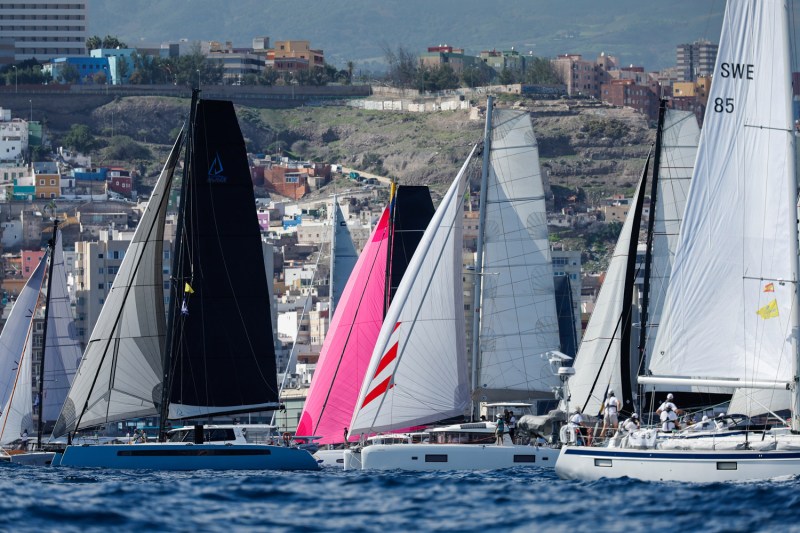
More than 700 sailors from 33 nations set out from Las Palmas de Gran Canaria in Spain’s Canary Islands on Sunday, November 22, at the start of the 41st Atlantic Rally for Cruisers. The 118 boats are sailing about 2,700 nautical miles to Rodney Bay, Saint Lucia.
World Cruising Club organizes the ARC, which began in 1986. The club calls it the world’s largest and longest-running ocean cruising rally.
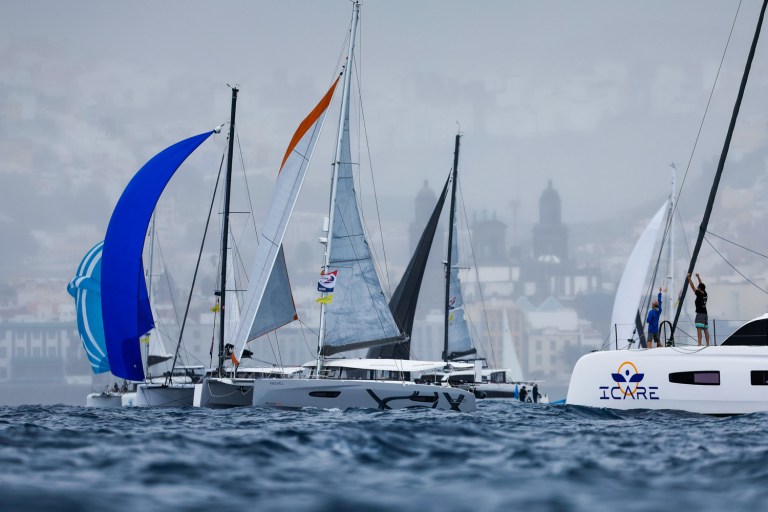
The fleet sailed in three divisions, each with its own start time: multihull, racing and cruising. The cruising and multihull divisions shared a start line to windward of the committee vessel. That was the Spanish Guardia Civil Maritime Service patrol boat Río Órbigo. The racing division started from a separate line farther inshore, to leeward of the committee boat.
The multihull division started first, at 12:30 p.m. local time (7:30 a.m. EST). Boats competed for the slightly favored pin end of the line, and Viva (USA), a Neel 52, broke clear into open air. The breeze was light, 8 to 10 knots from the northeast, but the fleet made steady progress toward the southern end of Gran Canaria.
The 10-boat racing division followed at 12:45 p.m. local time (7:45 a.m. EST). According to the organizers, it is the only ARC division scored under IRC handicap, and its boats may not use their engines.
The Dutch Volvo 65 Nextgen by Jajo crossed the line first and set a Code Zero, which lets a boat sail faster and closer to the wind than a conventional spinnaker. Nextgen by Jajo took line honors in ARC 2025, crossing in 10 days, 48 minutes and 51 seconds. Sailing as Team Brunel, the same boat also took line honors in 2015 and set what was then the ARC record. Whether it can beat last year’s time will depend on the weather. The current rally record is 8 days, 6 hours, set by the maxi Rambler 88 in 2016, according to World Cruising Club.
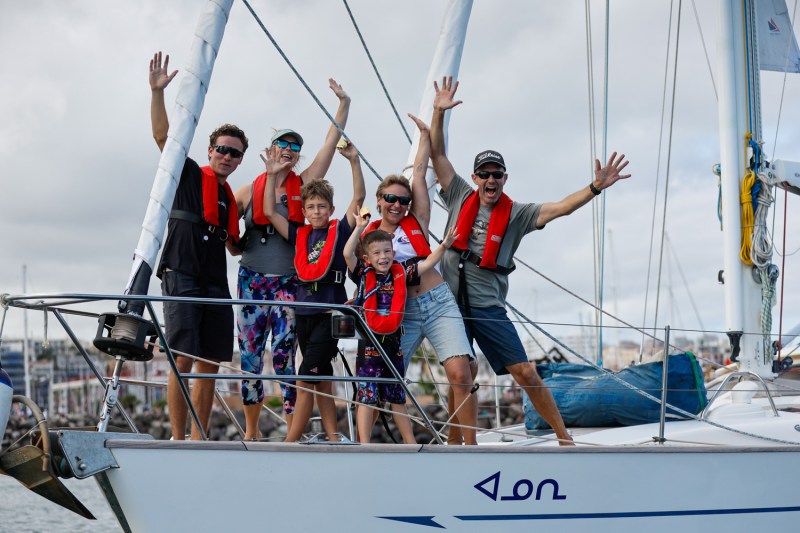
The cruising division, the largest of the three, started last. AFYX (Malta), a Grand Soleil 72, made the best start and also sailed its first miles under a Code Zero.
Before the start, crowds of friends, family and Gran Canaria residents lined the marina breakwaters to see the boats off, a long-standing ARC tradition. The local band Banda Guiniguada played, and World Cruising Club staff broadcast farewell messages to the crews.
Roger Dance of Maggie Ray (Marshall Islands) spoke before departure.
“I’m really excited and I can’t wait to get going. I’ve really enjoyed the social environment during the last two weeks here, as well as the camaraderie among all the boats,” he said.
“I think it’s going to be amazing. Everybody that we’ve been talking to is hyped up and they’re really excited about getting going. We just can’t wait for the start gun.
“I’ve done the ARC twice before and Saint Lucia is lovely. I love the approach when you come around the headland and see the finish line. It’s a tremendous experience!”
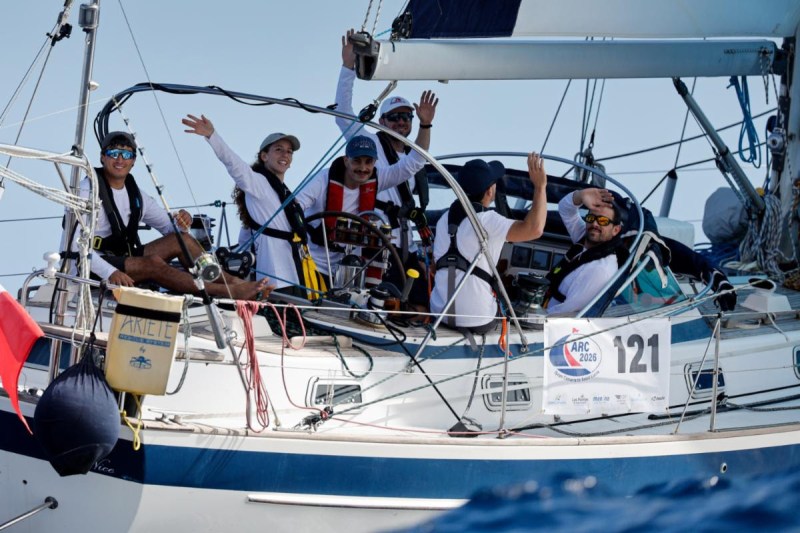
The start was streamed live on Facebook and YouTube. The broadcast used six onboard cameras in the fleet and two drones, with commentary from the marina breakwater, the committee vessel and a powerboat. A replay and fleet updates are on the ARC 2026 event page.
Paul Tetlow, managing director of World Cruising Club, spoke after the start.
“The departure of the ARC fleet from Las Palmas de Gran Canaria is always a special occasion, and celebrating this moment alongside the participants is always a hugely enjoyable experience. We recognize that even reaching the start line of the rally is a major achievement, and something which can take years to plan, so it is great to see people reaching this moment,” he said.
“The team at World Cruising Club have enjoyed getting to know the fleet over the past two weeks during our shoreside program in Las Palmas de Gran Canaria. It is clear that deep friendships have already begun to form among participants, and today’s departure encompassed the already strong sense of camaraderie within the fleet.”
Tetlow thanked the rally’s local supporters, Turismo Gran Canaria, the Ayuntamiento de Las Palmas de Gran Canaria (city council) and the Port of Las Palmas.
“We look forward to welcoming the fleet to the beautiful island of Saint Lucia in a few weeks’ time. There is always a fantastic atmosphere as boats enter Rodney Bay Marina to be welcomed by locals and fellow participants, to celebrate this amazing achievement,” he said.
The forecast calls for the northeasterly trade winds to continue, with the light start-day breeze building slightly. Most boats are expected to reach Saint Lucia in about 20 days. The finish line closes Dec. 18, and the rally ends with a prizegiving in Rodney Bay on Saturday, Dec. 19. That will be more than five weeks after the rally office opened in Las Palmas on Nov. 10.
Fleet positions can be followed on the ARC 2026 tracker.