Life rafts are like seat belts: We all hope they won’t be necessary. Nevertheless, most of us wouldn’t consider buying or driving a car that wasn’t equipped with them, and a life raft is an essential piece of gear for ocean passagemaking.
In my work carrying out vessel inspections, I routinely encounter incorrectly installed, weather deck-mounted canister life rafts. In the vast majority of cases, these deficiencies go unnoticed because, thankfully, life rafts, like seat belts, are rarely needed.
However, when a life raft is needed, you want to have complete confidence that it will work. Here are some important ways to avoid mistakes with canister-style life rafts that are permanently mounted on deck.
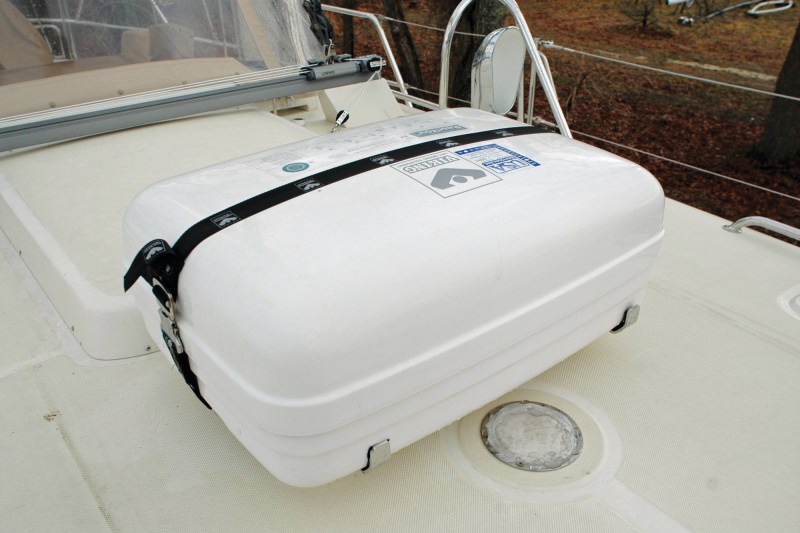
When it comes to installation, the first job is to mount the raft securely, so rough waters can’t carry it off the vessel. A deck-mounted cradle must be through-bolted, rather than screwed to the deck.
Rough waters can also unintentionally trigger hydrostatic release units. These units are valuable because they let the raft deploy automatically if the vessel sinks too quickly for the crew to deploy the raft. However, when these units are mounted on the foredeck, rough seas can be a problem. Hydrostatic release mechanisms are available in multiple release-depth and pressure ratings. For life rafts that may be subject to rough seas, use a deeper depth release.
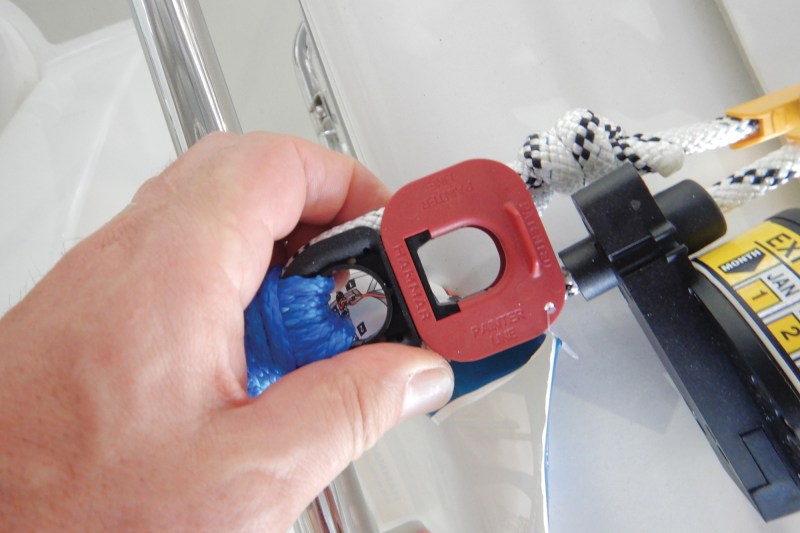
Correctly rigging the hydrostatic release unit is also critical. This unit typically includes a “weak link” to secure the raft’s painter (that’s the lanyard that triggers the raft’s inflation). As a vessel sinks, seawater pressure triggers the hydrostatic release unit, and the raft floats free from the cradle, deploying the painter. When it reaches its end, it triggers the raft’s inflation bottle. Then, as the vessel sinks deeper, there’s a danger that it will pull the raft down with it—hence the “weak link” parts that release the raft.
The painter must be secured through the weak link, which is typically labeled with the word “painter.” Incorrect rigging of the painter is perhaps the most common error I encounter when inspecting life rafts.
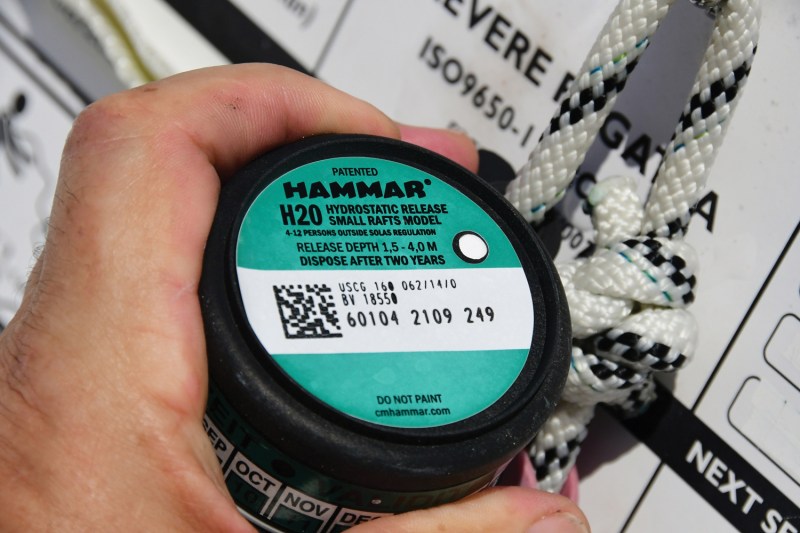
There’s also the fact that hydrostatic release units expire, typically after two years. The most commonly found variety requires the installer to scratch out the expiration month and year, so it’s clear when it must be replaced.
A life raft must also have a means of manual deployment. This typically consists of a pelican-type hook with an easy-to-grasp lanyard that you pull to release the raft’s lashings (I have seen these deteriorate to the point that when they’re finally pulled, they disintegrate).
Nothing—no lines, canvas, covers or cushions—should impede the raft’s release. And rafts with hydrostatic release units should not be mounted under a dodger or overhang, either of which could prevent a raft from floating free of a sinking vessel.
The simpler and less cluttered the cradle and lashings, the better. Canister rafts can be heavy, and you need to be certain that yours can be thrown or pushed overboard with ease. Ideally, you should be able to push it overboard or slide it across the deck and then tip it over the toe rail. If it has to be lifted over a rail or a lifeline, then the weakest crew member needs to be able to do that unassisted.
Many raft canisters, when they’re mounted horizontally, have drain holes on the downward-facing section. However, if the raft is mounted vertically—on a stern rail, for instance—then any drain holes that face upward or to the side should be plugged to prevent water from entering the canister.
And with the exception of a stern mount, under no circumstances should a rail-mounted raft stand proud of the toe rail.
There are many ways to install a canister-style life raft. Sadly, most of these are, in my experience, incorrect, even when boatbuilders or dealers are the installers.
Make certain your raft is properly installed and in full compliance with the manufacturer’s installation instructions. Hopefully you won’t ever need to use this important piece of equipment, but you should always have it ready just in case.
Steve D’Antonio offers services for boat owners and buyers through Steve D’Antonio Marine Consulting (stevedmarineconsulting.com).