The first time I took a friend out for a weekend sail, I didn’t set the hook overnight. And I don’t mean the anchor didn’t set properly. I mean that I never put it down. We just drifted. All night. In a lake. Confident, in the blissful ignorance of youth, that everything would be fine.
It was, but only because of dumb luck and dead calm. That calm evaporated in a spray of whitecaps at dawn when the mountain winds started cranking. I leapt out of my berth to see the rocky shore uncomfortably close to our unmoored hull. I hastily started the ancient outboard and steered quickly away from coastal collision. I spent the next hour fervently thanking the universe for teaching me an important lesson without dire consequences.
You might think that early experience would have made me a more cautious sailor. Surely, I would buck up and quit making cringeworthy mistakes. But it just meant that I stopped making that particular mistake. When I look back at my quarter-century sailing career, it feels a little like replaying a slapstick montage of what not to do.
To put my blunders to good use, I decided to share a few of them here, kind of like how Jimmy Cornell wrote in the May 2025 issue about some of his best decisions during onboard emergencies to better prepare readers for potential catastrophes. Except that I’m sharing my worst decisions in hopes that readers won’t repeat them.
Talk to Your Crew
One of the most valuable lessons I’ve learned as a captain is that the crew can’t read my mind. As an inexperienced twentysomething, I had figured that telepathy would save me from having to issue clear orders, especially to older males on my boat. And if that failed, they could simply intuit what needed to happen from my vague gestures and inarticulate mumbles.
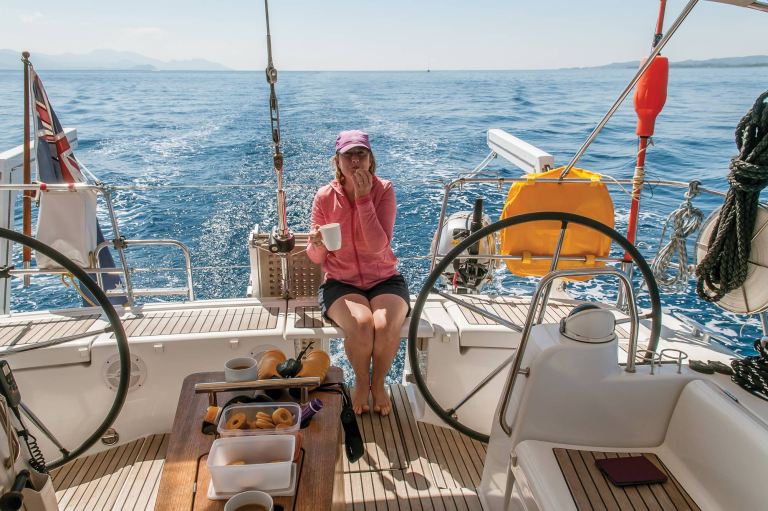
For instance, when my friend Tim joined me for a lovely afternoon sail, I was pretty confident he would know what to do even though he’d never been sailing a day in his life. Tacking was a breeze as we rounded an island. Anchoring in a bay to swim went smoothly. But that’s because I did everything myself while Tim chatted with me.
Docking was another matter. As I steered the Paceship 26 back into its slip with a stiff wind blowing off the stern, I quietly asked Tim to step off with the dock lines. He dropped gingerly onto the narrow finger dock, grinning triumphantly at his success.
And then he threw the lines back onto the boat. I had failed to mention the crucial next step to Tim: Secure the ropes to stop the boat from hitting the dock.
I yelled too-late orders at Tim, who watched wide-eyed as I made an improbable leap for the dock, channeling my inner gymnast, and grabbed a stanchion. The boat bumped the boards. The gelcoat was barely scratched. My pride, however, was gouged to the core.
Start Small
We had been dating less than a year when I informed my future husband that I planned to quit my job to sail across the Pacific. “Cool,” Rob said. “I’m in.” Eighteen months later, newly wed, we set sail as crew aboard a 53-foot steel ketch sailing from Colon, Panama, to the Marquesas in French Polynesia. My dreams were coming true: 4,000 miles of bluewater bliss.
There was only one catch: Neither of us had ever sailed overnight. Nor had we ever sailed out of sight of land. What better way to pop our passagemaking cherry than by undertaking one of the longest voyages a sailor ever undertakes?
Now, there’s something to be said for starting big and jumping in with both feet. But there’s probably a lot more to be said for starting small.
As Panama’s humid jungle disappeared into the twilight on the first day of our Pacific puddle-jump, my husband and I turned green. I felt nauseated because of the massive cargo ships speeding in all directions around our vulnerable, poorly lit sailboat. My stomach roiled as I pictured the unrelieved black of the sea if I were to fall overboard during my two a.m. watch.
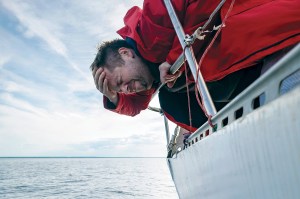
Rob turned green because of the house-high ocean swells. And stayed green for weeks. We eventually found the combination of medications and preventive measures that kept his seasickness at bay, but it took a lot of trial and error. Meanwhile, Rob’s illness was not only debilitating for him, but it was frustrating for the rest of the crew who required an able body during the passage.
Much of our misery could have been prevented had we practiced offshore sailing—even once—before committing to 33 days at sea. Short shakedown sails are a fabulous idea, just sayin’.
Practice Low-Risk
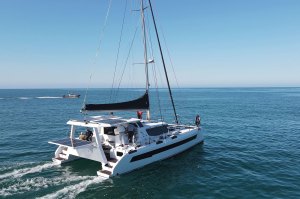
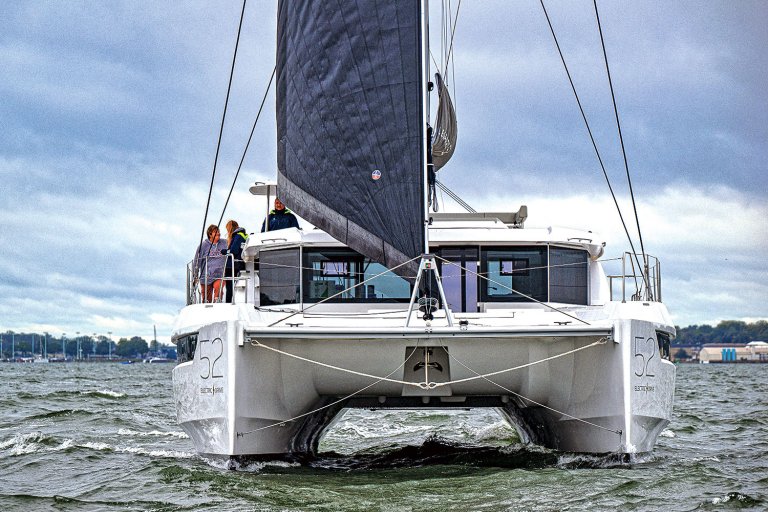
The first time I ever sailed a catamaran was on a bareboat charter for a week in the Caribbean. None of my fellow seven crew members had ever sailed a catamaran, either. For some reason, the charter company still let us leave the dock. (“No experience? No problem! Just buy the insurance.”) Not that I was worried. How different could a Lagoon 40 be from my 26-foot monohull?
A lot different, it turns out. The onboard systems took a solid two days to sort out: opening and closing the holding tanks to four heads confounded us, as did sailing upwind with such a boxy, top-heavy craft. By midweek, though, we were feeling pretty good about the day-to-day protocols. We were picking up mooring balls like seasoned pros and could even raise the mainsail without four people on hand to unravel reefing lines.
So we decided to sail a little further to an outer island. One without any mooring balls.
It probably would have been easier to attempt my first time anchoring a catamaran if the weather had been settled. Or if I’d been familiar with the landscape and the boat. Or if I’d had someone on hand with experience to show me how to do it.
Instead, it was blowing 25 knots, and we were all alone in an unfamiliar anchorage. The crew gathered on the bow, clustered helpfully around the anchor chain, chatting and occasionally pointing in opposite directions. I was glad they seemed to be having a jolly time, but was getting frustrated at the helm, where I couldn’t see or hear a thing. I was yelling questions into the wind with no answer: “How much scope is out? Should I back down now?”
Eventually, someone ran back to the helm to inform me, proudly, that the hook was set. I stupidly assumed this meant the bridle was on, too. But no one aboard had ever used a bridle or two engines while anchoring. I revved up and backed down, then put the engines in neutral, ready to relax and enjoy the scenery.
Except one engine wasn’t quite in neutral. And the bridle wasn’t exactly attached to the chain. A particularly stout gust hit our slowly rotating boat, and we heard the screech, ping, clang of the bow roller ripping off.
Good thing we’d opted for the charter company’s full insurance.
Set an Alarm
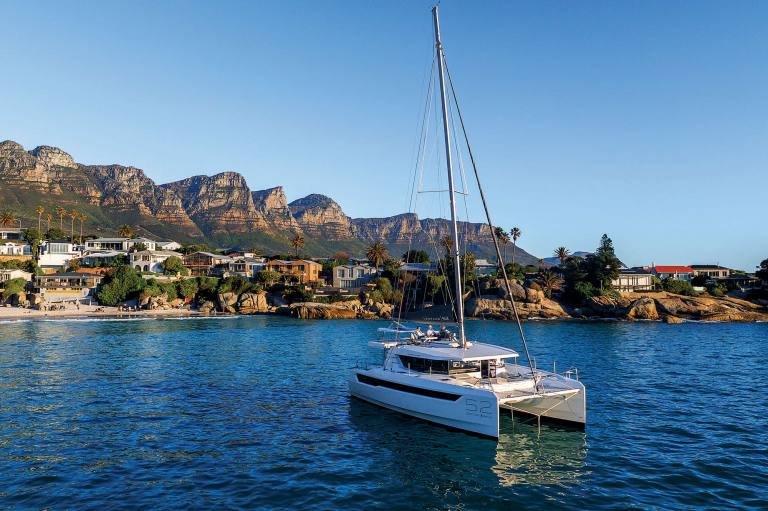
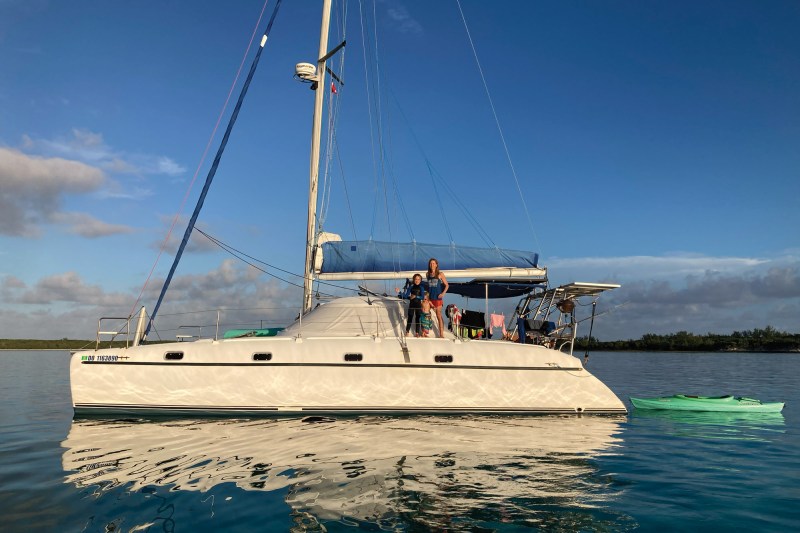
More recently in the Bahamas, Rob and I sailed a catamaran for two months each winter with our toddlers. We technically owned one-third of the Jaguar 36 with two other co-owners, but we were responsible for 100 percent of any damages incurred while we were aboard.
During our second winter, we left Great Harbour with two buddy boats to sail to the remote, unpopulated end of the Berry Islands. Both boats were monohulls with young couples on their first stint cruising in the tropics. One couple had sold everything they owned to buy their boat and were six months into a five-year, round-the-world voyage.
That couple anchored behind us. (Cue foreboding music.)
We arrived first on our speedy catamaran and scouted anchorages. A blow was predicted from the west for a few days—opposite of the prevailing trade winds—and we finally found a nook that had decent holding. We anchored closer to shore with our shallow draft to leave room for the monohulls. By now seasoned pros at cruising, we let out 10-to-1 scope and expertly secured our bridle before backing down.
Our friends arrived. Fun commenced, including snorkeling, sandcastle building and a lovely potluck dinner in our cockpit under the full moon. Amid all that fun, we forgot to swim over the anchor to check that it was solidly set, like we normally did.
At 1 a.m. the wind ramped up from zero to 30 knots, as predicted. With rigging jangling, we both leapt out of bed and immediately saw that we were dragging. Fast. Straight toward our friends’ new monohull. With just two boat lengths between us and them.
Rob and I each grabbed a fender from the bow locker and sprinted to the port side. We held our breath as our catamaran sailed past our sleeping friends, just a few arm-lengths from catastrophic collision.
And that’s how we learned to set an anchor alarm.
I’ll spare you more outtakes from my montage of mess ups and leave it at this: The hundreds of truly spectacular moments in my cruising career far outnumber, and definitely outweigh, the handful of regrettable fails.
Everyone makes mistakes. It’s part and parcel of learning how to do stuff the right way. So go forth. Cast off the dock lines (and tell your crew to catch them when you return). Mess up a little. And then try your best to laugh about it later.