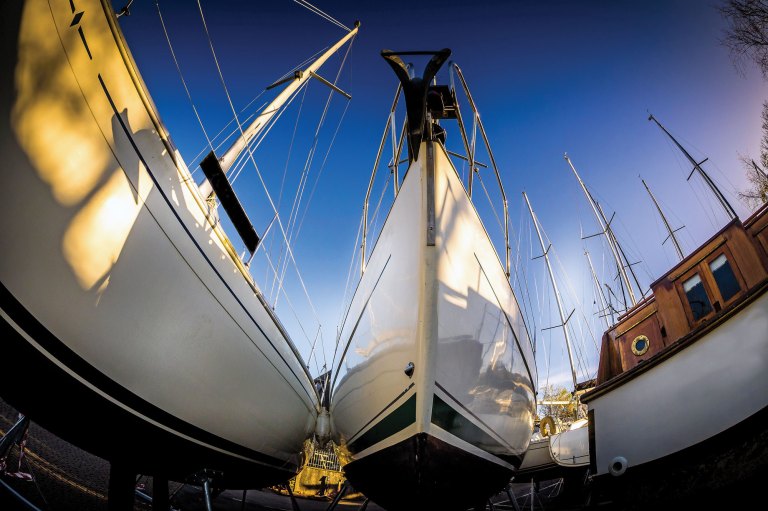
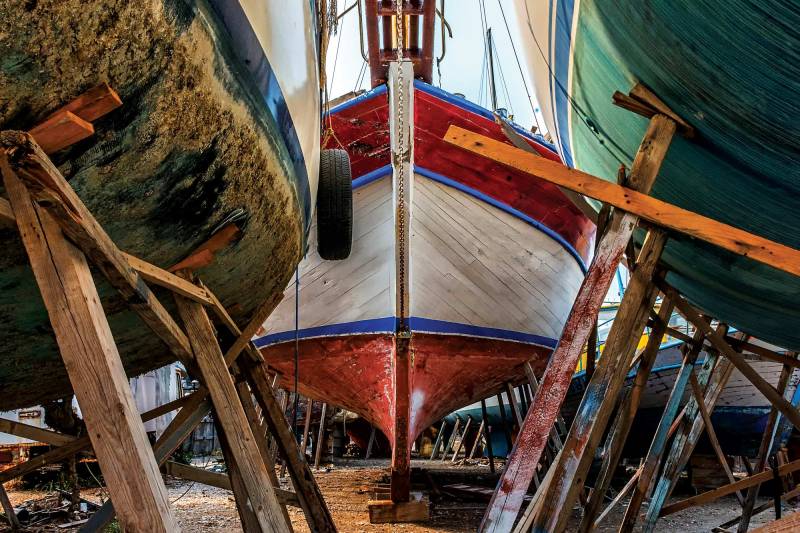
There’s something deeply personal about looking for a cruising boat. Not just because of what it costs—or what it might cost you to fix later—but also because of what you’re really chasing. Some people look for systems. Some for speed. Some want a tank that’ll outlive a hurricane.
Me? I think I’m looking for a feeling.
I’ve spent too much time in too many boatyards to be romantic about it. I know the smell of old diesel and dead dreams. But still, when you see a certain sheerline, or the sun hits the bronze just right, some part of your brain yells: Maybe this is the one!
I didn’t expect to find anything in Essex, England. Or in Amsterdam, for that matter. But I went anyway. Because you never know.
When the English yacht designer Laurent Giles was 34 years old, a lawyer from the island of Guernsey commissioned a small cruising sailboat. The result was Design No. 0015, a little cutter the owner christened Andrillot.
Andrillot was a modest boat, just 25 feet, 3 inches overall, but its lines were inspired by the hard-driving English pilot cutters. Giles adapted their best characteristics into a gaff-rigged cutter and gave it a sweeping sheer with a moderate draft.
In 1939, Andrillot won the Little Ship Club’s annual Vertue Challenge Cup, a 745-mile, round-trip race from the Solent in the UK to Southern Brittany in France. The success prompted Giles to expand the design into the well-known Vertue class sailboats, which have a hard-earned reputation for seaworthiness and long-distance cruising.
I thought about all this as I pondered the fact that we don’t have mud berths in Maine. Along England’s South Coast, with its 3-to-23-foot tides, they’re pretty common. They make for cheap dockage too, since you can only move your boat from mid- to high tide.
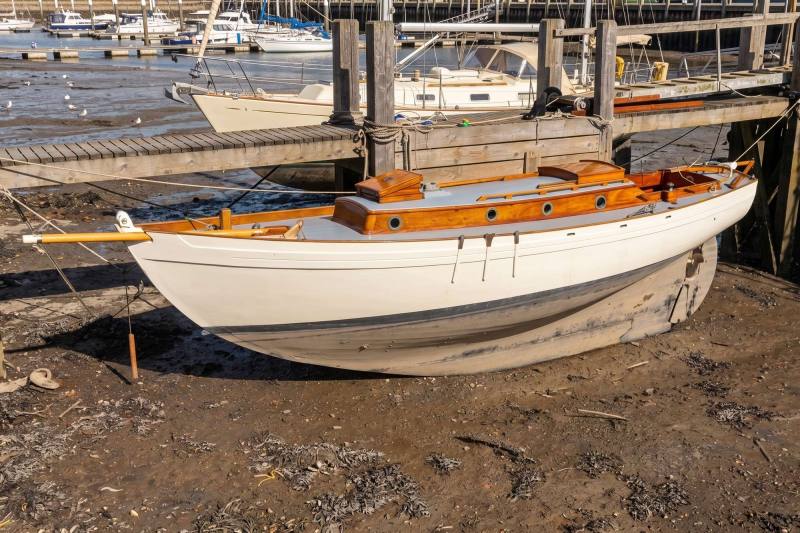
I’m in Essex, England, to see a 25-foot Vertue. In the photos, it looked just like Andrillot. At the marina, I meet Milt, a tall, easygoing yacht broker, and after a handshake and some chat, we walk through the boatyard to the gangway. Down, down at the bottom of the gangway is Fionna … waist deep in oozy black goo.
Steve, the owner, shows up. He’s wiry and not much over 5 feet, 8 inches, if that, a little gray and scruffy with sky-blue eyes in a nut-brown face. He’s a throwback to hippier times. He looks like the kind of guy who, as a lad, probably backpacked through Afghanistan but then came back, cut his hair and settled into an office job for many years. He still loves camping rough, and I imagine that Fionna reminds him of rougher, readier years.
One thing is certain: He loves his boat, and there’s a reason why he’s selling it, a reason that he won’t say. I’ve looked at a few boats, and the owners are usually upfront about their reasons for selling. He mumbles something about, “Can’t work on ’er anymore,” but that seems odd. This man is fit.
Fionna is thoroughly stuck in her mud berth, and after a few minutes, so is the conversation.
“Let’s have some breakfast,” Steve pipes up. And so the three of us walk to a very English tearoom for bacon and eggs.
The tearoom is small with high ceilings and bay windows. The waitresses wear gauzy, white paper tiaras. The food is good, and there’s plenty of it. As our waitress refills our coffee cups, the broker’s phone rings, whisking him away. Steve and I, after we’ve finished our coffee, walk back to the boat.
“I hope you’ll like the boat,” he says as we clomp down the steep gangway.
What’s not to like? It’s a boat right out of an adventure novel. But it’s a novel that hasn’t been opened lately.
Thick curls of white topside paint reveal bare wood. The linseed-oiled deadeyes supporting the shrouds have gone black in the sun and rain. Stiff halyards hang coiled on blackened belaying pins. We pull off several sheets of heavy canvas and reveal … a tiny boat. The cockpit is like a mini-bathtub where you can only sit up. The vertical coaming hurts my back when I take a seat. Steve unlocks a discolored bronze padlock, and with brute strength (this guy is surprisingly strong) forces back the unwilling companionway hatch. Now, I’m not a big guy, but the companionway opening is tight. And the three steps down are steep.
Standing on the sole: holy smokes. There’s so much stuff down here. It’s like a nautical museum. To port, there’s a World War II-era circular radar RDF unit. Next to it, in a dovetailed wooden box, there’s a taffrail log … with an extra log. You can’t sit on the settee because there are several canvas and cork life vests beside a nest of oiled wooden blocks, the varnished topmast and a bag that bulges with the topmast sail. There’s another sail bag, plus an assortment of logbooks and pilot books.
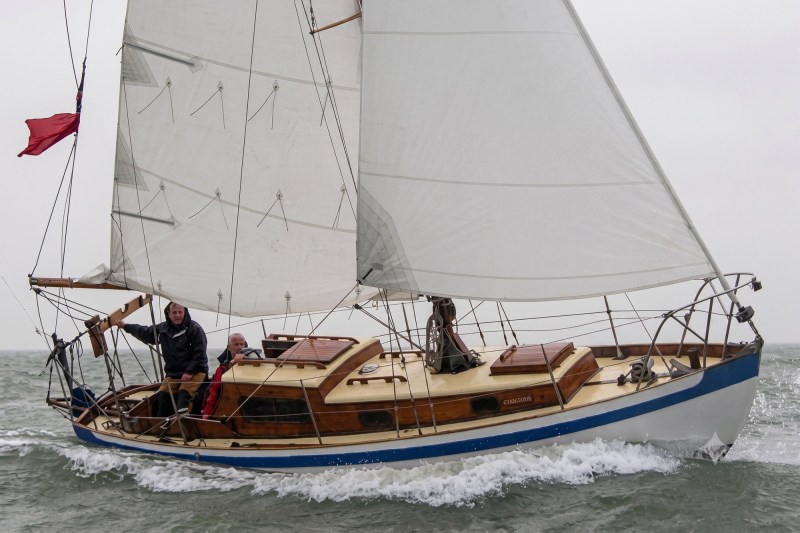
I want to restore this boat and keep it as a model. But as interesting as it is, it’s not a model, and I don’t want to sound like Goldilocks, but this boat is too small. I’m looking for a cruising boat, and frankly, I like simple and strong. I’d prefer if this one were an open boat with a boom tent. It’s difficult getting around the tiny cabin.
Case in point: going forward. Like Andrillot, the mast here is keel-stepped, so you squish yourself around it and ease forward to the vee-berth and the anchor locker. (This is also where you lift up one of the cushions and find the head underneath.) Well, it’s not easy getting around that mast, and that’s at the dock, solid in the mud. What about in a seaway or a stormy anchorage?
Steve is in his element, though. He’s opening boxes and rambling on about this and that He clearly loves this boat. But he doesn’t sail it. He spends a lot of time down here cruising through memories. Right now, he’s poking through a drawer with old chart-plotting instruments.
The boats (and the people) you find in these UK ports are interesting, but I don’t think this is the boat for me. I’ll mull it over, though.
“Steve,” I say, “how ’bout a pint?”
He looks up and slides the drawer closed. “You Yanks learn quick,” he says. He peers through one of the heavy bronze portholes and smiles. “Tide’s coming back.”
The Erin
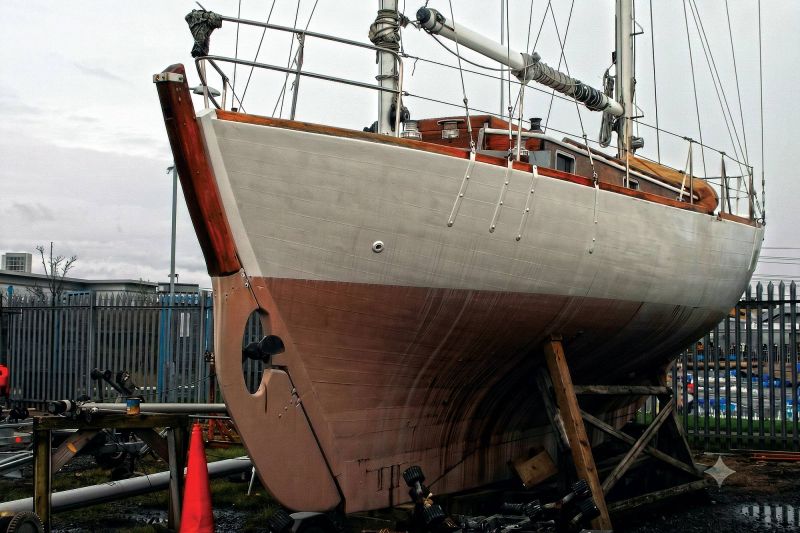
While Laurent Giles found inspiration in English pilot cutters, American designer William Atkin looked farther north, to Norway and Colin Archer’s redningsskøyte, or rescue skiffs. Atkin envisioned a smaller, slimmer version of these massive double-enders, and the result was the 36-foot Erin.
Atkin’s design philosophy was straightforward. It stressed simplicity, practicality and self-sufficiency. His audience was the amateur home builder, and his platform was the DIY magazines of the 1940s and ’50s. Plans for the Erin first appeared in 1949, and it became a popular design. Today, the plans can still be purchased through Mystic Seaport Museum in Connecticut, which houses the William and John Atkin Collection with more than 1,800 sheets of boat plans.
My own Erin adventure begins with redheaded Gordy, who has a big problem. His fantastic new job on a Spanish superyacht is awaiting in Mallorca, but here he is in Amsterdam trying to sell me his old boat.
At 39 feet, this double-ender is a bigger boat than I’d been considering, but it was advertised as an Atkin Erin, and I have always liked the wooden double-enders.
I’ve answered Gordy’s ad and am now checked into a “boatel,” a riverboat-turned-hotel. Soon, I receive the first of many texts from Gordy; this one has directions to the boatyard. The boat is ashore in a vast, unheated warehouse, and he’s waiting for me at the door.
Gordy ushers me through the place, introducing me to this guy and that with, “He’s here to buy my boat.”
Well, maybe. Maybe not.
Even in a good-sized shed, a 39-foot, full-keeled, heavy-displacement wooden boat is a wonder to behold, and this one doesn’t disappoint. We’ll definitely need a tall ladder.
Patches of the topsides have been sanded bare, revealing mahogany planking. For some reason, all of the hardware has been removed and is crammed into boxes lined up along the keel.
We find that tall ladder, and prop it against the topsides. Up on deck, I can see where the hardware had been removed.
“I had some projects in mind,” Gordy explains. “Re-bed the toe rails and stanchions. Then this Spain job came up…” His phone rings, and while he talks, I climb down the companionway steps.
More boxes. The cabin is full of them. No labels, either. Gosh, this boat is like a 39-foot jigsaw puzzle.
But that’s not the only puzzle. I look for a builder’s plate, something that says the Wm. Atkin yard, but I don’t find one. Maybe it’s in a box?
“Hey, Gordy!” I call up the hatch. “Is there a builder’s plate?”
Cellphone in hand, Gordy clambers down into the cabin. “No, I don’t remember seeing one,” he says. “This boat was built in the ’80s, in the Atkin boatyard in Connecticut. Then they it trailered it down to Florida and finished off the interior down there.”
Snap. He flips his phone shut, turns to me and says, “Well, whattaya think?”
I think that’s a very interesting story.
I walk through the cabin. With a 10-foot beam, it seems narrow for a 39-footer. But, Atkin did prefer slim, slippery hulls. In comparison, one of Archer’s 40-foot double-enders would have had a beam closer to 11½ feet.
Back down the ladder to inspect those exposed planks. Looks good. Nice wood. “Bronze screws,” Gordy volunteers. “Quality work.”
Yes, but whose? I’m still not impressed. Too many questions. I’m ready to leave.
Downtown Amsterdam: My phone rings three times. Each time, Gordy lowers his asking price. That boat’s a project, and while I’m not afraid of projects. I am afraid of the cost of keeping that boat in indoor storage. In Amsterdam.
When I get home, that plate puzzle still irks me, so I drop an email to Atkin’s widow, Pat. I send her a couple photos and tell her about the boat. I ask some questions about building Erins.
And what a pleasant surprise: She writes me back.
But not with good news for Gordy.
“That’s a pretty boat,” she writes, “but it’s not an Erin. … Stretching her from 36 to 39 feet changes the design. And the bow looks a little different.”
And the builder’s plate? “There [was] no Atkin boat yard,” she says. “In Connecticut, they only had a design office in the house.”
Now, I’ve seen fake Rolex watches, fake Converse All-Stars, but a fake designer boat?
Finally, the kindly Mrs. Atkin ends with a barb: “I don’t take it kindly when people use the Atkin name to make a sale.”
My search continues.
Selling Your Boat? 8 Tips for Making a Video Walkthrough
I once contacted a fellow in Southampton, UK, over WhatsApp about his Catalina 36, and he suggested a live video walkthrough of his boat. It was a neat idea, and, when I later decided not to pursue the boat, the walkthrough saved me the expense of a trip. But here’s the takeaway: just turning on your camera then walking and talking about your boat may not be the most appealing to a potential buyer. Here are some tips to create a persuasive live or pre-recorded video walkthrough.
- Length. Ten minutes is long enough. I was on WhatsApp for over 35 minutes, and while the seller was very thorough, I did start wondering when it was going to end. Eight to 10 minutes provides a good overview of the boat and then allows for follow up questions. Also, before a live walkthrough, email the potential buyer an informational pdf with images of the interior layout, the sail plan and a gear inventory.
- Plan Your Route. Before you start filming, plan the route you’ll take through the boat. This ensures you cover all important areas systematically and won’t miss any key features. As the buyer, I printed out views of the boat interior and profile from sailboatdata.com and had some specific questions ready for the owner. For example, I wanted to see access to the chain plates, and since this boat has a winged keel, I wanted to see some exterior closeups of the keel-to-hull attachment. The printout was a good place to note these questions before the walkthrough and to make notes during the presentation.
- Lighting. Natural light is best. Try to film during the day when the light is bright but not glaring. If necessary, use additional lighting down below to ensure all areas are well lit and appealing.
- Stabilize Your Camera. Use a tripod, or better yet, a helper, to keep your camera steady. Shaky, erratic footage can be distracting to the viewer.
- Highlight Key Features. Focus on the unique and desirable features of the boat, such as updated electronics, galley equipment, storage, hatches up forward for good ventilation and access to the chain locker. Good, sharp close-ups are important, as is letting the camera roll while you focus on equipment or specific areas so the viewer can get a good look. One tip, when recording or going live, is to silently count to four while you show each feature.
- Provide Commentary. When it comes to your boat, you’re the expert. Narrate the video to explain the importance of what the viewer is seeing. Highlight the benefits of each feature and provide the boat’s history, maintenance records and any recent upgrades.
- Smooth Transitions. If you edit a recorded video, be sure to include smooth transitions between different sections of the boat. This helps maintain a professional look and keeps the viewer’s attention.
- Call to Action. Remember the point of making the video: to sell the boat. At the end of the video, either in front of the camera or as a voice-over, encourage the viewer to contact you for more information or to schedule a viewing. Make it easy for them to take the next step.