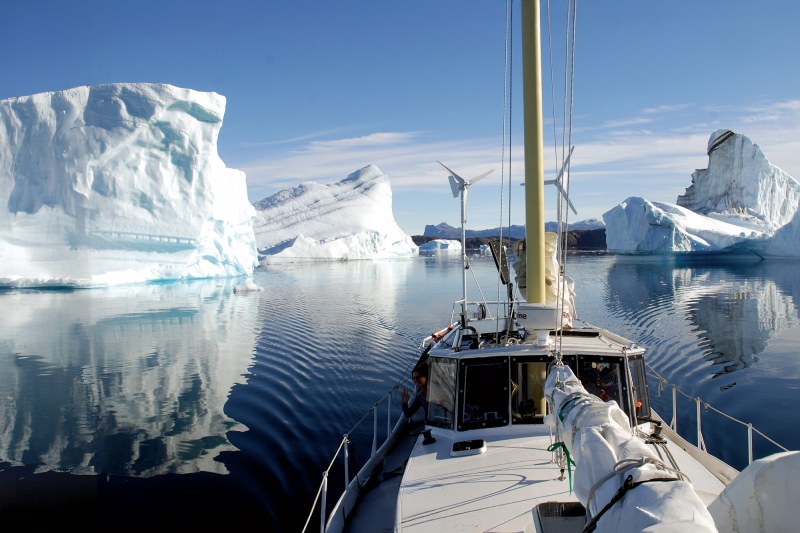
The worst part isn’t the ice. It isn’t the fog that settles for days and doesn’t lift, or the lee shores that appear out of nowhere on uncharted Russian charts, or the 70-knot storms that rolled through Baffin Bay three times last October. It isn’t even the prospect of navigating 3,500 miles of Siberian coastline on dead reckoning and radar if Russia’s GPS jamming takes out every GLONASS antenna he managed to scrounge.
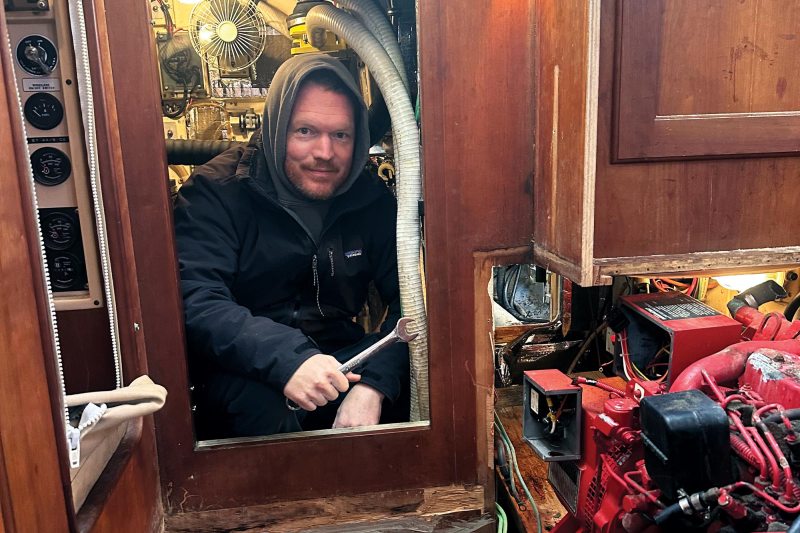
The worst part, Matt Rutherford will tell you, was lying awake in Annapolis, Maryland, at 3 in the morning trying to remember whether the new Balmar alternator had a diode problem or just a field-voltage issue, and doing the math on how many days he had left to figure it out before he had to leave.
“This part sucks worse than the sleep deprivation in the ice,” he said in early May, stepping away from the boat for a few minutes. “This is where you wake up in the middle of the night to pee and you can’t go back to bed. You’re lying there going, ‘Oh shit. What am I going to do?’ This is the worst part of the trip.”
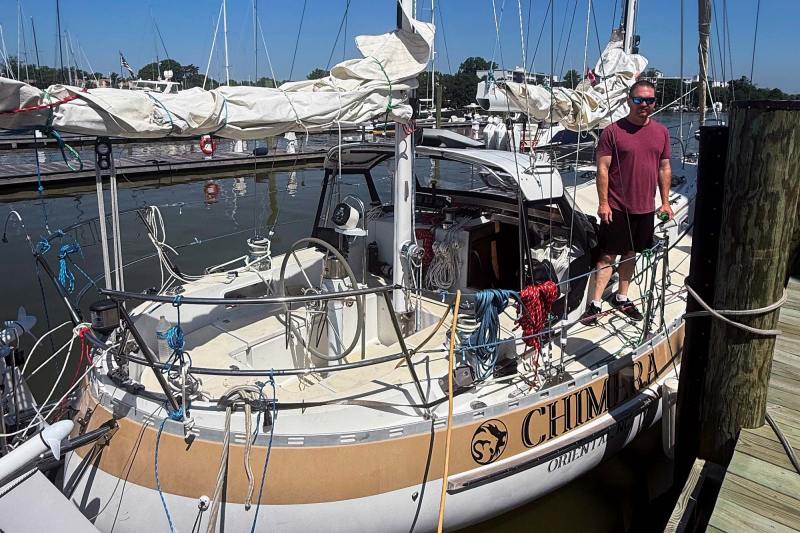
That part is behind him now. As of this writing, Rutherford has departed Annapolis and worked his way north on his shakedown passage to Lunenburg, Nova Scotia—breaking in a new engine, chasing down chafe and putting miles under a Valiant 42 that has been rebuilt from the mast down during the past six months. From Lunenburg, he picked up new sails, then pointed north and east across the Labrador Sea. His real departure, the start of the record attempt itself, was from Aasiaat, Greenland, on June 25.
His destination is the same harbor, pointed the other direction, sometime in November.
If he pulls it off, Rutherford will become the first person to circumnavigate the entire Arctic Ocean singlehanded in a single season. Nonstop or otherwise.
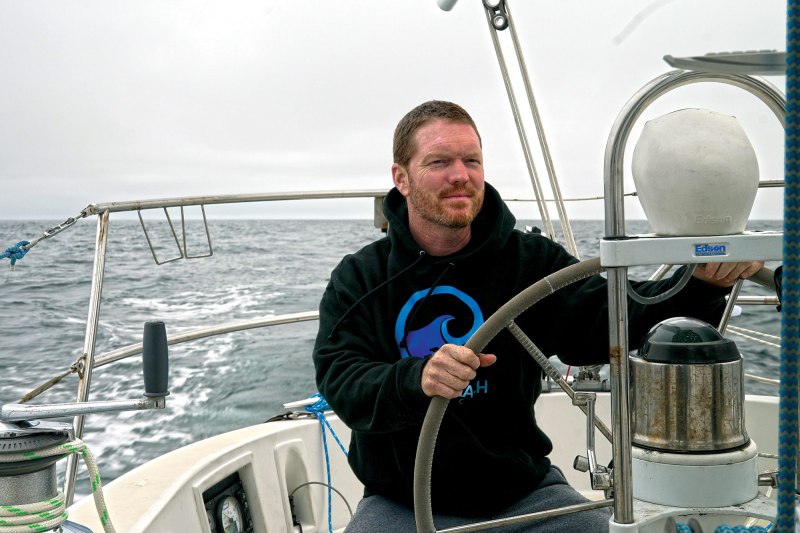
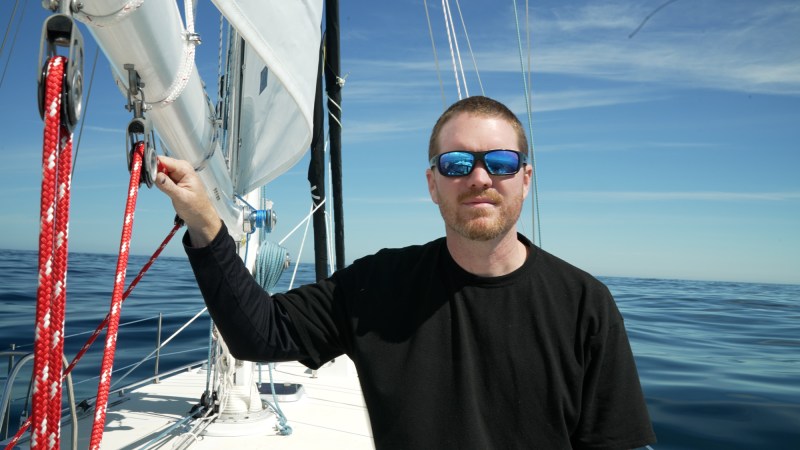
Rutherford’s name is already etched into the record books. In 2012, he sailed around the Americas solo, nonstop and singlehanded. It was a 27,077-nautical-mile passage aboard a 27-foot Albin Vega with a 13-gallon fuel tank and a 100-gallon bladder wedged down the middle of the cabin. It took 309 days. He had to step over the bladder to get from one settee to the other. He didn’t stop. The trip earned him a Guinness World Record, a feature in National Geographic and, more practically, the notoriety he needed to build the Ocean Research Project, a Chesapeake Bay-based nonprofit that has since conducted seven Arctic research expeditions aboard its purpose-built research vessel, Marie Tharp.
The new trip isn’t a sequel. It’s a different category of hard entirely.
“When I went around the Americas, the hardest part by far was the Arctic section,” he said. “Harder than Cape Horn. A boat got put upside down in the Bering Sea, and I still wouldn’t say the Bering Sea was harder than the Arctic. And this entire trip is the Arctic.”
The route begins at Aasiaat, runs south around the bottom of Greenland (you can’t sail over the top, the ice makes it impossible) and then continues north of Iceland, north of Scandinavia and east along the Russian Arctic coast through the Barents, Kara, Laptev and East Siberian Seas. That’s the Northeast Passage, which the Russians call the Northern Sea Route, roughly 3,500 miles and the single most fraught section of the circumnavigation. From there, Rutherford must thread the Chukchi Sea, cross the Beaufort and enter the Northwest Passage from the west, arriving at its maximum ice melt around early September. Then Baffin Bay, the Labrador Sea and back to Greenland before October turns Baffin Bay into 70-knot chaos seeded with glacial ice.
The window is brutally narrow. He needs to depart Greenland around July 1 and figures 90 days to close the loop, averaging 100 miles a day. “You have to prioritize the finish line, not the start line,” he said. “Because when you come out of the Northwest Passage, it’s October. Three storms blew over 70 knots in Baffin Bay last October. That’s where icebergs go after they calve from Greenland. That’s where the berg that sank the Titanic came from. You don’t want to be slow.”
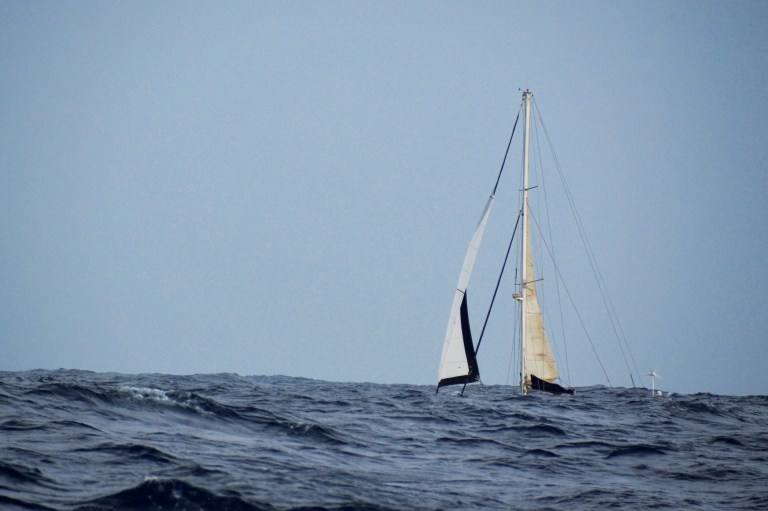
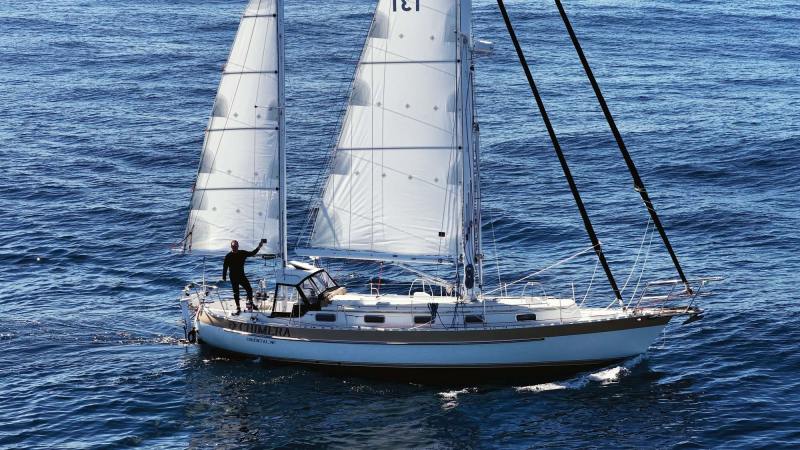
The boat is a Valiant 42. It’s a cutter-rigged ketch, the only ketch the company ever built, and one that Rutherford is quick to note is really a 40-footer with a 2-foot bowsprit. He bought her for $135,000, then put another $135,000 into her, replacing virtually every system aboard. There’s a new Yanmar 57 engine with a new shaft, new propeller, new transmission and new dripless stuffing box. He pulled the mast and stripped it to bare metal, replaced everything on it. New furlers, new standing rigging. The 28-year-old original sails were good enough to get him to Nova Scotia; the new suit was waiting for him in Lunenburg.
“It’s basically a new boat at this point,” he said. “We didn’t do much with cosmetics.”
The Valiant is reputedly the most-circumnavigated production boat per capita ever built. Sailors buy them specifically to go around the world. Rutherford has logged enough offshore miles on Valiant 42s (including one brutal passage at 45 gusting 55 to 60 with half a staysail out and 20-foot seas driving from astern) to trust the design in conditions most sailors would prefer not to imagine. The cutter-ketch rig means he can single-line reef the main without leaving the cockpit. In the Arctic, that matters. Going forward to slab reef in breaking seas above 78 degrees north is not a plan; it’s a headline.

He built a 360-degree polycarbonate enclosure around the cockpit—“my little bubble”—with a roll-down panel on the after end and a jury-rigged bus heater plumbed off the engine to push warm air up into it while motoring. The Arctic is cold, but what makes it relentless isn’t the temperature so much as the wet: fog for days, perpetual clouds, everything soaked. He has two Watt & Sea hydrogenerators trailing astern and has 1,280 amp-hours of Dakota Lithium batteries below. A Garmin radar draws essentially nothing in standby. He won’t run a refrigerator; the boat will hover between 33 and 40 degrees for most of the passage, and free cold storage is one of the few advantages the high latitudes offer.
Navigation above Russia presents its own particular problem: Russia jams GPS. Everything except GLONASS, their own system, gets blocked. Rutherford stocked up on GLONASS antennas, aiming for three layers of redundancy for every chart and nav system aboard. He may still run out.
“I might have to navigate 3,500 miles of Russian coastline with dead reckoning and a radar,” he said with the measured tone of someone who has thought about this carefully and concluded it’s not outside the realm of possibility. “That would suck. But it’d be a hell of a story.”
He would prefer the boring story. Probably.
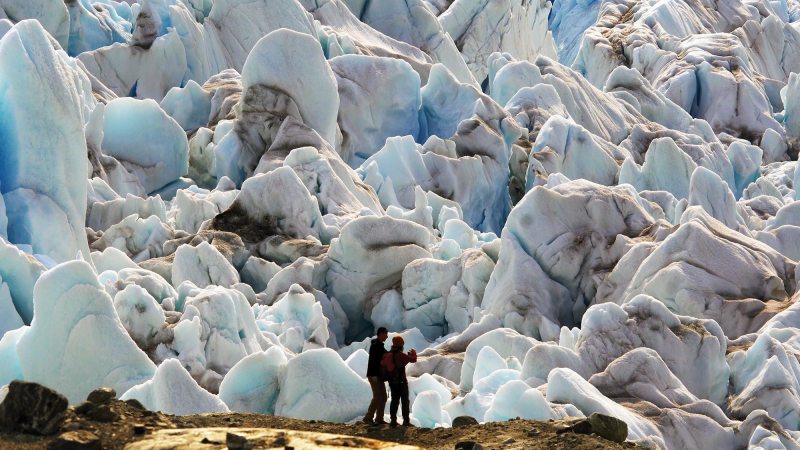
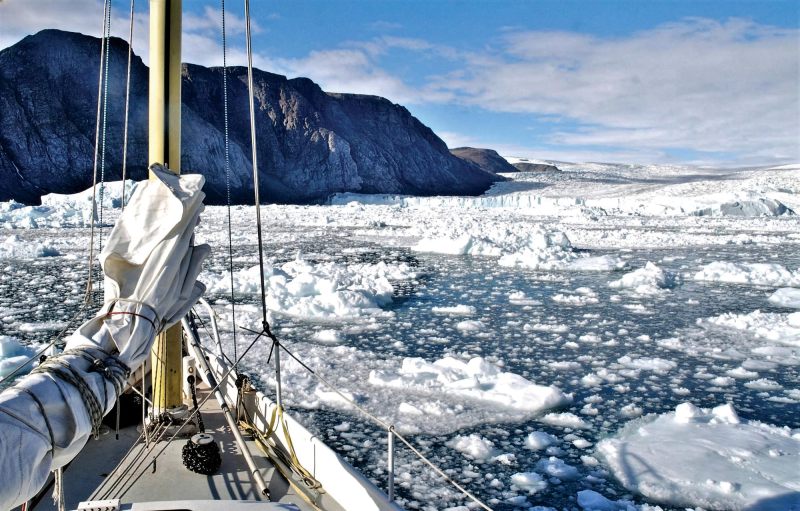
Ice, in 2026, is behaving strangely. This past winter set a record, with 15 percent less Arctic sea ice than the previous all-time low. For a trip like Rutherford’s, less young ice is mostly good news. Young ice, what freezes each winter and melts each spring, is the kind you can work through. Old ice is different. Old ice is 3 years or older, ice from the polar ice cap itself, and as the cap warms and destabilizes, it doesn’t simply disappear. It breaks up. It spews.
“For probably the next 10 to 15 years, we’re going to have a huge chunk of old ice up there just destabilizing,” Rutherford said. “Eventually we’ll reach a point where there’s open polar sea in the summer because all of it will be young. But the period between now and then, you’re dealing with destabilized old ice going everywhere.”
Last year, the disintegrating cap was being compressed against the northern Canadian archipelago and Greenland, pouring down the western entrance to the archipelago in what Rutherford described, without exaggeration, as a river of ice. He didn’t face that when he went around the Americas. This year, depending on where that old ice migrates, he might.
Above Wrangel Island, on the east Siberian coast, the ice pinches especially hard. At one of the two major constriction points along the Russian coast, he’ll be pushed as far north as 78 or 79 degrees.
“You want the Goldilocks,” he said. “Warm enough for the young ice to melt, but not so much that the polar cap is spewing old ice everywhere. You don’t really know what the hell you’re going to encounter until you’re already there.”
He’s not going in blind. This is his eighth time sailing in the Arctic. He has thermal imaging goggles for the fog, a drone to scout leads in the ice when visibility allows, and PredictWind weather downloads via the Iridium Go! Executive—40 times faster than the old model, still roughly the bandwidth of a 1997 dial-up connection, but enough to pull a forecast and push a one-minute vertical video once a day. He’ll lose Starlink above Russia; it was already illegal there before Elon Musk blocked it entirely on February 1, rendering the question moot. And he’ll be dark for roughly a month. After that, he’s reachable by satellite phone via Wi-Fi calling with enough clarity, he says, that you’d think he was calling from Annapolis.
He might be calling from 75 degrees north in a force 8. Whoever is on the other end of the call won’t know the difference.
The Russian permit was, going into this trip, a wild card. He’d been told he would get one. The language was “a little weird.” His stated intentions—”transit only, nonstop, no landings”—were apparently acceptable. Freighters transit the Northern Sea Route the same way, and there are expected to be far more of them this year, up to 20 times normal traffic, as the route functions as a pressure-release valve for the Strait of Hormuz while Russian oil moves east to Chinese buyers under the relaxed sanctions regime.
Still, it’s Russia. He said it plainly: “They could pull me off the boat and throw me in a gulag. Who the hell knows what’s going to happen up there.”
His contingency, if he arrived at the Russian border and got turned around, was the figure eight: the Northwest Passage alone, a longer trip at roughly 320 days, without the same record on the line. It would keep the boat moving and the mission intact.
He gives the full Arctic circumnavigation roughly 70 percent odds. Better than the trip around the Americas, which he pegged at a 50/50 “heads you live, tails you die.” The improvement is largely experience: seven prior Arctic passages, six months of refit work done mostly himself because he couldn’t afford to hire it out, and the institutional knowledge of what went wrong in 2018, the last time he tried the Northwest Passage, when nobody got through that year and he turned around.
“Experience is everything,” he said. “Whether it’s writing, sailing, anything. I’ve been doing this a long time. I know what I’m getting into.”
The voyage is also an Ocean Research Project mission, though Rutherford is careful about how he frames that. The nonprofit’s scientific director is focused on publishing peer-reviewed climate papers this year. It’s a process that takes longer than most people realize, with manuscripts rejected once or twice before clearing review. And a full flow-through sensor array, the kind the team has deployed on previous expeditions, isn’t feasible for a solo passage. He’ll collect nitrate and nutrient data north of Alaska and Canada in partnership with a NASA-affiliated modeling program. He won’t collect anything above Russia; if he does, the Russians consider it “stealing state secrets,” which is one way to describe oceanographic sampling. The legal consequences are not theoretical.
He is direct about what the trip is primarily for: raising money and awareness for the nonprofit. The Ocean Research Project needs to repower its research vessel Marie Tharp. The current engine is a 1960s rebuild with only 60 hours on it, and replacing it will cost roughly $100,000. Science sensors run $80,000 apiece. “Nobody is going to donate to a nonprofit they’ve never heard of,” Rutherford said. “People care more about these big singlehanded trips than the research expeditions. I get that. So let’s use it.”
He built the Ocean Research Project from the notoriety the Americas trip generated. He intends to use this one the same way. The live tracker and all video will live at oceanresearchproject.org. Daily posts, one-minute verticals for the phone crowd, longer horizontal cuts once a week. He’s been learning video-editing software. He will figure it out somewhere on the Labrador Sea.
It’s a goal-oriented enterprise built on something that can’t be manufactured: the thing itself. The ice. The fog at midnight above Siberia, sun still hanging at the horizon, radar on, thermal goggles up, one hand on the wheel and the other on a GLONASS antenna he’s hoping still has a signal.
“It wouldn’t be a good adventure if you knew the ending,” he said before he left. “You don’t find out how it goes until it’s over.”
Right now, the ending is still months and thousands of miles from being written. The Valiant is eastbound. The new engine is turning hours. The ice above Russia is at its lowest on record, and the polar cap is doing something nobody has seen before, Matt Rutherford is pointing his bow at all of it, one watch at a time.
Editor’s note: Follow Matt Rutherford’s passage and support the Ocean Research Project at oceanresearchproject.org.