For five full days in last spring’s running of the roughly 935-nautical-mile Antigua Bermuda Race, the big Yeti cooler mounted on chocks abaft the wheel of Jay Gowell’s well-traveled Tayana 52, Moonstone, had been a nondescript, inanimate entity. In the mornings, it would be loaded with frozen ice packs and assorted beverages to be enjoyed during the mostly warm, calm days that unfolded. Then came the sixth day, when the weather and the ice chest took a turn for the worse.
Which is when the cooler tried to kill me.
We’d been tracking the cold front since before leaving Antigua. We were fairly certain we’d rendezvous with it a couple hundred miles south of Bermuda, which was precisely what happened. It was no mystery. We understood we’d probably get walloped.
And then, just before sundown on that fateful day, the big, classic, cigar-shaped lenticular cloud appeared directly in our path. The front.
We were ready. We’d already doused and stashed the kite we’d been flying for days, and we’d shortened the headsail. It was then upon us. Northerly gusts to over 35 knots. Lightning everywhere. Blinding, sideways rain. At the helm, Jay asked for quick relief while he dashed below for his harness. I slipped behind it.
I’m not quite sure how I managed to bang into and unmoor the cooler, only that I did. The Yeti was suddenly alive. It whacked me hard from behind and wedged me right up against the wheel (I’d apologize to Jay later for the bend in it). It rattled down to leeward, and I had a brief moment of panic when I failed trying to jettison it overboard—the stainless-steel Bimini top’s rails were in the way—and almost launched myself instead. It would’ve been a very lame, but maybe fitting, way to go.
I couldn’t see a bloody thing in the squall. It was a supremely lousy time for the red compass light to have packed up. I accidentally tacked, which in hindsight was the luckiest thing ever. We were suddenly hove to, forereaching at 2 knots, everything instantly calm and collected. My watchmate, a super-competent and reliable sailor called Anderson Noel, remounted the damn Yeti. Jay returned and relieved me of my folly. We tacked and got back at it. Because, you know, we were racing.
The irony is, right up until that sequence of events, it had been such a pleasant journey.
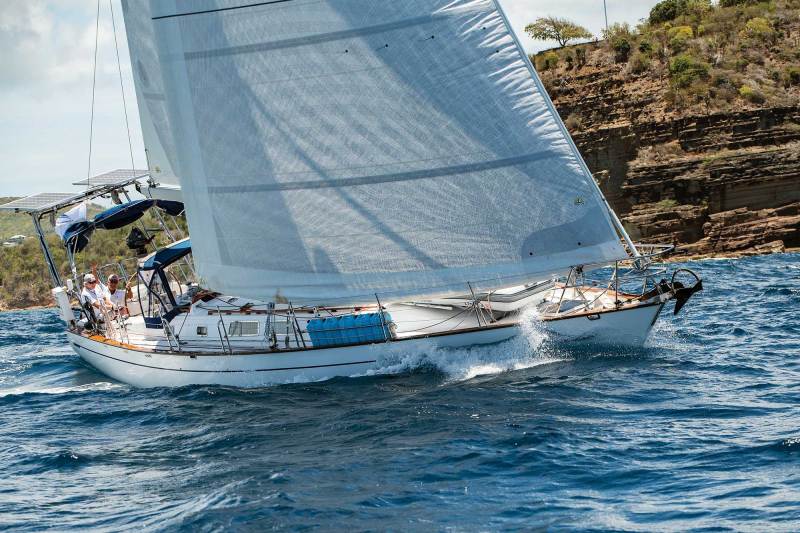
For Moonstone, the voyage north from the islands was the culmination of a grand two-year odyssey for Jay and his wife, Elizabeth, that included two transatlantic voyages and extensive travels in Europe and the Caribbean. In the middle of all that, with Jay serving as the commodore of the Cruising Club of America, the couple enjoyed the Western Isles Cruise up Scotland’s west coast, a wonderful event that I sailed on a different boat.
Jay and I raced Shields class one-designs together back in the day and reconnected in Scotland. When he asked if I was up for the Antigua Bermuda Race, I was all in. So, too, was Anderson, a rare CCA member from Canada who’d also been on the Scotland cruise, and Phil Thorn, who’d sailed many a mile with Jay. With a start in late April, the race attracted eight boats bound north from the Caribbean, and the finish was timed to coincide with the stopover of the SailGP Bermuda series. When all was said and done, Moonstone took third behind Howie Hodgson’s Swan 75, True, and Michael Hennessey’s scow-bow Class 40, Scowling Dragon. It wasn’t a huge fleet, but it was a good one.
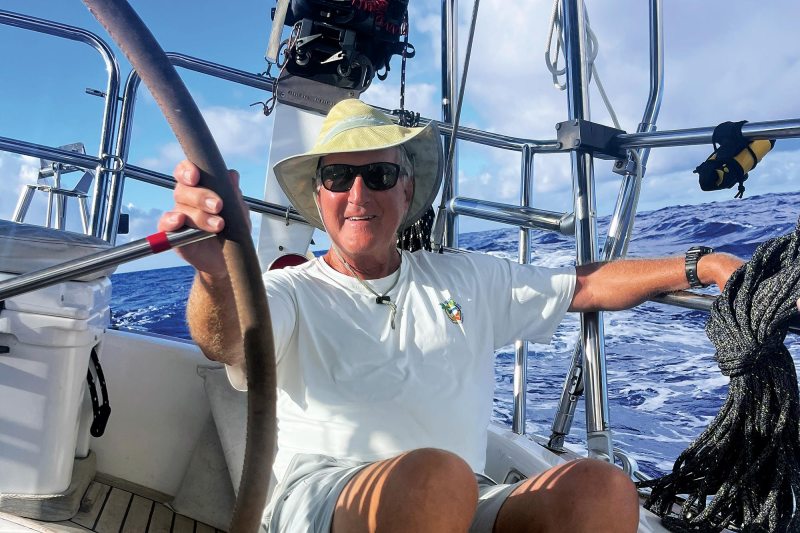
And for me, the real allure was an early season adventure on a well-prepared offshore cruiser with some fun, accomplished sailors. That mission was definitely accomplished.
The end of April, following the conclusion of Antigua Sailing Week—the final act in the long winter season of Caribbean regattas—is an ideal time to head north from the islands. The weather is generally settled, hurricane season is many weeks away, the easterly trade winds should be reasonably steady. As we prepared to set off, wrapping up some boat projects and taking in the scene, music, chow and view at Sunday’s weekly, legendary Shirley Heights Sunset Party, Jay also obtained the services of router and forecaster Ken McKinley at Locus Weather, who had some sobering news. Those usually reliable trades? They were nowhere to be seen. In fact, the first few days looked to be drifters, with a pesky low well north to keep an eye on.
Luckily for us, the cruising class in the Antigua Bermuda Race allows for motoring, though one pays a stiff time penalty for doing so. With all that well-established, on April 27, off we went.
For the start at least, off Antigua’s southern shores, a sweet easterly of 12 to 14 knots had filled in. We got away cleanly and then had a fine beat out past Green Island before the breeze softened and veered, and we got the kite up. The first tactical decision was whether to leave Barbuda to port or starboard. While a few boats went outside, by sailing a deep angle we were able to soak past the low, low island to the west and picked up a few competitors in the process.
I’ve sailed enough cold, miserable offshore miles to fully appreciate an ocean race conducted in shorts and a T-shirt, and the opening stanza of the race in such array was pretty blissful. The islands soon vanished astern. The breeze never rose much beyond 6 or 7 knots, but by coming up and sailing a relatively tight reach, our boat speed pretty much matched the wind speed. The seas were flat, a full moon appeared, there were a million stars to steer by. I jotted down my early impressions in my notebook: “Very mellow, civilized start to the proceedings.”
We’d had a good run with the spinnaker, well over 24 straight hours averaging about 6.5 knots, when the breeze absolutely and completely vanished. Gone. The magic-carpet ride was over. At which time two things occurred that I’d never done before in an offshore contest: Turn on the engine and have a drink. When Jay offered a fresh sundowner gin and tonic, I couldn’t think of a good reason not to enjoy one. It was quite delicious. Making 7.5 knots while motorsailing at 2,300 rpm, Moonstone remained a going concern. I must confess I was quite happy not to be becalmed while the sails slatted. Yes, I’m getting old.
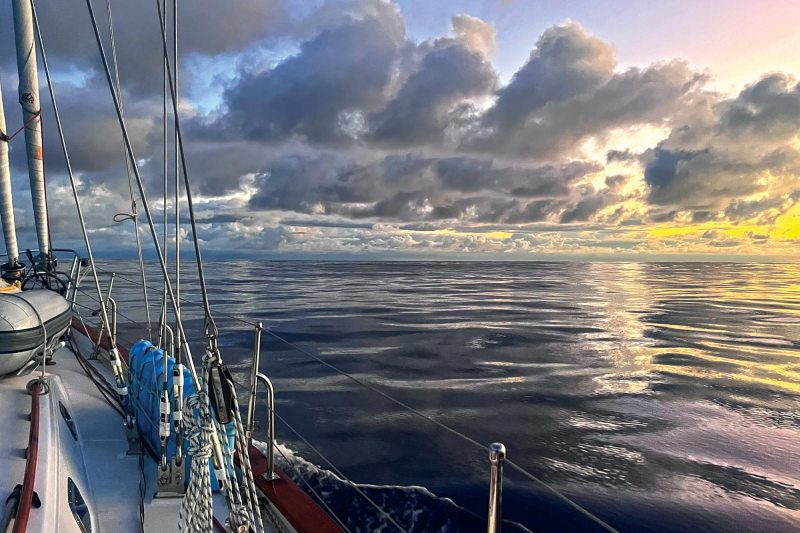
On May Day, I came on watch at dawn to an astounding sight: The water was a flat, reflective mirror of the distant, pastel clouds, an amazing vista not many humans who aren’t sailors are ever privileged to see. “It’s a sea of oil,” Anderson said, and I couldn’t disagree. But an hour later, the ripples in that sea signaled the arrival of fresh wind, some 7 to 8 knots of it, and Moonstone once again was propelled by sail alone. The oily aqua morphed into a deep Atlantic blue, and we were close-hauled directly on the rhumb line, knocking off a steady 5.5 to 6.5 knots. In a word, it was sensational.
As an aside, I must say that businessman Phil missed his calling; the dude should’ve been a stand-up comic. When the breeze filled, he said, “Sure glad I put the extra glue on my toupee today.” As the day progressed, however, the bottom once again fell out of the breeze. I was on watch chasing the apparent, which was clocking to the east, which meant I was sailing higher and higher to keep moving. Eventually, I was more or less on course for the Azores. Not good. As it again petered completely out, Jay reluctantly gave the signal to once more kick over the kicker. Phil: “Who knew there’d be a motorboat division in this race?”
Happily, the second powering session was not only brief, it was the final one.
Now five full days into the voyage, and more than two-thirds of the way there, at long last we found some solid pressure, 13 to 15 knots with occasional higher gusts. With the kite again up and drawing, we were making anywhere from 7 to 9 knots over the bottom but seeing steady 10s on the GPS, clearly getting a boost from a favorable eddy as we closed on Bermuda. We were sailing high and fast to get east of the rhumb line for the northeast shift our router had predicted at the outset. It was the best sailing of the trip, still being conducted in shorts and tees.
But not for long.
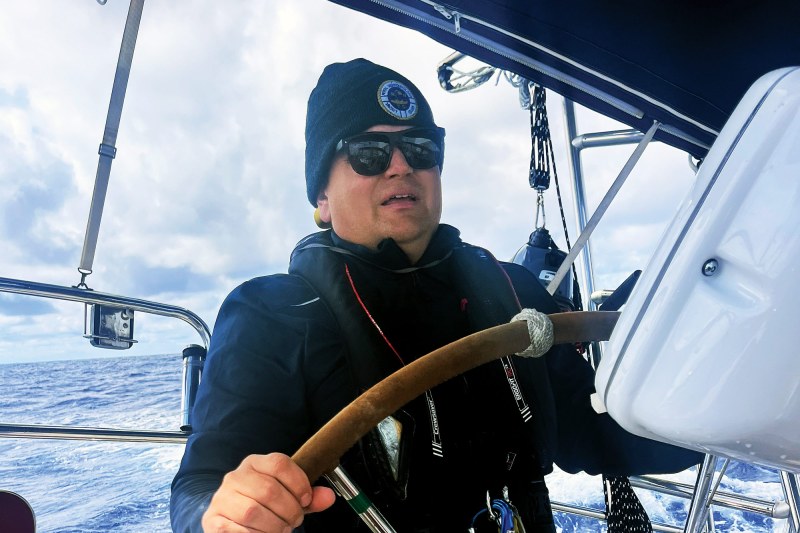
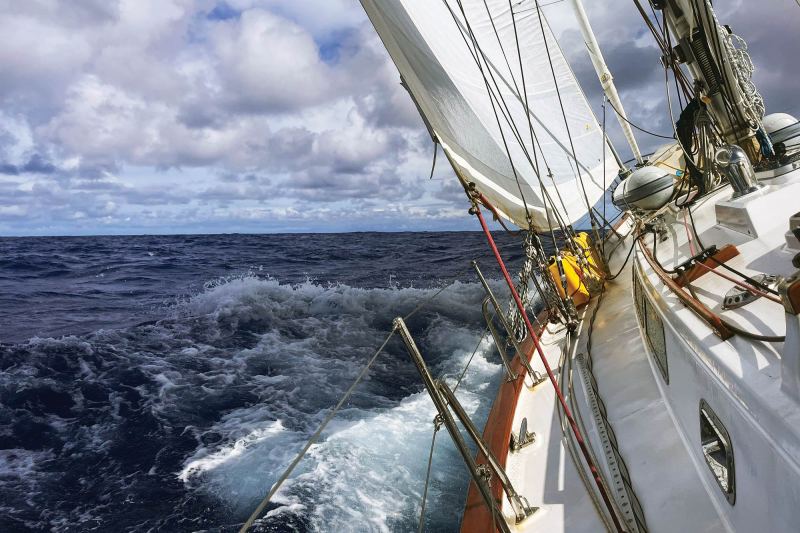
By late afternoon, the seaway devolved into a confused, convoluted mess, and the accompanying milky skies were ominous. If it had been a movie, the music would’ve been dramatic and suspenseful. Think “Jaws.” On the foredeck, we doused the kite (for the last time) and stashed it in the sail locker. It wasn’t a question of if we were going to get creamed, but when. Out came the foul-weather gear. Everyone suited up.
“You can feel the change in the weather,” Anderson said.
“It’s going to get interesting,” Jay said.
“Why do I get the feeling we’re going to get all the breeze in this race at the same time?” Phil wondered aloud, presciently.
Then, in the blackest of nights, the storm was upon us. Lots of things happened, many of them chaotic. I yelled very bad words at a cooler. The temperature plunged from the 80s to the 60s. We all got soaked to the skin. There was more reefing. A jerry can of fuel lashed to the lifelines got dangled over the side to leeward, bouncing in the bow wave, which Phil heroically addressed. I slept not a wink.
Rarely have I been happier to witness dawn’s early light. By then, the northeast breeze had sort of arrived, but it was squirrelly. We hadn’t gained enough easting beforehand, which meant we weren’t laying the finish line and it would take multiple tacks—not the hoped-for reach—to the finish. I jotted another thought: “It’s definitely time to wrap this thing up.”
It was a long day followed by a long night. But all’s well that ends well. Almost exactly seven days after departing Antigua, the sun rose in glorious fashion, the morning light was crisp and clean, and so was the northerly breeze that accompanied it. And right there, on the bow, was the unmistakable outline of Bermuda. Landfall.
We saw a whale, then another one. Longtails wheeled overhead, gliding on the thermals. Just for good measure, there was a rainbow off to the west. A movie director couldn’t have dialed up a prettier picture. The finish line, off Town Cut leading into the placid waters of St. George’s Harbour, loomed into view. Phil went up the bow to call out our finish time, and then it was over. It always feels good to wrap up an ocean sail. This one had offered up a bit of everything.
When all was said and done, moments after we crossed the line, I was quite pleased I hadn’t succeeded in launching that cooler overboard after all. Why, you might ask? Because there were four cold beers in it, begging to be cracked.
Herb McCormick is a Cruising World editor-at-large.