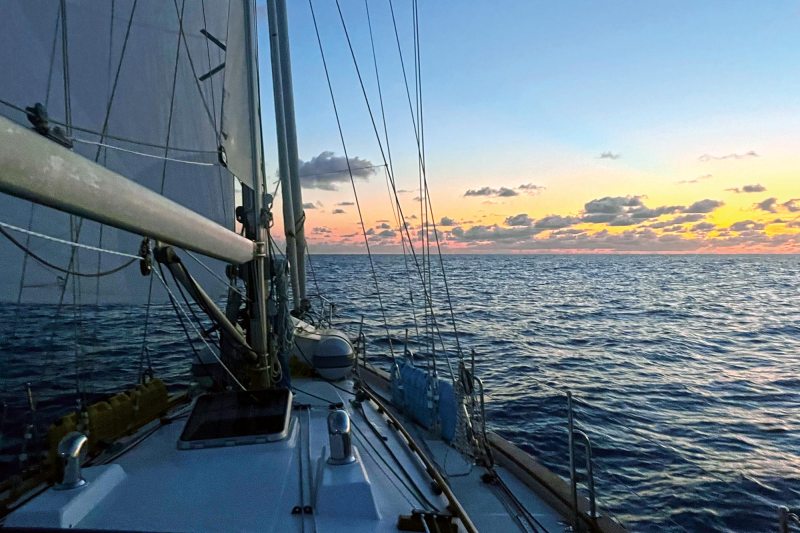
We were five days out of the Caribbean, another couple away from landfall, in May 2026’s running of the Antigua Bermuda Race. Aboard Jay Gowell’s sweet Tayana 52, Moonstone, the forecast for the upcoming 48 hours was not pretty, as we were on a collision course with a nasty cold front that was tracking south of the mid-Atlantic island. It looked like a wet, sporty, upwind conclusion to the trip in a chilled northerly.
But when I came on watch at 0300, we were running before light southerlies of less than 10 knots that had been the dominant feature of the entire voyage thus far.
There was no place on the planet I’d rather have been.
Back ashore, I’m not what you’d call a morning person. But the 0300 to 0600 watch—when the stars fade, the light emerges, and night becomes day—has always been my favorite at sea. I’ve heard it called “the graveyard shift,” but in my mind’s eye, it’s always been the “dawn patrol.” As I settled in behind the wheel, alone on deck, I had no idea how stellar this edition would be.
On my previous watch, several hours earlier, I’d had a hard time keeping the spinnaker full when the wind softened to 4 or 5 knots. But as I slept, Jay had furled the mainsail, and it made all the difference in the world. I had a clear view of the entire kite, so if it started to collapse, it was quick and easy to come up or down and keep it full and drawing. The bloody breeze was all over the place, with the true-wind angle crazily veering to and fro between 175 and 225 degrees, and chasing it was a game of constant small adjustments.
It could’ve been maddening. It was actually blissful. There were still stars on the horizon, welcome blinking reference points, and once we were on a fairly stable course heading, I locked onto one. The late, great John Masefield captured the moment in the opening lines of his iconic poem “Sea Fever,” which may still be the most beautiful thing ever written about offshore sailing: “I must go down to the seas again, to the lonely sea and the sky, And all I ask is a tall ship and a star to steer her by.” I mouthed the words a few times over.
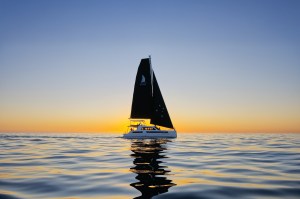
The best part of a moving, memorable dawn patrol is that it’s not static, but instead a slow and steady state of ongoing transition. On this particular one, everything seemed to soften: the air, the light, the sound and motion of the big, husky yacht sluicing through the flat, barely ruffled water. Incongruous. Enchanting. It was almost like a dream. But I was fully, totally, wide awake.
Too soon, the stars vanished, replaced by a low ribbon of blue-gray clouds on the far horizon. I picked one out from the plenty to choose among, my new focus of reference. Dawn was quickly approaching, and as the world brightened up, the shadowed clouds took on pastel hues. It felt like I’d been dropped into a seascape by one of the great French Impressionists: Monet or Renoir or Cézanne. Such a gift to share such quiet inspiration.
Down below, there was movement, the boat awakening. I glanced at my watch: 0545. How could that be? Hadn’t I just come on deck? The unmistakable, welcome aroma of fresh coffee wafted up, just as familiar as the salty brine fragrance that it replaced. A word popped into my mind that seemed like a summation: peaceful.
And then, there was company on deck, the next man up, the oncoming watch. The spell of silence was broken. A cup of joe. Conversation. What had transpired in the night. What the day ahead promised. Where we stood relative to the other yachts on the racecourse. What that first Dark ’n’ Stormy was going to taste like at the White Horse Pub & Restaurant. Is that more pressure? Should we get that main back up?
Which all led to sunrise. A fresh start. A brand-new morning.
There was only one problem: I hadn’t even had breakfast, and the best part of my day was already over.