It’s hard to say exactly how many models of Jeanneau sailboats I’ve tested or sailed over the years, but we’re definitely talking double-digit numbers. After all, with the introductions of their Sun Odyssey 415 and 455, the brand is now on its ninth generation of production builds, and I’ve stepped aboard my fair share of them.
With regards to pure, unfettered sailing prowess, I’ve always considered Jeanneaus to be in the upper echelon of production cruiser/racers. And as a judge for our annual Boat of the Year contest last fall, when scanning the entry list of 2026 nominees, I was pleased to see we’d be testing the Performance version of the 415.
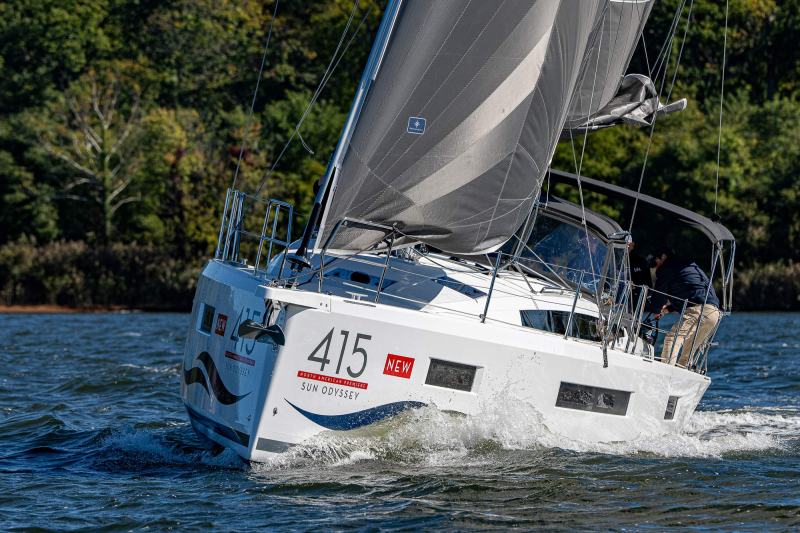
I had a feeling it might be a special boat and a rewarding sailing experience. Turns out I was right on both counts.
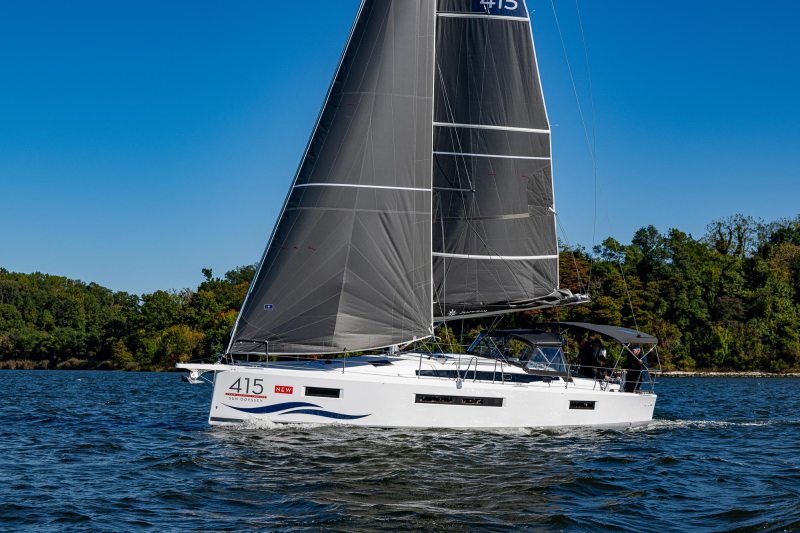
The Performance package is one of four sail plans available. It includes a taller Z-Spar aluminum mast and solid boom vang, and the deeper 7-foot, 4-inch keel (a 5-foot, 2-inch shoal option is available, as is a swing keel). There’s also a sweet set of sails, including an overlapping genoa (rather than the standard 100-percent jib) and traditional mainsail, from the New Zealand SeamTech loft; a Harken electric halyard winch; a split hydraulic Dyneema backstay and Flexofold folding propeller; and floating jib leads on adjustable rings to dial in headsail trim. This is an eminently tweakable vessel.
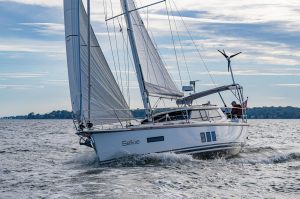
On a blustery Chesapeake Bay afternoon with northerly breeze in the high teens, we got underway with a reefed main and trucked to weather at 6.5 knots. But the real fun started when we shook the reef and set the code zero off the fixed bowsprit, and reached through life at better than 8 knots. The twin helms, coupled to the dual rudders, provided excellent visibility and fingertip control. Steering the boat was pretty exquisite. I have no doubt this vessel could do some serious damage in club-racing fleets.
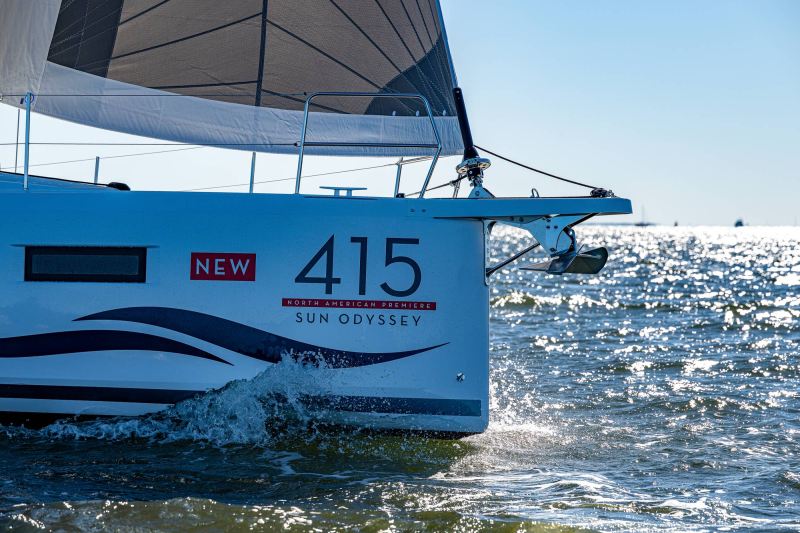
With the exception of a few added inches of beam well aft, the 415 employs the same Marc Lombard-designed hull as the roughly 40-foot Sun Odyssey 410 that it replaces in the Jeanneau lineup. As the old saying goes, if it ain’t broke, don’t fix it: The 410, of which some 800 units were built, was a fine sailing boat, as is the 415. The signature feature is the walkaround deck that has become a Jeanneau staple. Otherwise, though I hate to lump things together, there is definitely a shared aesthetic for contemporary production sailboats from France. The 415 has most of what we’re used to seeing nowadays: a fixed sprit, inverted bow, low coachroof, hull windows, open transom. Check, check, check.
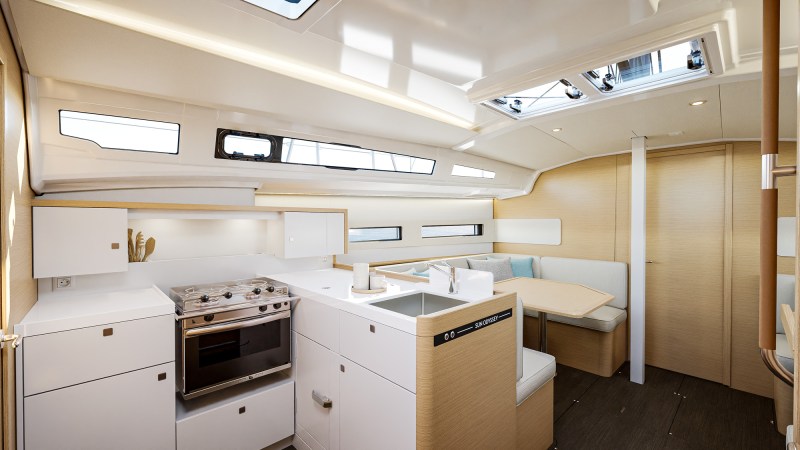
If Gallic boats share some appearances, the difference—the devil, if you will—is in the details, specifically the equipment and interior approach. Our test ride was absolutely loaded. The engine is a shaft-driven 45 hp Yanmar that, along with Raymarine multifunction displays and Harken hardware, are all standard. (Under power, the boat scooted along at 6.8 knots at 2,500 rpm and 7.2 knots at 2,800 rpm.) Notable additions on our test boat included factory-installed air conditioning, a nice dodger and Bimini canvas package, and a Fischer Panda generator. While the base boat is listed at $350,000, our fully equipped model came in at about $550,000.
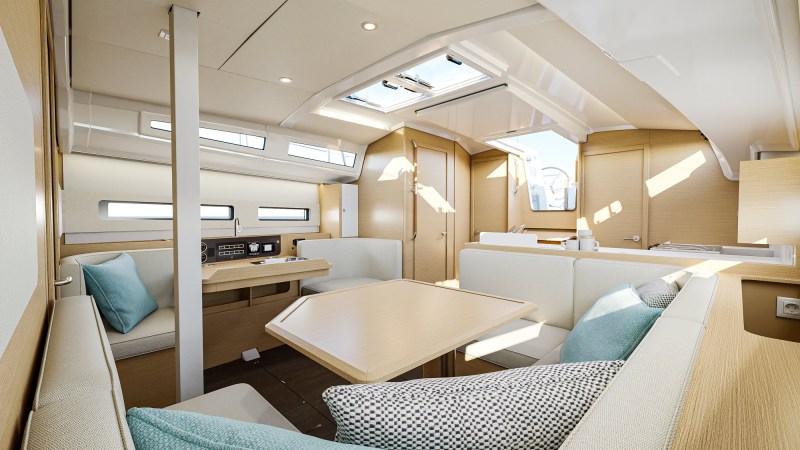
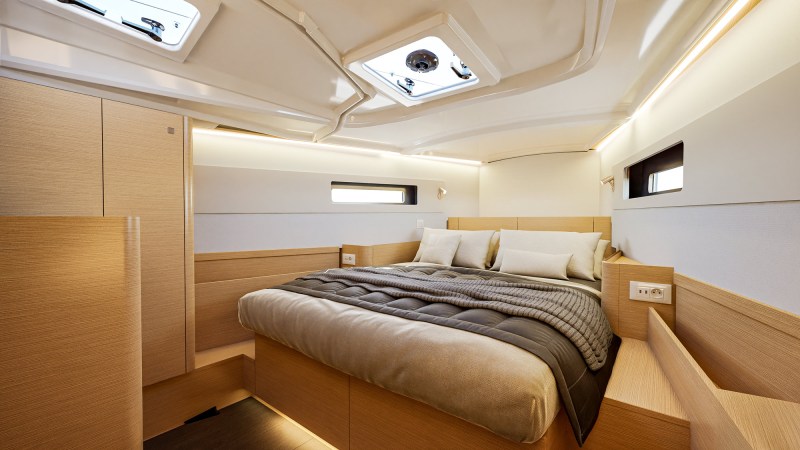
Down below, there are roomy accommodations for a 40-footer. A company representative described it as a “social layout,” and I wouldn’t disagree. Our test boat was set up with a three-stateroom, one-head layout with an owners’ stateroom forward and twins aft. (Alternatively, one of those aft staterooms can be replaced by a technical/storage room, and an en suite head is offered for the forward stateroom.)
In all three versions, the central salon remains the same. To port, off the companionway, is an L-shaped galley with oodles of counter space. Just forward of that, a U-shaped settee wraps around a dining table that can drop to make a berth if guests come aboard. Opposite, to starboard, the head and shower compartment flanks the companionway. Forward of that is a set of armchairs positioned to either side of a central table that doubles as the navigation station.
Now, back to that test sail. In breezy conditions off Annapolis, Maryland, it never hurts to short tack up the Severn River off the U.S. Naval Academy, where you get a good sense of how close-winded the boat is while avoiding the sometimes-choppy seas in the open Chesapeake’s relatively shallow waters. I was at the helm as we clipped past the Academy to weather and continued onward. At which point I couldn’t help myself.
It was so much fun that, to the chagrin of the Jeanneau team on board, I tacked right under the Academy Bridge. Yes, we eventually bore off and concluded the trial. If it was up to me, we would’ve kept on going.
Herb McCormick is a CW editor-at-large.