If there’s one thing we’ve learned beyond a shadow of a doubt the past few years with our Boat of the Year competition, it is this: The contest is a lot cooler, more interesting and much more fun when one of the nominees is a Dragonfly, from the longtime Danish builder of sporty trimarans. In 2024, the Dragonfly 40 blew us away and was the unanimous winner of the Best Cruising Trimaran award. For 2026, we had a smaller sistership on our hands, the Dragonfly 36. To say we were excited about the prospect of putting her through the paces is an understatement.
The reasons were twofold. Yes, Dragonfly tris are spritely, innovative and unusual. But the same could be said of Jens Quorning, whose dad launched the company almost six decades ago and who is now the face of the brand. His enthusiasm not only for the snazzy boats that he builds, but also for the pure joy of peppy sailing, is infectious.
Quorning is eminently quotable, as my notebook attests, and I still remember this zinger from the last time around: “We sell fun. Fun means speed. That’s what we do.” (Note: More builders should make “fun” part of their mission statement.) This time, he hit us with this gem: “I am the mastermind.” Quorning and Steen Olsen are credited for the design, and we were all eager to see what the master had in store.
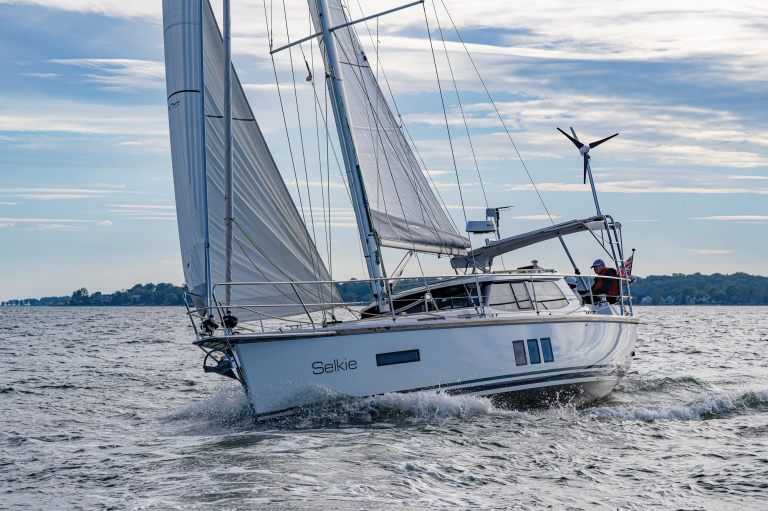
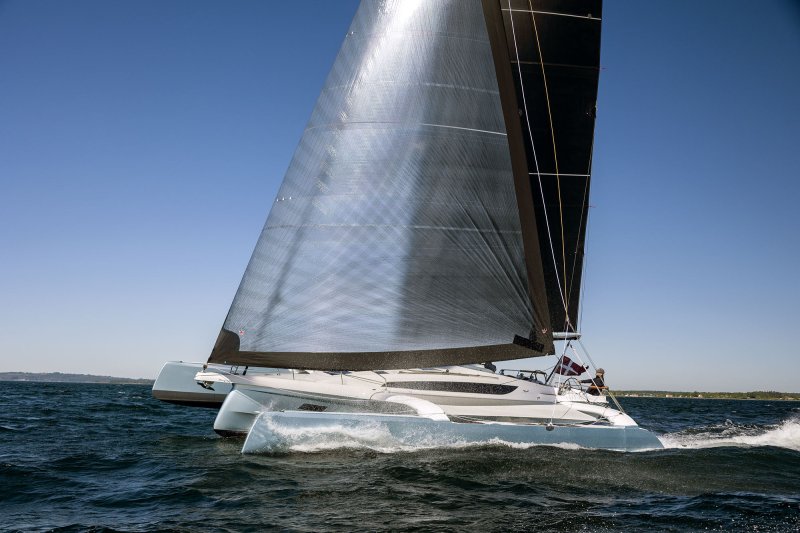
The 36 was an immediate success, with three dozen sold soon after it was introduced. Much of this boat takes pages from the 40’s playbook, and it exhibits the usual Dragonfly DNA. The aesthetics are almost exact, just more compact, with an integral bowsprit and wave-piercing, reverse bows in the central hull and the outboard amas (or “floats,” as Quorning prefers).
The coachroof is low and lean, and the cockpit is surprisingly spacious with twin helms. And of course, the Dragonfly Swing Wing system allows those floats to be quickly and easily folded, reducing the sailing beam of about 26 feet to just 12 feet for docking.
Weight savings is always important in sport boats. The 36 displaces about 11,500 pounds, light for a fully found cruiser, which this is. One difference in the 36 from previous models is that the floats are fully composite structures, with no metal employed at all.
But the entire boat is a testament to contemporary boatbuilding, with 80 separate molds utilized to complete the finished product. The laminate is a blend of carbon, E-glass and vinylester with a Divinycell foam core in the hull and floats, as well as the infused bulkheads. The aft bulkhead, which supports the rig loads, is all carbon. A full carbon/epoxy model is also available. Our test boat was the Touring version with a base price of $700,000, as opposed to the Performance option, which has a taller rig, among other accoutrements.
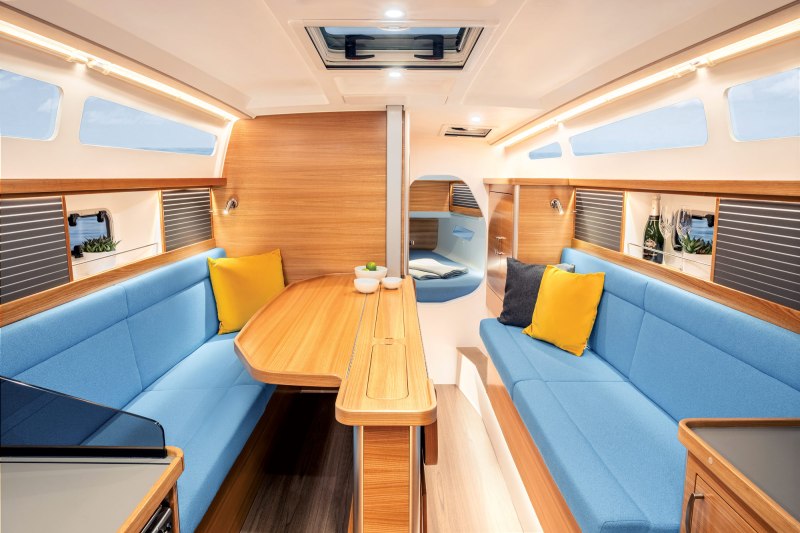
As with the cockpit, the interior is surprisingly spacious, with a V-berth in the bow and another berth stashed aft, below the cockpit. The central table in the saloon neatly doubles as the centerboard trunk. With the board raised, the draft is negligible, and once deployed, it’s about 6 feet, 5 inches. All the furniture and joinery in our test ride was skillfully crafted with the optional elm interior (“A work of art,” I scribbled in my notebook), though ash is the standard wood. You may not be boarding the Queen Mary when you board the 36, but your comfort is still assured.
However, the reason you step aboard a Dragonfly in the first place is to go sailing, and for our sea trial on Chesapeake Bay, we had almost ideal conditions at the outset. A fall northerly settled in at about 12 to 15 knots. Sheer perfection. The 36 sports a triple-headsail rig, and upwind with just the jib, we trucked along making a very respectable 8 to 9 knots. That gave us the sea room to turn and burn. It was precisely what we came for. Which is when the wind, at just the right moment, filled in to around 18 knots.
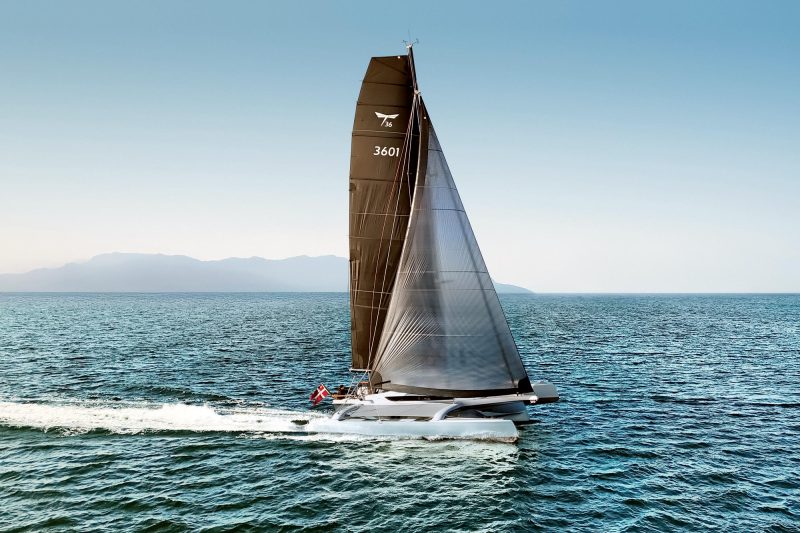
With the asymmetrical kite up and drawing, on a beam reach we zipped across the bay at a good 13 to 14 knots, topping off at 15.7 in the puffs. We could feel the acceleration viscerally. The 36 is a literal wind machine, generating more apparent breeze the faster it sails. While driving, we had to consciously bear away in the puffs. The helm was light as could be. But the true, unreal sensation was the boat’s stability, the reward for those outboard floats. It was truly a fantastic sail.
“You feel alive when you sail this boat. You feel like you’re sailing,” Quorning said with obvious satisfaction. “Those double-digit speeds. That’s when you feel free.”
For some reason, when I was steering the Dragonfly, I kept thinking of one of the better names in rock and roll: Tré Cool, the drummer for the band Green Day. Then it hit me. It’s hard to find anything in sailing that’s cooler or more fun in three hulls—a trey, like a three-pointer in basketball—than the Dragonfly 36. It’s just trey cool.
Or is it très cool, with a French accent? Whatever the translation or inflection, man, it rocked my world.