My first boat was a good old J/24, and there were several reasons I loved it. Most of all, it sailed so well that it was an ideal performance cruiser, at least the way I used it back in my youth. That J/24 was a modest cruising boat and a serious racer.
True, not many sailors would consider a 24-foot one-design race boat ideal for cruising, but mine had been used as a weekend condo in Boston before I bought it. The boat was laid out with plush cushions, a portable toilet, a spinnaker sock (and an unused kite) and even mosquito netting. All that came ashore when I was racing, of course, but I have many fond memories of weekend getaways on that little boat up and down Rhode Island’s Narragansett Bay.
As it turned out, the racing skills I acquired on that J/24 led to crewing in plenty of ocean races, including the Newport Bermuda Race and the Sydney Hobart Race. At the same time, I’ve enjoyed plenty of satisfying cruising adventures, especially in my beloved high latitudes like the Northwest Passage and Chile. The sheer variety of it all is what makes sailing so great.
I guess what I’m saying is that I’ve eventually morphed into a competitive cruiser. Which means I have plenty of opinions about what’s required in a performance-oriented yacht on which you can enjoy both pursuits: comfortable cruising and competitive racing.
What follows are profiles of a trio of like-minded sailors with extensive racing and cruising backgrounds. Equally important are the examples of and reasons behind their choices of the dual-purpose yachts on which they sail. As the old saying goes, there’s more than one way to skin a cat … and to sail far and wide.
Contending with a Classic
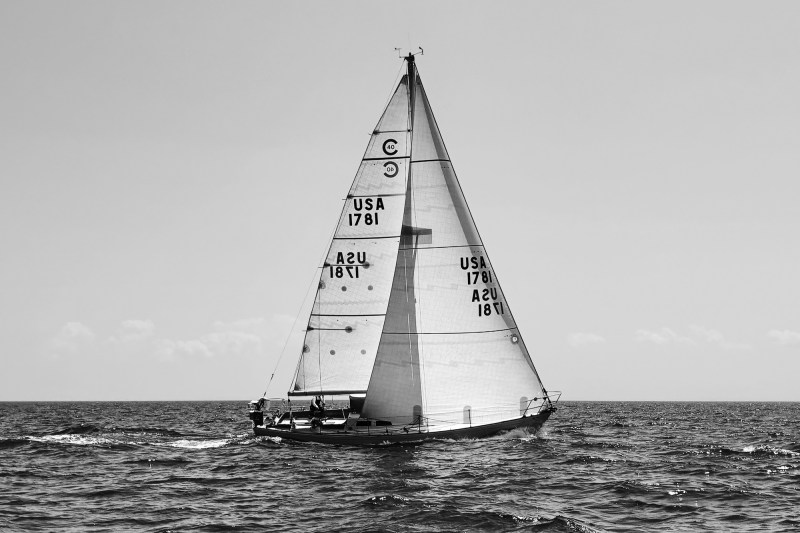
No discussion of what constitutes an ideal representation of a classic, proven racer/cruiser would be complete without a deep bow to the Cal 40. My own strong respect for the Bill Lapworth design came, fittingly, on a pair of different trips. Each one was aboard Mark Schrader’s Dancing Bear: first, a memorable ocean race (the 2005 Transpac) and, later, a voyage to an amazing cruising ground (the Pacific Northwest, including Haida Gwaii, in 2023).
Originally launched in 1963, the Cal 40 has certainly stood the test of time. In 2022, Stan and Lindsay Honey won overall honors in nothing less than the Newport Bermuda Race aboard their Cal 40, Illusion. As Stan wryly observed, Cal 40s have “no bad habits.”
It’s safe to say that Paul Jennings, the owner and skipper of Towhee—the next Cal 40 behind Illusion in that ’22 Bermuda run—would agree. Born and raised in Connecticut to a family of sailors, Jennings started sailing on Long Island Sound as a kid on 9-foot Sea Dogs and a Cape Cod Marlin. After launching his career in hospital administration, he owned a trailerable 27-foot cruiser/racer designed by Ron Noe that he campaigned in big regattas like Key West Race Week. (Amazingly, all three boats are still in the family.)
Eventually, Jennings began to consider distant horizons. “I wanted to do more offshore racing and more cruising,” he said. “I’d done a number of Bermuda, Halifax and Annapolis-Newport races on other people’s boats. Then I decided maybe it would be a good idea if I did them on my own boat. That’s why, in the fall of 2016, I bought the Cal.”
Towhee has an interesting history: Her previous owner was Drew Lyman, CEO of Maine’s Lyman-Morse boatbuilders, so there was no doubt the boat came in fine fettle. Jennings and his longtime regular crew quickly started stacking miles, including New England classics like the Round Block Island and Vineyard races; the Marblehead to Halifax Race (a class win in 2019); and a third and fourth in class, respectively, in the ’22 and ’24 Newport Bermuda Races (Towhee will attempt to up that ante in this summer’s running of event).
As a member of the New York Yacht Club and the Cruising Club of America, Towhee has participated in organized summer cruises in New England by both those organizations. Jennings has also cruised as far afield as Chesapeake Bay—he once had Towhee sluicing down Delaware Bay at 15 knots—and enjoys destinations closer to home.
“I didn’t even really know those islands outside Boston Harbor existed until last year,” he said with a laugh. “Some of them are historic, with strategic forts and things. Others are uninhabited. There are lots of good anchorages. And Marblehead, Salem, Cuttyhunk, Hadley Harbor … there are so many nice places.” It should also be noted that the family’s fox terrier, Petunia, is a regular crewmate and a salty sea dog in her own right.
From the moment he started considering an offshore steed, Jennings says, he was focused on the Cal 40. “I was looking for a boat that was seaworthy and had a good pedigree, and there wasn’t a better boat for the kind of sailing I wanted to do,” he said. “Downwind or on a reach, there’s really not a better boat. They’re comfortable and they go. Upwind, they will pound a bit if it’s choppy. But they’re built to withstand that, which we found out in the ’24 Bermuda Race when we were basically upwind in 20 knots for 600 miles. But I’ve read stories from various owners over the years that have put them through a lot of different things, and they keep coming back for more. I’ve found that to be the case with this boat.”
Going forward, Jennings would love to get Towhee out west for a running of the Transpac Race from Los Angeles to Honolulu. “Afterwards, it might be fun to do some cruising in Hawaii or back in the Pacific Northwest. I have crew now that were based in Seattle, and it would be fun to go to some of the places they’ve talked about.”
One thing’s for certain: He has the boat for it.
Converting to a Catamaran
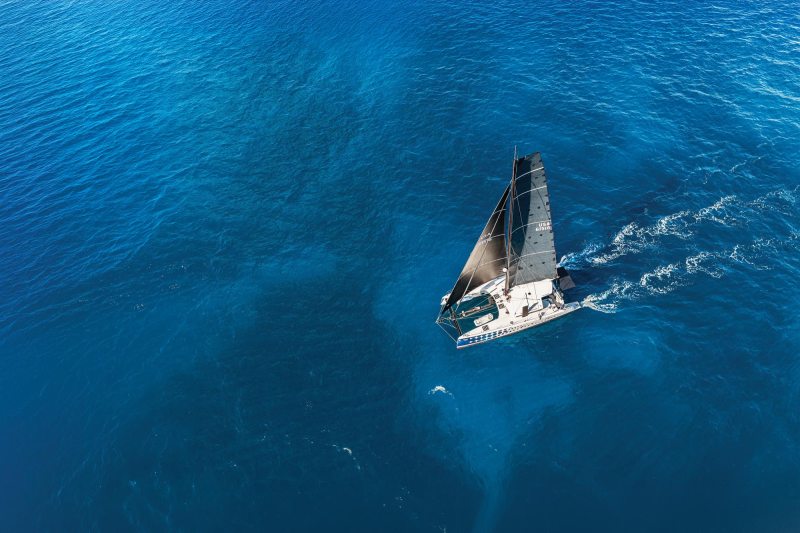
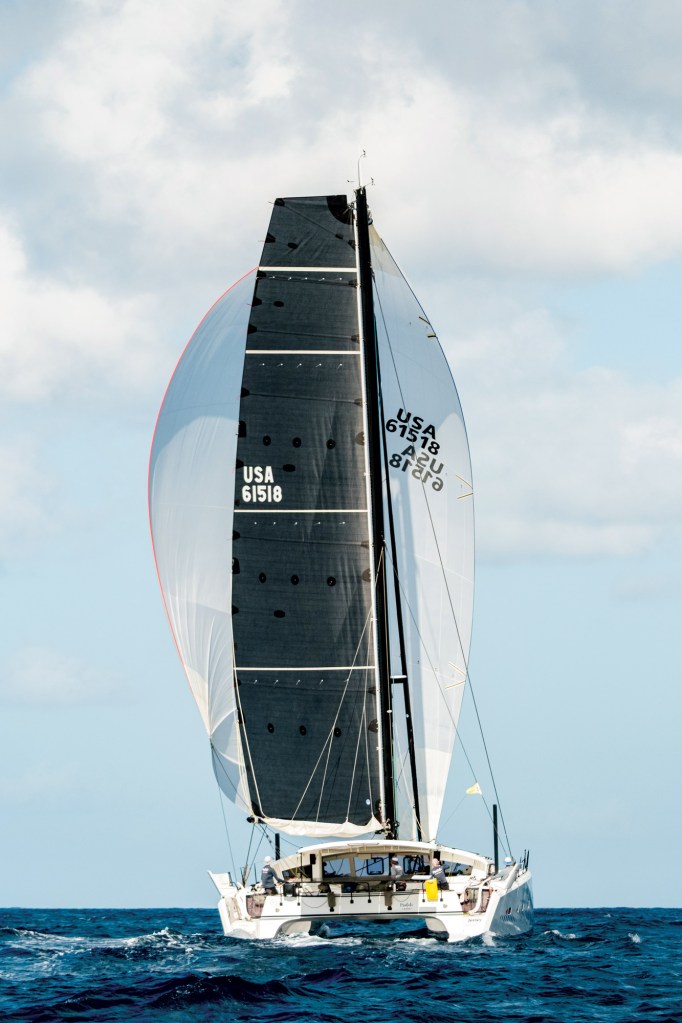
During the past several winter seasons visiting the Caribbean, I’ve become intrigued with a brand of fast, sleek performance-cruising catamarans that are a rare sight in U.S. ports: the French-built ORC 50. It’s a boat formerly produced by Marsaudon Composites, which has now joined the Grand Large Yachting group (also responsible for the Gunboat and Outremer lines). Cat guru Christophe Barreau, who has some Outremer and Catana cats to his credit, designed the ORC, which stands for Ocean Rider Catamarans, a very fitting name.
Last January, at the Caribbean Multihull Challenge, I was surprised to see an ORC 50 called Malolo flying the Stars and Stripes and competing in the racing class. Naturally, I wanted to learn more, which is how and why I sought out West Coast sailor Thomas Kassberg, who told an interesting tale. Like me, he had a memorable history with the J/Boat line. More amazingly, after many years sailing monohulls, Malolo was his first catamaran.
Few sailors I know have had as eclectic or varied a background in sailing as Kassberg. His father, an executive at General Mills, was always on the move, which is why he started sailing on dinghies in England and got his first taste of cruising when his dad bought a Cape Dory 30 in Puerto Rico.
Kassberg also followed a career in international business, and pursued sailing all along the way. Which is why he tackled Newport Bermuda Races as crew when living in New Jersey; campaigned an Etchells in Hong Kong; bought a J/105 once he’d moved to San Francisco; and followed that up with a 505 dinghy, a Melges 20 and 24, and a J/70. After moving to Seattle, he was itching to do the so-called R2AK—the singular, wild, 750-mile Race to Alaska from Port Townsend, Washington, to Ketchikan—and found a 35-foot trimaran from New Zealand to do just that. He finished second, the famous prize for which is … steak knives.
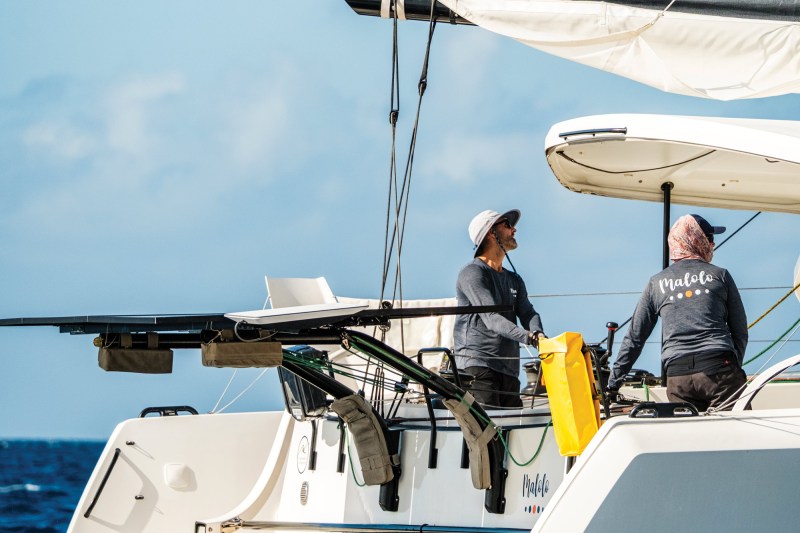
It was his first exposure to multihull sailing, but not the last. “It was a time in my life that I decided I wanted a bigger boat, and a catamaran,” he said. “I wanted something I could race and cruise, and went down the path of figuring out what the best boat would be. Which is how I ended up with Malolo.” The name was inspired by his wife’s connection to, and fondness for, Hawaiian culture.
All the current popular performance-cat brands were considered, but all roads led to the ORC 50. “It felt like the boat where I could get the most for my money in terms of sailing capabilities and as a super-comfortable cruiser,” he said. “We did the build, and there was a lot of customization. It was quite a process, but we really leaned into how it would be set up for cruising. I’m so happy with how it turned out.”
After taking delivery of the boat in France in 2022, Malolo’s crew enjoyed a shakedown cruise in the Med before tackling the ARC Rally from the Canary Islands to St. Lucia, ripping across the Atlantic in about 12 days (with a top speed of 28 knots) and winning the multihull class in the process. Kassberg and crew—including his right-hand man and consultant in putting the entire program together, Duncan Gladman—followed that up with an even more impressive result, taking top honors on corrected time in the highly competitive multihull division of the 2025 RORC Caribbean 600. Kassberg plans on a full slate of racing next year, with a return to the Caribbean 600 and Caribbean Multihull Challenge, as well as a new event planned for Antigua.
“The performance has sort of exceeded what I expected,” Kassberg said. “There have been a few issues, minor things, but I’m super happy with our choice of the ORC. It’s been a very solid boat.”
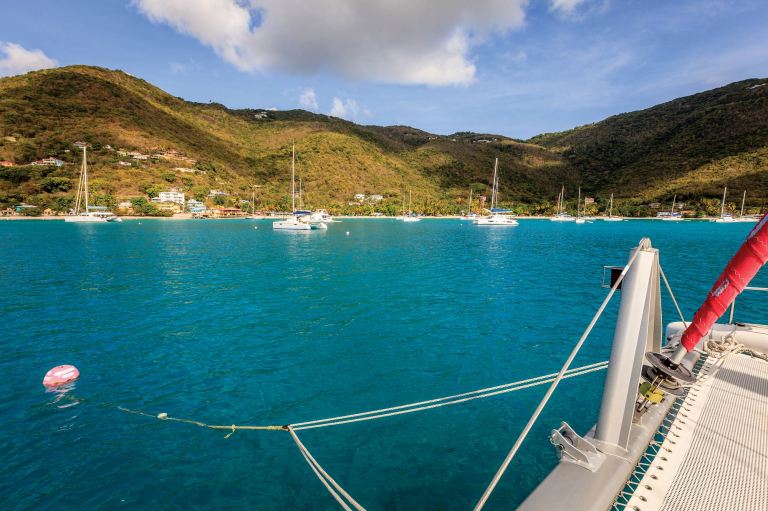
Following the Caribbean Multihull Challenge, later in the spring, Kassberg switched crews, swapping out his racing mates for his wife and friends, for a chill vacation foray through the always alluring waters of the British Virgin Islands. Afterward, Malolo was bound for Grenada and a berth on the hard for hurricane season. For the time being, the competition was completed. It was time to go cruising.
Continued Pursuit of Performance
In summer 2025, sailing aboard former Cruising Club of America commodore Chris Otorowski’s Swan 68, Aphrodite, I was lucky enough to participate in the Western Isles Cruise 2025, a movable feast that several yacht clubs hosted for dozens of boats along Scotland’s west coast and through the Outer Hebrides. There, I encountered Ken Andrew, the Scottish secretary of the Clyde Cruising Club, one of the event’s primary organizers. It was a fateful meeting.
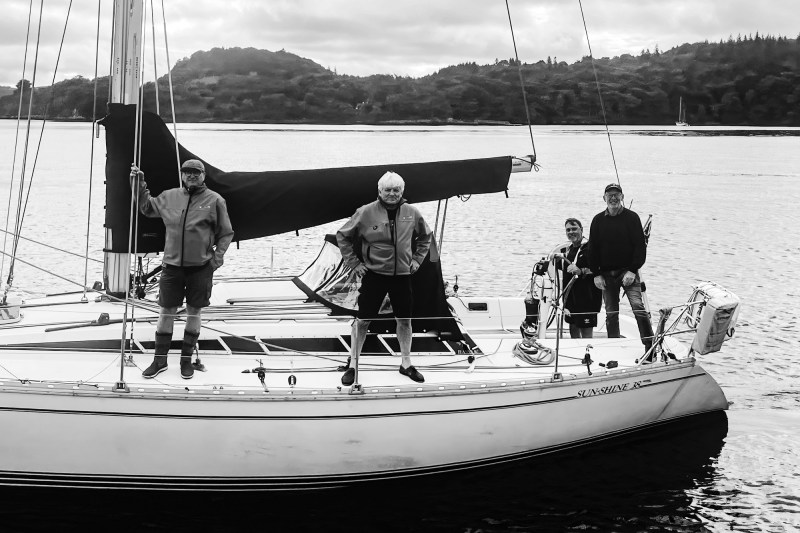
Andrew and his crew aboard the sporty Jeanneau Sunshine 38 Argento immediately struck me as kindred spirits. When it comes to sailing, as I soon learned over a dram or two of Scotch with his Argento posse, Andrew and I shared many sensibilities. Since then, he has traded up to Argento II, a Grand Soleil 43, which has addressed a couple of issues.
First, it’s a bigger, faster performance platform for the club racing he loves and for exploring his favorite U.K. cruising grounds, in northwest Scotland, Ireland and, of course, the mighty River Clyde. Second, and perhaps more important, his wife, Louise—who found the cabins aboard the 38-footer to be claustrophobic—greatly approves of the expanded accommodations. On both sides of the Atlantic, a happy wife means a happy life.
The Argento sagas represent the latest chapters in Andrew’s long history of boats and sailing that began with a Kestrel sailing dinghy in his youth that was trailered all over the Med. His racing career was launched aboard 505 and Laser dinghies before he purchased a 27-footer called Lucy Morals. “She was a very stiff boat and was unbeatable in Force 6 and above, but was very slow in lighter breeze,” Andrew said.
After several seasons, he upgraded to a Scottish-built 28-foot production boat, a Highlander 28 called Stevie B. “We raced her a lot,” he said. “Most of our cruising on that boat was largely the delivery trips to and from regattas.”
Still primarily a racing sailor, he moved after the Highlander to an Oyster SJ35 called Nuage, basically a flat-out racer aboard which he did some serious damage. But Andrew had come to a crossroads in his sailing career: “With the intention of doing more cruising, and retirement looming, we started looking for a boat that would race and cruise equally comfortably.”
Andrew had been enamored with a Tony Castro-designed One Tonner that Jeanneau had adapted as a fast cruiser, the Sunshine 38. Andrew said, “We found one locally that had been refitted to a fabulous standard: fully Harkenized on deck with a substantial North Sails inventory. She was a good buy and made great sense for us.”
Argento was also a wolf in sheep’s clothing. “She didn’t disappoint us,” he said. “We won a number of club championships and class wins at big regattas. In 2013, we raced in Clyde Cruising Club’s bluewater race from Scotland to Brittany in France. It was a downwind slide, and we didn’t tack or jibe for 380 miles. As the smallest boat in the fleet, that gave us some leverage, and we were awarded the winner’s trophy by the mayor of Benodet.”
After a long, varied career in engineering, banking, semiconductors and consulting, Andrew has officially retired to his fleet of motorcycles and, yes, Argento II. Purchasing her had been a bit of a lark. He’d taken some frayed rigging to the rigger at the Clyde Marina and spotted a familiar-looking boat with a “for sale” sign (the lines of the Grand Soleil are quite similar to the Sunshine 38). “Five hours later, we’d agreed to terms,” he said.
Thus far, he’s only sailed Argento II a couple of times, but he planned on rectifying that in the near future. “We’ll be racing after all in 2026,” he said.
The quite happy ending to this tale of competitive cruisers is that Andrew has invited me to come sailing in Scotland aboard Argento II and have a good look around. I believe I’ll take him up on it.