When the French boatbuilding conglomerate Groupe Beneteau launched the Excess line of performance cruising catamarans in 2019, I was more than a little confused and had several questions. First, why was a boatbuilder that already had a popular collection of catamarans with the Lagoon line bringing an erstwhile competing brand to the marketplace? I mean, it wasn’t as if Lagoon didn’t already have a worldwide following and considerable market share.
Even more puzzling was the marketing slogan that accompanied the launch: “Be immoderate.” With my Hibernian roots and fondness for wordplay, I understood it was a take on an observation by the great Irish poet Oscar Wilde: “Everything in moderation … including moderation.” OK, it seemed like a nod toward pushing envelopes, but it wasn’t entirely clear. What the heck did it have to do with building sailboats? And why were Frenchmen quoting Irishmen?
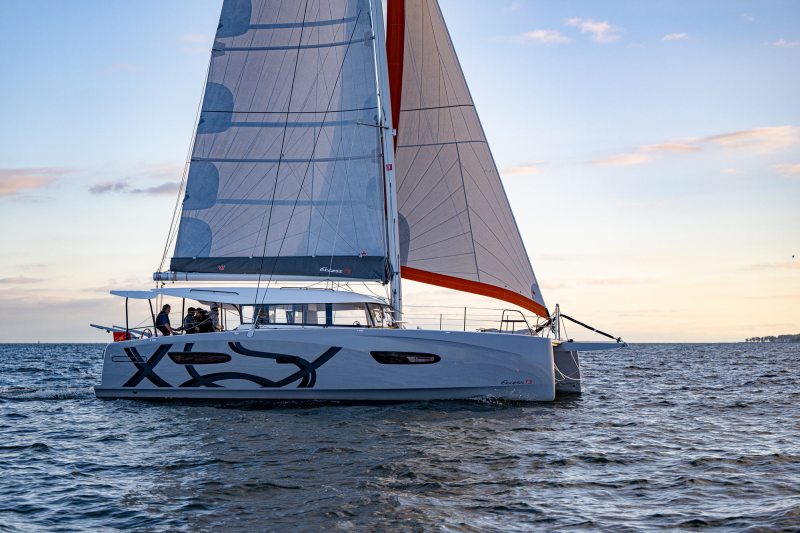
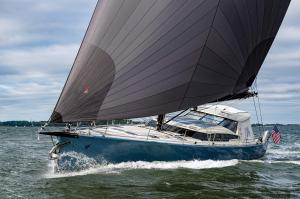
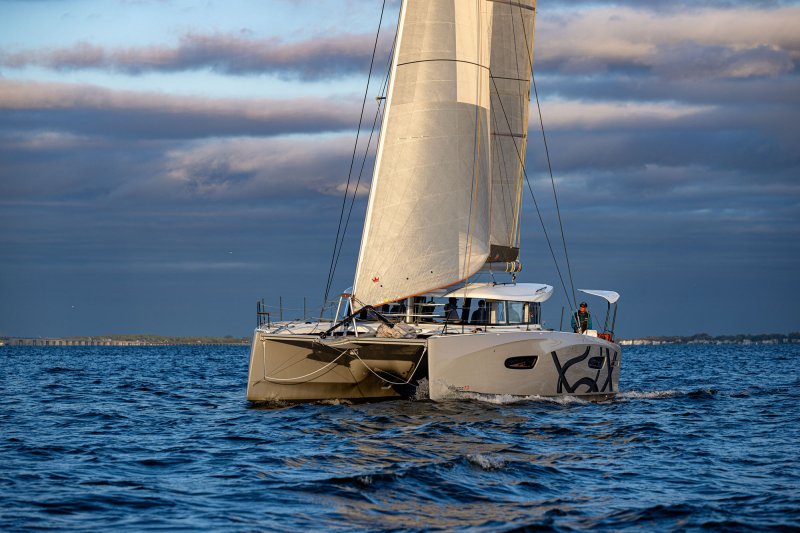
Well, in the intervening years, I’ve sailed all five Excess cats to date and have come to understand what Groupe Beneteau was getting at and why. So consider this review an admission and a mea culpa. It’s now clear that the Excess team set forth to bring a different, no-holds-barred, incredibly fun sailboat to the world of cruising. And, as evident with the introduction of their latest cat, the 42-foot, 7-inch Excess 13—a 2026 Boat of the Year nominee that we inspected on Chesapeake Bay last fall—they have succeeded.
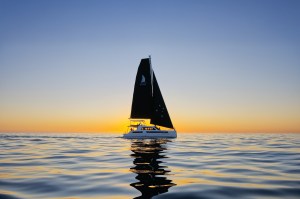
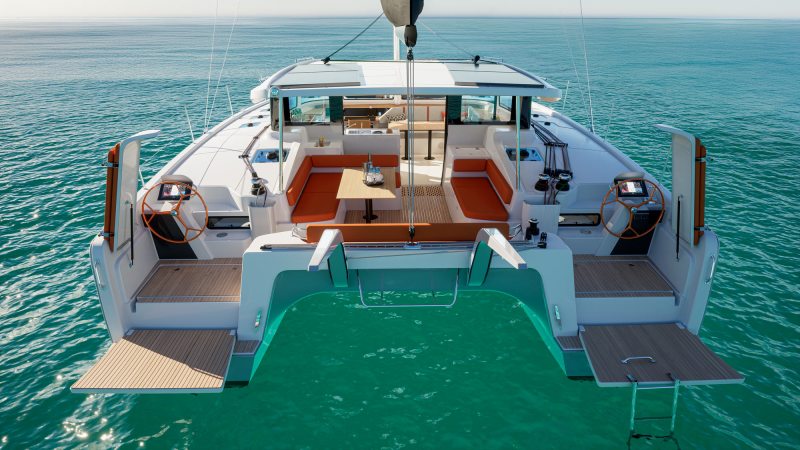
It’s perhaps instructive to begin an assessment of the Excess line by comparing it to their sister brand, Lagoon. Yes, they’re both catamarans. That’s about it. You’re not going to see many Excesses in the charter trade, where Lagoons thrive with their raised helms, flybridges and sunbeds, massive interior volume and attendant lush accommodations. The Excess exudes an entirely different vibe, with twin deck-level helm stations aft; a careful and efficient use of space in the accommodations; and a concerted emphasis on a nimble, fun sailing experience.
The Excess 13 is not a departure from earlier models, but rather a tweaked continuum of what has already been established. Aesthetically, every Excess has a similar appearance and style, with pronounced chines in the hull to open up space in the staterooms; maxed-out waterlines; matching hull graphics; and a disclike coachroof that extends over the cockpit to form a hard hood or dodger (albeit with a sliding door that opens to the elements). One thing new about the 13 is the Marc Lombard naval-architecture consortium that replaces the earlier models from the VPLP group (which also designs Lagoons, which may have contributed to the decision to switch horses). Lombard reworked the bows and increased the volume to create a smoother ride in a seaway, which contributes more to the feel than the looks.
Otherwise, the Excess DNA traverses a familiar road. There are no daggerboards. It’s not a boat that’s meant to win races or break records. Light-air performance remains a priority. In spirit and approach, the brand is more aligned with Outremer, Nautitech and Seawind than Leopard or Fountaine Pajot. Choose accordingly.
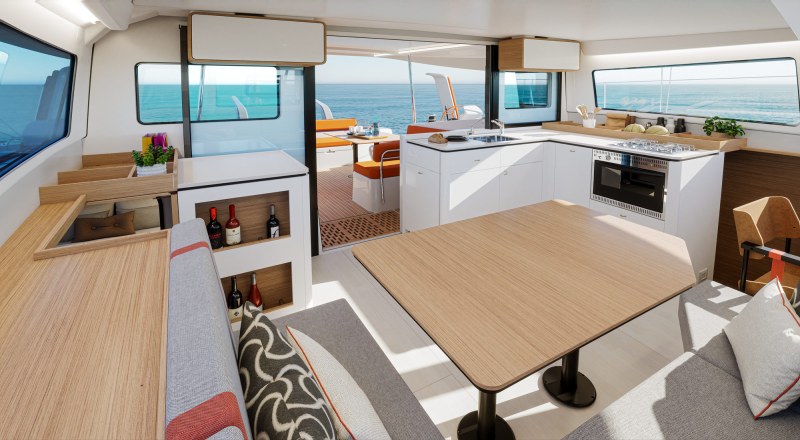
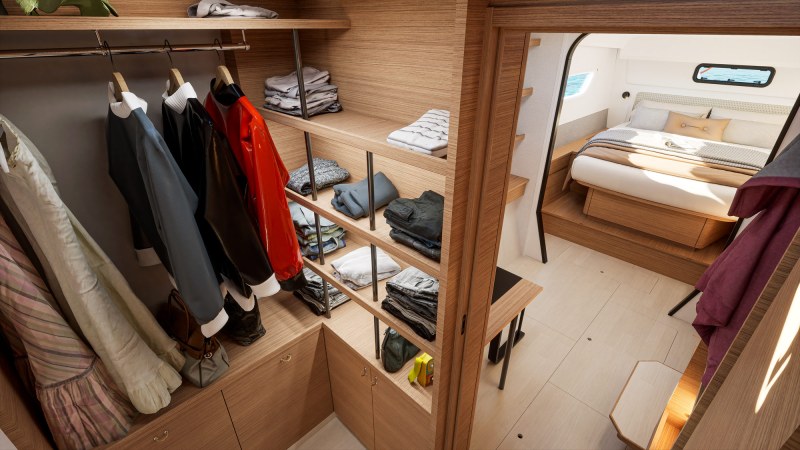
The deck plan is cozy, straightforward and smartly laid out. The cockpit is terrific, with a quartet of settees spaced around a central table that will be the focal point for gathering and kicking back. The salon has an L-shaped galley, a dedicated navigation station and an adjacent dining area. Our test boat had a pair of staterooms in the port hull and a lengthwise owner’s stateroom to starboard (a four-stateroom version is also available). This is a well-tested layout for extended cruising or living aboard. All up, the price tag for our test boat was $758,000.
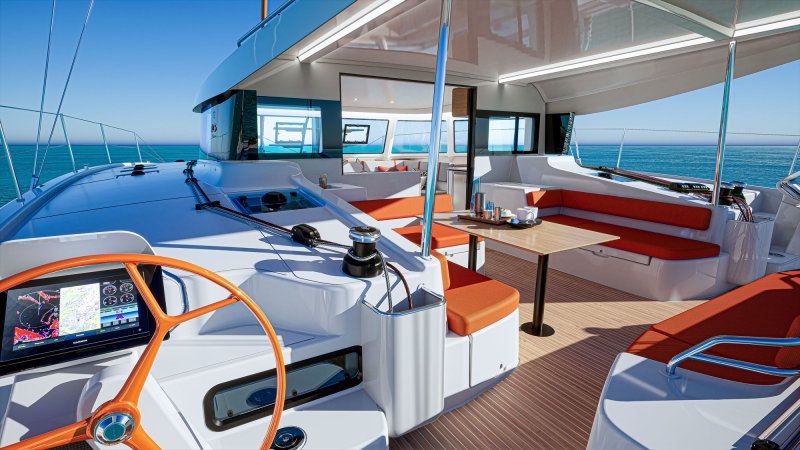
And it all comes together under sail. Our sea trial was conducted in the consistent breeze we enjoyed for all of our Boat of the Year tests off Annapolis, Maryland, last fall, in a welcome 12-to-15 knot northerly. The square-topped, Elvstrom full-battened main is a powerful engine that’s coupled with a full-length traveler for pinpoint trim and control. The dual wheels, while admittedly more exposed than on most cats, have terrific sight lines and put the driver out in the elements where you feel the wind and see the telltales, precisely where I like to be.
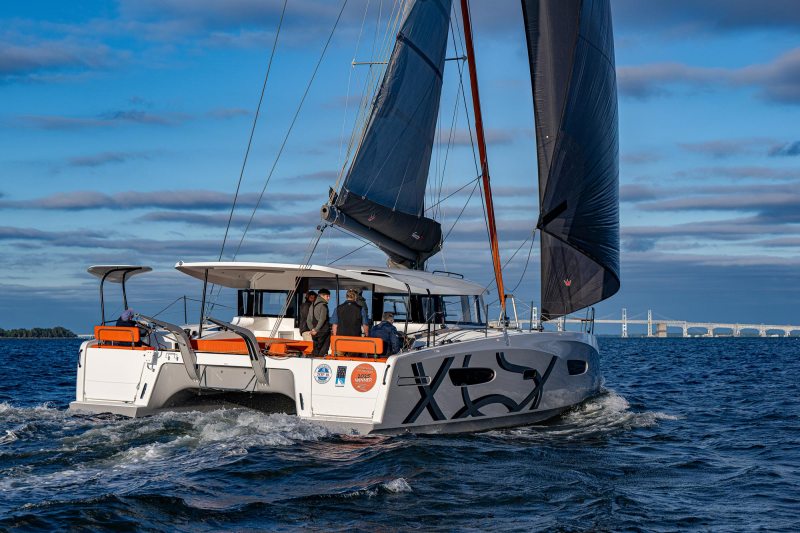
We started out on a beam reach under the full main and a code zero set off the fixed sprit and easily recorded 8s and 9s on the speedo. The pace and control were excellent.
Swapping down from the reaching sail to the genoa, we still recorded a solid 8.5 knots hard on the breeze. It occurred to me while steering that I could do this for quite some time. Like all good things, however, our time on board soon came to an end. Drats.
One last thing that’s relevant to the brand: It’s notable that Excess actively seeks to recruit monohull sailors to its ranks, something the company representatives pointed out as we departed. They want folks who know what it feels like to lean into the breeze, who have a love of pure sailing. And there’s nothing immoderate about that.