Once a sailboat has left the starting line on a long-distance race, the crew shifts into an organized routine that is important to follow. I enjoy these long passages for many reasons: watching the environment change with every mile, crew camaraderie and conversations, the miles left behind that feel like a milestone, and the cadence of a watch routine. There’s an urgency to do things correctly, but also a sense of comfort on the water. To me, these precious moments under sail are real freedom.
Last summer, I sailed more than 1,000 miles in several ocean races. Those miles taught me many lessons about how to prepare for long-distance sailing and deal with unexpected problems. Our crew had our share of issues.
We had sailed almost flawlessly for 441 miles of the Annapolis to Newport Race. The finish line was just over the horizon, with only 32 miles to go. And then, disaster.
A hydraulic valve was released and then immediately pumped back up without easing the headsail. The pressure broke the headstay track, which came tumbling down on deck. Our crew spent 30 minutes cleaning up the mess before we could head for the finish, sadly with no headsail. A small staysail was set, but the boat was tacking through 110 degrees and sailing 2 knots slower.
The incident likely cost us a victory, but it reminded me that people get tired after a long passage. One must be diligent not to make mistakes. The lesson is to talk through the proper procedure when making an adjustment.
Another incident involved standing watches, a practice that has been an important routine for mariners for centuries. Personally, I am a fan of the standard four-on, four-off system. Many years ago, the U.S. Navy taught me the importance of relieving a watch stander on time and being diligent during your assigned time on deck. Morale and performance break down when sailors miss a watch.
In one of our races, the wind was strong at 27 knots. We were on a beam reach and sailing fast, often over 20 knots. We made a sail change, and the halyard of the old sail was mistakenly hauled to the top of the mast. A second halyard somehow got jammed and was disabled. The wind shifted aft, and we needed to set a spinnaker, but there was no available halyard. We were in a quandary about our options.
We sent a crewmember aloft to lock off the mainsail and then shift to the main halyard, to go farther aloft and clear up the tangled headsail halyards. But the waves were big, and the sun was setting. It would be a hard climb.
We kept the boat heeled to help the ascent of our 21-year-old bowman who took on the challenge. He scaled the mast to the head of the double-reefed mainsail and hooked into the mainsail halyard. From there, he could be hauled to the top of the mast. Fifteen minutes later, he cleared the two headsail halyards and was down on the deck. We set the spinnaker. The successful, resourceful effort earned the intrepid sailor a double ration of rum.
Yet another incident made me happy that before my summer of racing, I had taken US Sailing’s Safety at Sea Seminar. Taking the course is a requirement every five years. I recommend that every sailor, whether racing or cruising, complete the full syllabus. The course started with 15 mandatory lessons, each followed by a 10-question quiz. Participants had to correctly answer eight of the 10 questions to advance to the next stage. It took me 13 hours to complete the lessons. I only failed one section with a seven. I was able to get a 10-point score on the re-exam.
The daylong seminar went smoothly until the hands-on sessions. These exercises included jumping in a pool to use an inflatable floatation device, followed by a 30-minute session in a life raft on Long Island Sound. The minutes passed like hours as six of us sat in the enclosed raft. The fun quickly faded.
The exercise reminded me how important safety protocols are when sailing, including during a race when the breeze increased from 8 knots to well over 20. The strong current was flowing against the wind. The waves became steep. Our 66-foot sloop was sailing fast but pounding hard in the chop.
I was below and off watch when the pounding became uncomfortable. I was worried we might break something. I went on deck and announced that it was time to shorten sail.
We changed to a smaller headsail and reefed the mainsail. It was a difficult task in the seaway, so we did a bald headsail change. The boat was more stable, but we were still pounding. At the helm, we experimented with sailing a few degrees low instead of feathering up in each wave. The test worked, and we continued at a high speed with no pounding.
As it turned out, we won the 186-mile race by just 57 seconds. The sail change and steering angle worked. The lesson on this race was reducing sail and experimenting with a new way to steer.
It’s easy to be mesmerized while sailing. It’s soothing to listen to the water and wind. But a few crewmembers must remain focused. This starts with the helmsperson.
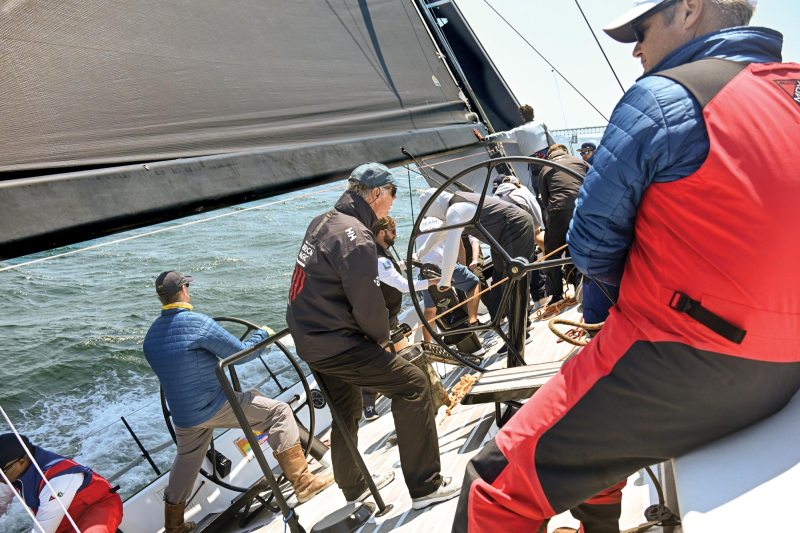
Maximum time at the tiller or wheel should be one hour. Everyone enjoys time steering. Another crewmember needs to be diligently watching for crossing yachts and changes in weather, and keeping track of a boat’s position. This sailor is the eyes outside the boat. Another member of the crew should constantly watch the sail trim and make adjustments when the wind changes direction or speed, or when the course is changed.
Big gains can be made by watching the weather. When the wind is light, I’ve learned to head for clouds. New wind often develops under a cloud bank.
On one of our races, we were heading east on Long Island Sound off New York. Traditionally, the wind is stronger along the shoreline. As a general rule, when the wind is out of the south, work the Long Island shore. When the wind is out of the north, head for the Connecticut shore.
This particular afternoon, the wind looked stronger in the middle. We decided to give the middle course a try, and our gambit worked. We gained speed and left the fleet behind.
On our race to Halifax, Nova Scotia, the temperature turned cold as a thick fog drifted across the course. It was an eerie feeling, sailing with limited visibility. I came on deck and noticed the crew sitting still and looking somewhat bored. I took the opportunity to say how cool the fog was and how much fun it would be to describe the dour view to non-sailing friends. This sparked a series of fun stories that lifted everyone’s spirits.
In another race, we were taking bearings on a competitor to monitor our speed. We noticed that we were suddenly gaining. We had some luck sailing into a river of swift-moving current. The favorable stream was only half a mile wide. We jibed within the current sheer and gained a few miles on our rival. We were lucky to find the current and used it to our advantage. It was a happy moment.
The Debrief
Follow these tactics to keep your crew focused, your rig standing and your morale high.
- Preset the watch. Assign every crewmember a specific job in case there is a call for all hands.
- Call the play. Announce any maneuver in advance so the crew is prepared. Early warnings are appreciated.
- Clear the decks. Keep the crew off the foredeck during maneuvers. Weight forward slows a boat down.
- Heads up. One crewmember should keep watching what is going on outside the boat.
- Talk through situations in advance of taking an action.
- Watch the Windex. Keep an eye up high. The wind changes at the top of the mast first.
- Slow your roll. If the boat is rolling when sailing downwind, then sail 10 degrees higher to reduce the roll.
- Crew maintenance. Make sure the crew stays hydrated and wears the proper clothing for the weather.
- Command with purpose. Look directly at the person you are communicating with. Be concise.
- Shadow the fleet. Study the performance of other boats in the area to see where the best wind is.
- Postmortem. Hold a crew meeting after every sail to dissect what worked and what didn’t.
- Log it. Keep a logbook and make notes after every day on the water.
Gary Jobson is an America’s Cup-winning tactician and renowned ESPN sailing analyst. An editor-at-large for Sailing World and Cruising World, he is an ambassador for American sailing through his work as a broadcaster, lecturer and author.