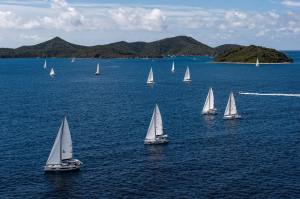
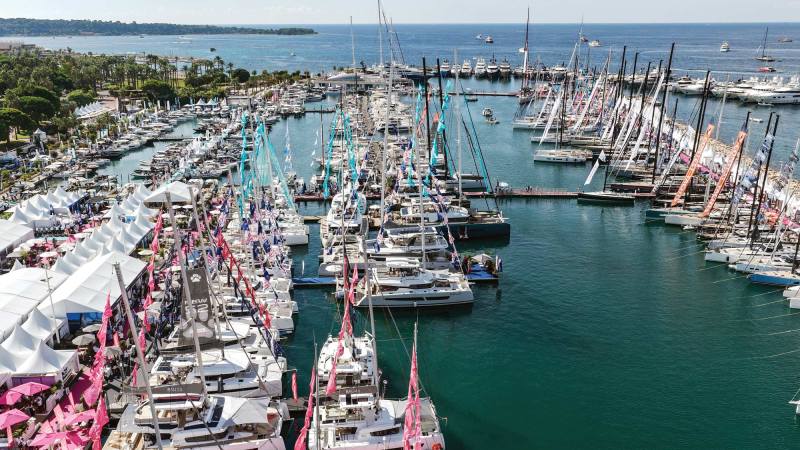
The halyards are already slapping against the masts at Port Canto before most of Cannes, France, has finished its coffee. By midweek in September, the Sailing Area will be a forest of rigging—monohulls and cats alike rafted along the pontoons—while across the bay at Vieux-Port, the power fleet will fill every berth with fiberglass and teak. Dockside, a naval architect walks a prospective owner through a hull he spent three years drawing, the two of them working toward a sea trial slot booked weeks in advance.
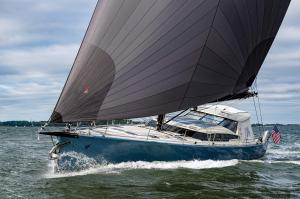
Out past the breakwater, a 55-footer takes a would-be buyer out for the first time, heeling into one of the first crisp morning breezes of the fall. This is how boat show season opens, with the distinct buzz of a fleet coming alive on the water. Three times over, on two continents, across six weeks.
For Cruising World readers, fall is the season that matters. Spring shows sell the dream; fall shows deliver the fleet. Builders time their splashiest reveals—the boats meant for a Pacific crossing, a Bermuda beat or just a weekend on the bay—for these three events.
This year’s new models are expected to lean hard into the offshore end of the market: shorthanded bluewater cruisers, wave-piercing catamarans and at least one all-electric cat built to cross an ocean on sun and battery power alone. Here’s what to expect when the docks fill up in Cannes as well as in Newport, Rhode Island, and Annapolis, Maryland, this year, and how to make the most of each stop.
Cannes Yachting Festival: September 8–13, Cannes, France
Cannes opens the season, and it does so as the biggest in-water show on Earth for sailboats. Spread across the Vieux-Port and Port Canto, the festival is expected to host more than 700 boats from 16 to 180 feet, some 680 exhibitors and north of 56,000 visitors. It’s a scale few other shows approach.
The Vieux-Port has gone all-in on power since 2019, but Port Canto remains sailing’s home turf, hosting the Sailing Area, the yacht brokerage sector, and the water toys and gear that fill out a cruiser’s inventory. Boats under 33 feet sit ashore for easy boarding; everything larger sits in its own berth in the water, stern-to along the quay, exactly as it will sit in a marina from Antibes, France, to the Balearic Isles in Spain.
Cannes also stands apart for premieres that should appeal to offshore-minded cruisers. This is where European builders unveil the yachts meant to cross oceans, not just hop between anchorages. Among this year’s world debuts is the Amel 50.2, updating one of the most trusted names in shorthanded bluewater cruising. Expect the docks to be thick with sailors circling that boat all week, waiting their turn to duck under the shipyard’s signature protected center cockpit.
Beyond the big reveals, Cannes offers something few American shows can match: sea trials, arranged directly with the builder rather than left to chance. Powerboat trials run out of a dedicated area near Vieux-Port; anyone hoping to get time on the water, sail or power, should contact the yard before landing in France.
The show also leans into sustainability through its Innovation Route, spotlighting builders that are pushing electric propulsion and recyclable construction into the bluewater conversation. Journalists turn out in force, too. Last year’s edition drew nearly as many press credentials as exhibiting brands. Cruising World’s daily social media and e-newsletter coverage is a useful watch for anyone tracking a specific launch from afar.
Newport International Boat Show: September 17–20, Newport, Rhode Island
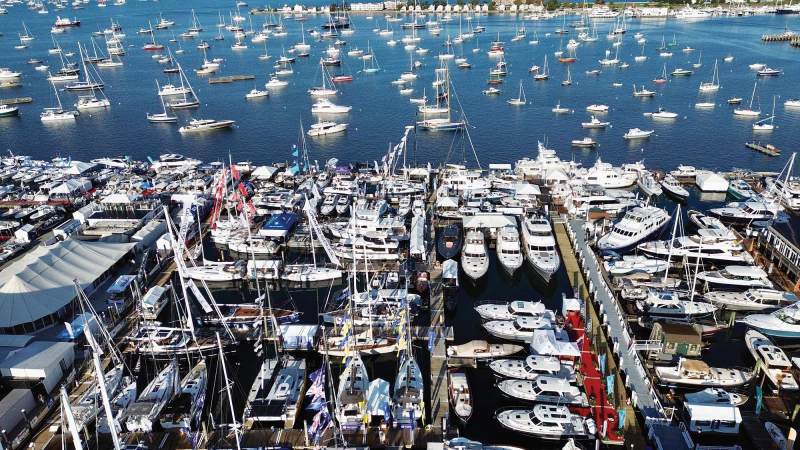
A week after Cannes wraps, another fleet convenes stateside. Newport is marking its 55th year this fall, and the show remains the true kickoff to the American fall circuit. It’s the first major Northeast event where builders roll out what’s new for the coming season.
This show spans more than 17 acres across six connected sites: Newport Yachting Center, Bannister’s and Bowen’s Wharves, Perry Mill Wharf, Hammetts and Market Square. Organizers expect to float more than 450 boats from 15 to 90 feet, sail and power, all set against the granite seawalls and clapboard charm of Newport’s historic waterfront.
Newport has always understood that a boat show works best when it teaches as much as it sells. The “Tech Talks” series, run in partnership with IYRS School of Technology & Trades, puts attendees into three-hour hands-on workshops on subjects that matter to anyone maintaining a boat offshore: gelcoat repair, diesel electronics and lithium battery systems. Seating is limited and these sessions fill fast, so register before you book your hotel room.
The Cruisers Classroom at Hammetts runs daily seminars for new boaters and seasoned mariners, and the show’s on-water training program lets attendees log real time at the helm. The expanded Brokerage Basin now shows sail and power models up to 90 feet, staged north of Bannister’s Wharf. It gives shoppers a look at the secondhand market alongside the new-boat docks, a pairing that makes Newport as useful for refit-and-go buyers as it is for anyone chasing a factory-fresh hull.
The Windward VIP Lounge offers early admission and a quieter corner to compare notes between test sails. It’s worth the admission-ticket upgrade if your show days are numbered.
Newport for New Products, the show’s long-running innovation award, remains the fastest way to see which new gear and boats the industry considers worth watching.
Annapolis Sailboat Show: October 15–18, Annapolis, Maryland
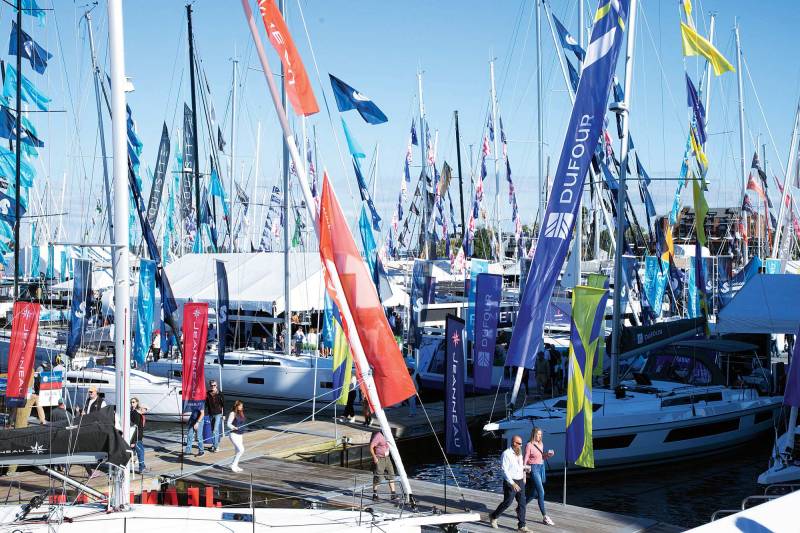
Annapolis closes the mid-Atlantic and Northeast season, and for a certain kind of sailor, it’s the only stop that counts. This is a pure sailor’s boat show set along City Dock in a location that’s called itself sailing’s American capital for half a century.
Floating docks will carry monohulls, multihulls, cruisers, racers and dinghies from builders worldwide, with show tents stocked with rigging, electronics, sails and the marine trades that keep a bluewater boat sound. Gates open at 10 a.m. each day of the four-day run, with a Thursday preview day for those willing to pay extra to beat the crowds.
Cruisers University, presented in partnership with the show, offers a full curriculum for sailors preparing to live aboard. The “Offshore Emergency Medicine” course is consistently one of the most sought-after sessions on the docks, training crews to handle medical crises when the nearest hospital is a thousand miles of open water away. Free daily seminars feature cruisers, racers, surveyors and marine trades experts who offer routing and weather-app deep dives, offshore race debriefs and cruising-lifestyle panels. Check the show’s seminar page closer to October for confirmed speakers and times.
Just off the show docks, on a quiet stretch of the Chesapeake Bay, is where Cruising World’s Boat of the Year testing happens. Judges spend days after the show sea-trialing the year’s nominees back to back—hoisting sail, reefing early and late, climbing through bilges, and tracing wiring runs.
Three of this year’s most closely watched debuts are the Balance 502, Vaan R4 and Knysna 550. U.S. builder Tartan Yachts is expected to make a splash as well, bringing its highly anticipated 34 to the docks for the first time.
Plan Your Fall Around the Water
Three shows, two countries, six weeks. There’s no wrong place to start, but there’s a right way to go: with a plan. Buy tickets ahead for all three shows, since weekend days sell out and preview days carry a premium worth paying if your schedule is tight. Book “Tech Talks” and “Offshore Emergency Medicine” early; both cap enrollment and fill fast. And budget real time on the docks, not just at the reveals. The conversations with builders and riggers between lobster rolls and crab cakes are where a boat show earns its keep for a cruising sailor.
Whichever port (or ports) you walk, the same thing waits at the end of the gangway: a fleet of boats built by people who still believe in going far, and a season’s worth of reasons to believe it too.
Five Early Debuts Worth Crossing a Border For
Amel 50.2 (Cannes Yachting Festival, Port Canto)
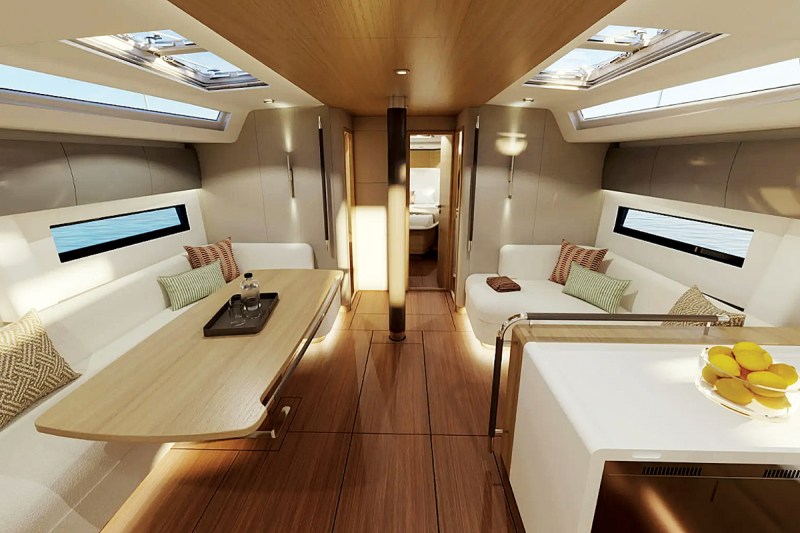
Amel doesn’t reinvent. It refines. The 50.2 proves the point. Succeeding the 140 hulls of the Amel 50, this 54-foot, 9-inch cruiser keeps the shipyard’s signature deep, central, protected cockpit that has been favored for shorthanded passagemaking since 1969. It also widens the hull, reversing the bow and moving the hardtop supports aft for better visibility at the helm. Berret-Racoupeau Yacht Design reworked the interior for offshore comfort: an aft owner’s stateroom turned for privacy, improved sound insulation, and a galley built for long-haul provisioning with expanded cooling and counter space. Electric furling on the main, genoa and optional staysail keeps sail handling within reach of a two-person watch system. She’s built for owners who measure a cruise in oceans, not weekends.
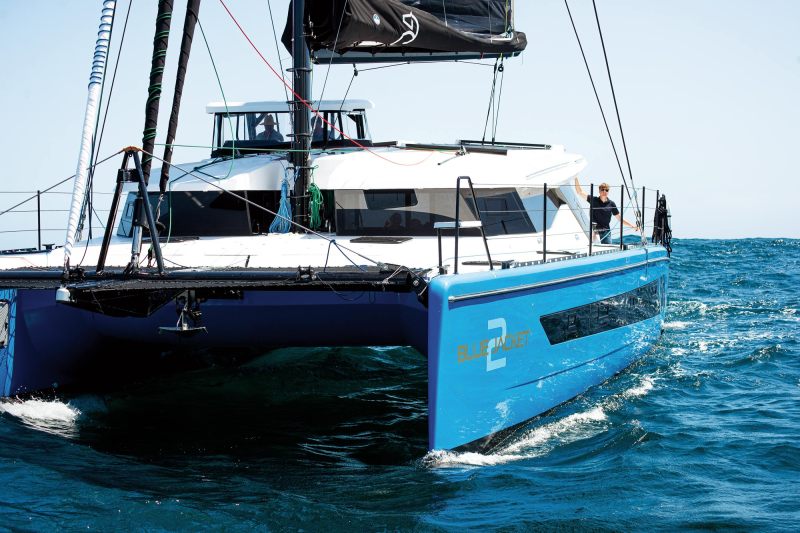
Knysna 550 (Annapolis Sailboat Show, City Dock)
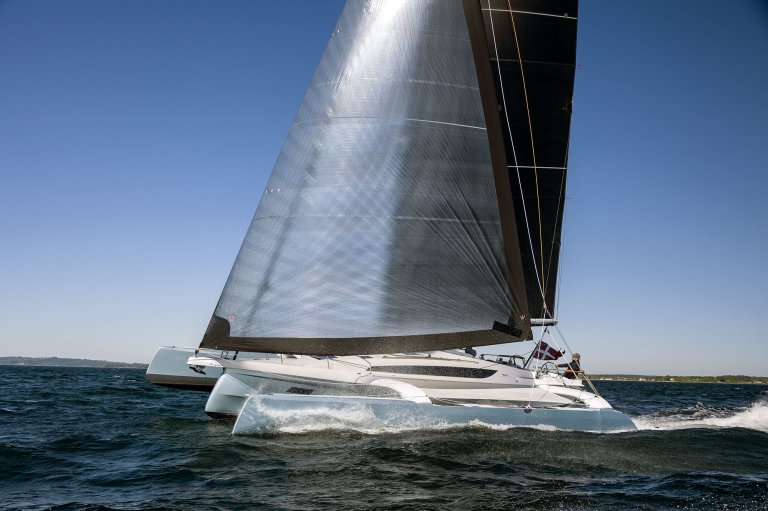
South Africa’s Knysna Yacht Company built its reputation on the 500. The 550 sharpens every line of it for serious bluewater work. Developed with VDS Marine Design, this 55-foot semi-custom catamaran carries wave-piercing bows and about 20 tons of displacement, with fuel and water capacity sized for extended passages. Buyers choose between the 550SL Sky Lounge, built for elevated visibility on long watches, and the 550SE Solar Explorer, which trades lounge space for expanded solar real estate and offshore systems capacity. Belowdecks, three- or four-stateroom layouts are specified directly with the build team, down to joinery and fabric. This model is already shortlisted for World Multihull of the Year 2026 and is a Cruising World Boat of the Year 2027 nominee before her public debut, a rare honor for a boat nobody outside the yard has yet sailed.
Vaan R4 (Annapolis Sailboat Show, City Dock)
The R4 makes its case with materials as much as design: a 42-foot cruising catamaran built from an aluminum hull that’s 60 percent recycled and fully recyclable at end of life, with cork and flax worked into the interior. Dutch builder Vaan Yachts pairs that sustainability pitch with genuine sailing chops. Dykstra Naval Architects drew the underbody, and the polar diagram shows real upwind performance for a cruising cat this size. Propulsion is all-electric, backed by solar charging and regeneration under sail, a combination that lets the R4 make way silently at anchor and recharge on passage. A removable Bimini top in place of a fixed hardtop lets owners chase sun in high latitudes or shade in the tropics. This is her first public showing in North America, following a well-received run through European shows since 2024.
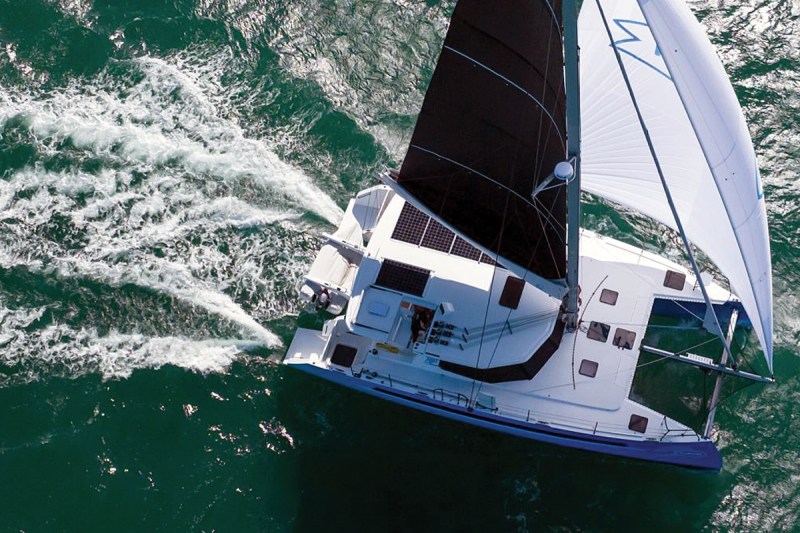
Balance 502 (Annapolis Sailboat Show, City Dock)
Balance built its name on a simple pitch: a performance catamaran that doesn’t ask you to give up comfort to get speed. The 502 carries that mission into its most refined form yet. Launched in October 2025 and already a Multihull of the Year nominee, this 50-foot carbon-cored cat pairs carbon/epoxy daggerboards and rudders with a hybrid VersaDrive propulsion option: twin diesels backed by electric motors that hydrogenerate under sail, a 36-kWh battery bank and up to 3,000 watts of solar. Balance quotes upwind speeds of 8 to 9 knots and downwind bursts into the high teens, numbers that put real miles behind a passage plan. The VersaHelm swings between upper and lower stations, so a shorthanded crew can steer from an exposed flybridge in settled weather or a sheltered cockpit console when the Gulf Stream turns unfriendly.
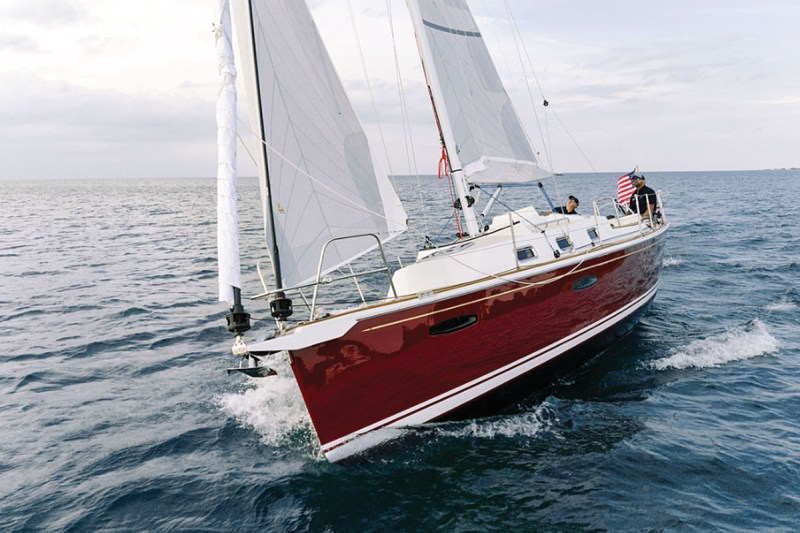
Tartan 34 (Annapolis Sailboat Show, City Dock)
The new Tartan 34, making her debut at Annapolis, is the compact end of a lineup that includes genuine offshore passagemakers—the 37, 40, 45 and 53 are all capable ocean crossers—but the 34 herself is tuned for something different: the sail you can actually get out for on a Tuesday evening, or the weekend hop that doesn’t require a passage plan. At 33 feet 6 inches overall with a 29-foot-2-inch waterline and 10-foot-11-inch beam, she’s scaled for sailors who want the performance and finish of the bigger boats in a size that’s easy to manage shorthanded. That easy-managing comes with real engineering behind it. A carbon-fiber mast—half the weight of a comparable aluminum rig—lowers the center of gravity and cuts pitching, while the hull is resin-infused using multi-axial E-glass and closed-cell foam coring for a stiff, void-free laminate. The deck has been re-engineered for this model as well, swapping balsa coring for Corecell SAN I-foam while keeping all major structural components resin infused, a durability upgrade that matters as much to a weekend sailor as an offshore one. Tartan’s Cruise Control Rig pairs a self-tacking jib with a furling masthead reacher, giving her 601 square feet of upwind sail area and 845 square feet off the wind—enough to come alive in a puff without overpowering a couple sailing shorthanded. Buyers choose between a deep-fin keel (6-foot draft, 9,000 pounds displacement), a shoal beavertail (4-foot-6, 9,200 pounds), or a keel/centerboard option that swings from 4 feet with the board up to 7 feet with it down. Twin wheels open up the cockpit and sightlines, and all sail controls lead aft to winches within reach of the helm. Belowdecks stays efficient rather than expansive: one open cabin with four berths standard, now with an optional starboard quarterberth that brings the total to five. Fuel and water run 25 and 40 gallons respectively, tankage sized for a long weekend rather than a passage. She’s not the boat Tartan is putting up for an Atlantic crossing—that’s what the rest of the range is for—but for a Cruising World reader shopping the Annapolis docks for something that rewards frequent use as much as ambition, she’s a must-see.