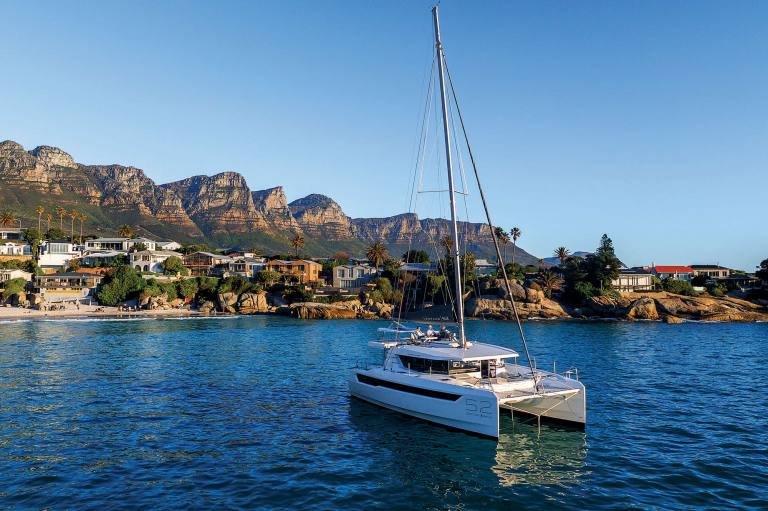

There’s a tell at any serious cruising anchorage in the British Virgin Islands. A Hylas 46 or a Hallberg-Rassy 42 drops the hook cleanly, scope sorted, done. Twenty minutes later, a 45-foot Leopard comes in under the hands of a family from Cincinnati who picked up the boat in Tortola four days ago. Three attempts at anchoring, a 200-degree swing, and they end up about 30 feet off someone’s stern. By nightfall, drinks are out and reggae is drifting across the water.
The monohull sailors exchange the look. You know the one.
That scene has done more damage to the catamaran’s offshore reputation than any design argument ever could. The charter cat became the platform’s public face, and for a lot of accomplished sailors, that face is disqualifying. Call it the charter cat stigma: Catamarans are floating vacation condos, built for bareboat fleets, unserious about seamanship.
It may not be a groundless bias, but it’s a flawed one.
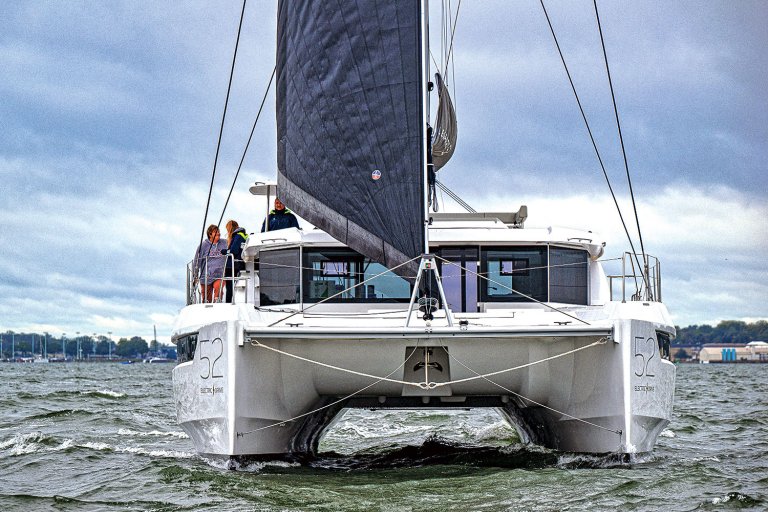
The association exists because it was earned. The Caribbean charter industry runs on production cats, and those boats are designed around charter economics. Beamy, flat platforms pack in the interior volume. Shallow draft works for island navigation. Furling everything and electric winches mean charterers can sail without ever having touched a mainsheet before. The boats are generally forgiving because they have to be.
None of that is shameful. It’s engineering for a market. But it has calcified into the way that much of the sailing community reads every boat with two hulls.
Category confusion is the result. Writing off offshore cats because of charter cats is like writing off offshore monohulls because of the Beneteau in the corner slip that hasn’t moved since 1998. The platform isn’t the product. When charter-fleet familiarity becomes your ceiling for what a catamaran can do, you’re leaving a lot on the table.
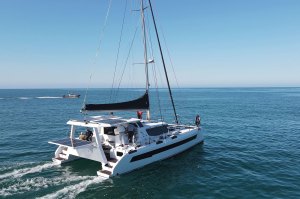
So what does the platform offer a serious bluewater sailor? Speed, for one. A Gunboat 55 or an Outremer 51 sails true multiples of monohull hull speed without the brutality of driving a fin-keeler hard. An 18-day passage on a 45-footer becomes 12 days.
Then there’s stability. A cat doesn’t heel. Over a 3,000-mile trade wind passage, that quality changes everything aboard. Cooking is safer, sleep is restful, and crew fatigue across a two-week run is a different animal entirely. The notion that monohull rolling builds character wears thin somewhere around day seven east of the Azores.
Redundancy matters too. A well-set-up cat carries twin engines, twin rudders and a split electrical system. Failure modes are genuinely different from a single-keeler, and on a long offshore passage, different often means better.
The capsize argument is where monohull sailors have their most honest footing. A cat can’t self-right. In the Southern Ocean, that’s a real liability, not a technicality. If Cape Horn in winter is the goal, then the monohull’s stability case is legitimate.
But most offshore sailors aren’t rounding the Horn. They’re on the trade wind route to the Canaries or running the Pacific milk run. For that kind of sailing, the capsize risk is low, and the performance and comfort advantages are real.
Sailors who have figured this out are mostly the ones who’ve put serious miles on a cat.
That Leopard in the Virgins hosting the family from Cincinnati isn’t an indictment of the catamaran. It’s a snapshot of the charter industry, which opened sailing to people who never would have found it otherwise. That’s worth considering, even when their anchoring theatrics test your patience.
Blame the sailor, not the boat. If your offshore resume gives you the right to hold opinions about hull forms, then hold an honest one. Go sail 1,500 miles on a well-found performance cat before you write off the platform entirely. You might just be surprised—and not at a 20-degree heel.