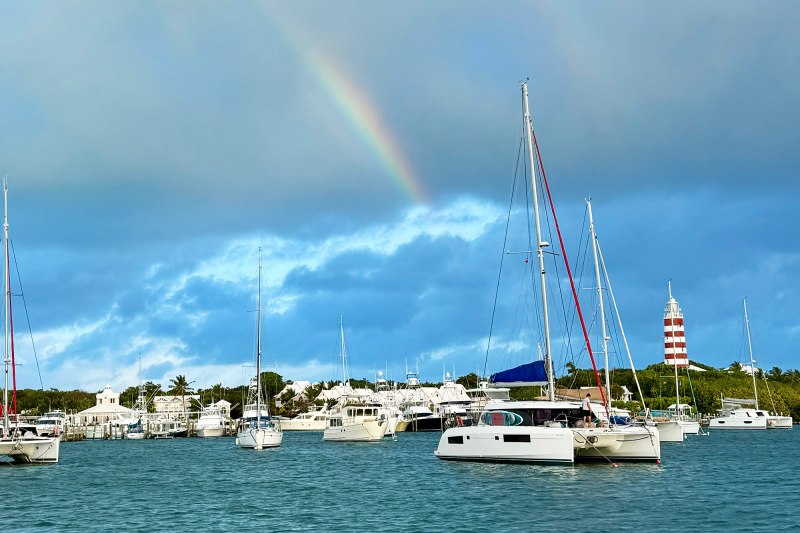
There is a particular satisfaction in shooting a mooring ball cleanly on the first try when your father is watching from the cockpit.
My dad has always been “Capt. Dad” to me; a title that’s held in our family since before I was old enough to understand that other people’s fathers didn’t spend their weekends offshore. He’s been putting lines on cleats and balls for longer than I’ve been sailing, which is saying something, since I’ve been sailing for 34 years. He’s saltier than any sea I’ve sailed on.
So, when I brought a 42-foot catamaran onto a mooring in Little Harbour, on our third day aboard in the Bahamas, without drama and without asking for help, something clicked into place that had been loose for a very long time. My 2-year-old daughter, stationed on the bow and fully convinced that every pelican on the horizon had been placed there for her personal entertainment, didn’t even look up. That’s probably as it should be.
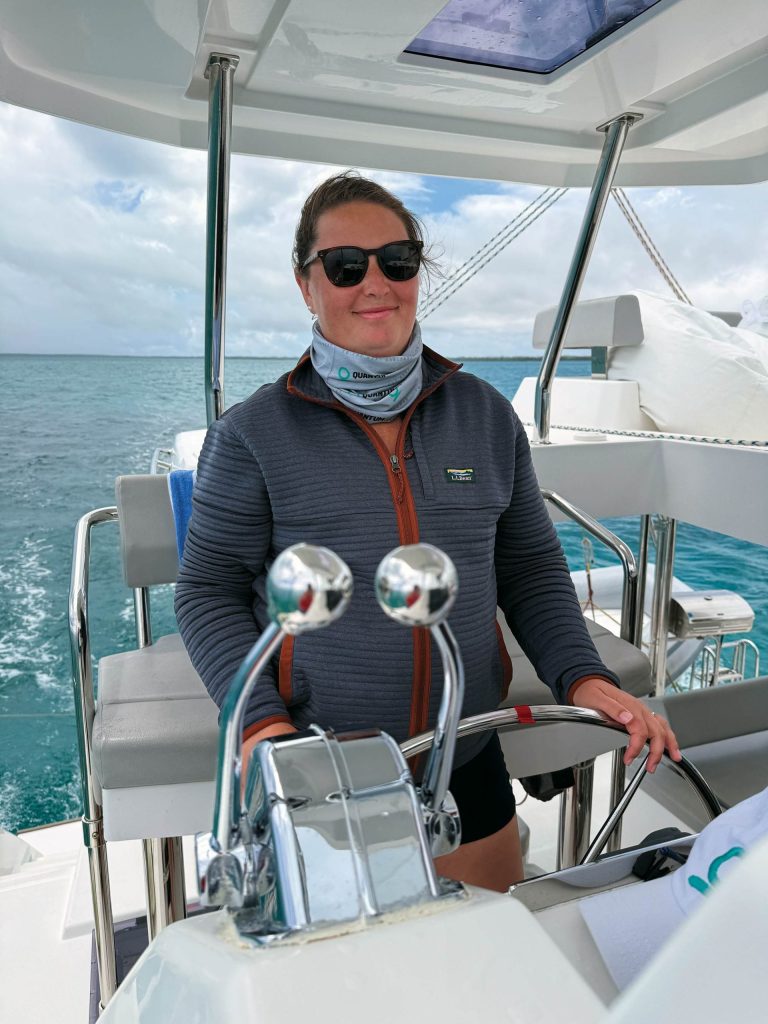
I’ve been following Capt. Dad around on boats since before I could read a chart. Crewing for him was how I learned to sail. It’s how most of us learn, really, by absorbing the habits and instincts of someone who already has them. But there’s a difference between being crew and being skipper, and for most of my life, I was firmly the former.
A Cruising World assignment in 2016 formally began to change that. The magazine sent me to the Offshore Sailing School for a week in the British Virgin Islands, with the explicit goal being to fast-track a fledgling editor from capable crew to independent skipper. The resulting article ran with a subhead I still think about: “After chartering under Capt. Dad for years, a burgeoning skipper goes to Offshore Sailing School for the skills and self-assurance she needs to set sail independently.”
I came home from that week full of intention. Then real life intervened, as it reliably does. Military postings that took us far from the coast. Children. A five-year detour entirely out of the sailing industry. The decade passed, the bareboat career stalled somewhere between ambition and circumstance, and Capt. Dad remained, quietly, the one who knew exactly what he was doing aboard.
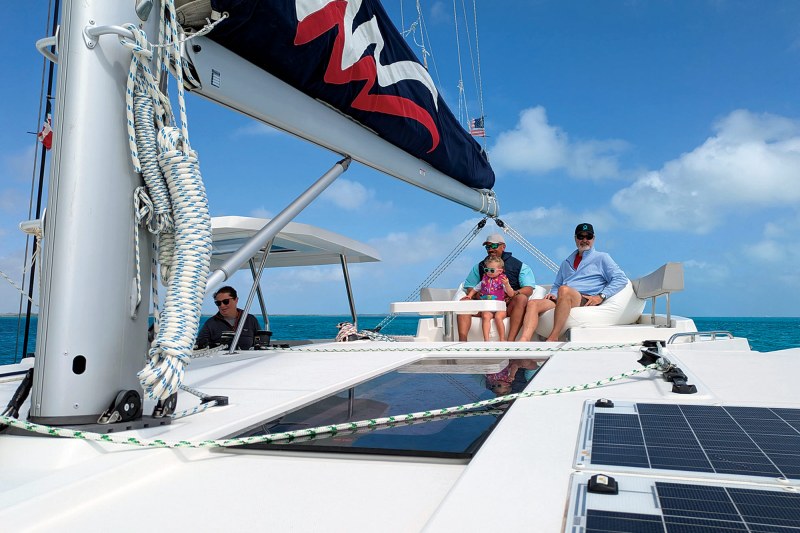
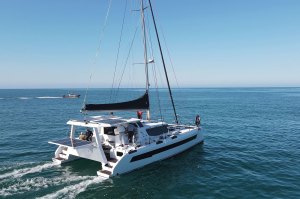
Then the Army sent us to the Bahamas, and I didn’t waste any time. We settled on a spring break charter in the Abacos aboard a Moorings 4200, a three-stateroom Leopard 42 that offered considerably more real estate than I, as a monohull sailor, was accustomed to. The Abacos are, in many ways, the ideal reintroduction to bareboat cruising. The cays run close together, which means short passages and easy bailout options if the weather turns. The water is the particular shade of bright blue that makes you want to drop the hook and stay for days.
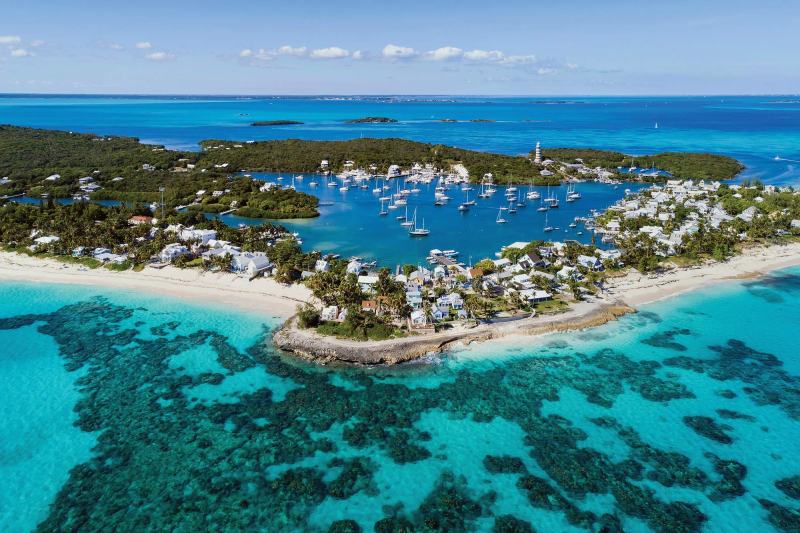
Historic Hope Town with its candy-striped lighthouse, the wild beaches of Lynyard Cay, the legendary watering holes at Tahiti Beach—each stop earns its place on the itinerary. The navigation is straightforward, the anchorages are well-protected, and the cruising community is friendly in the way that people who have found something good are always friendly. It’s the kind of ground that rewards a skipper shaking off some rust without punishing her for it.
Because our crew now includes an extraordinarily energetic toddler who has a selective relationship with instructions, we brought Capt. Dad and my mom. They came aboard as grandparents, not crew. Their job was the child, not the boat. My husband and I would handle the sailing.
The deal held. Mostly. What we didn’t anticipate was the weather. We had the singular misfortune of landing in one of the roughest non-hurricane-season weeks the Abacos had seen in years. It pushed us off our planned itinerary within the first 24 hours and forced a smaller, slower circuit than we’d imagined.
It turned out to be the best thing that could have happened. The truncated route meant fewer miles and more time to settle into anchorages, to let the toddler set the pace, and for me to stop thinking about the boat and start feeling it.
It wasn’t the charters of my childhood, when our family would routinely log 20 or 30 miles a day without a second thought. But a midday stop at the Thirsty Cuda floating bar at Tahiti Beach, while the toddler napped, made up for most of the lost miles.
We did have one educational moment. Approaching Little Harbour on day three, I made the executive decision to attempt entry through a channel charting at 1.5 meters at a moment when our Leopard 42 was drawing nearly that in feet. The catamaran and the arithmetic did not agree. We backed out, waited for the morning tide, and entered at high water as the cruising guides clearly intended. Pete’s Pub & Gallery (a Bahamian institution, open-air and unhurried, the kind of place that feels like it was built for sailors who’ve just learned a lesson they needed to learn) was waiting on the other side of that tide, and worth every minute of it.
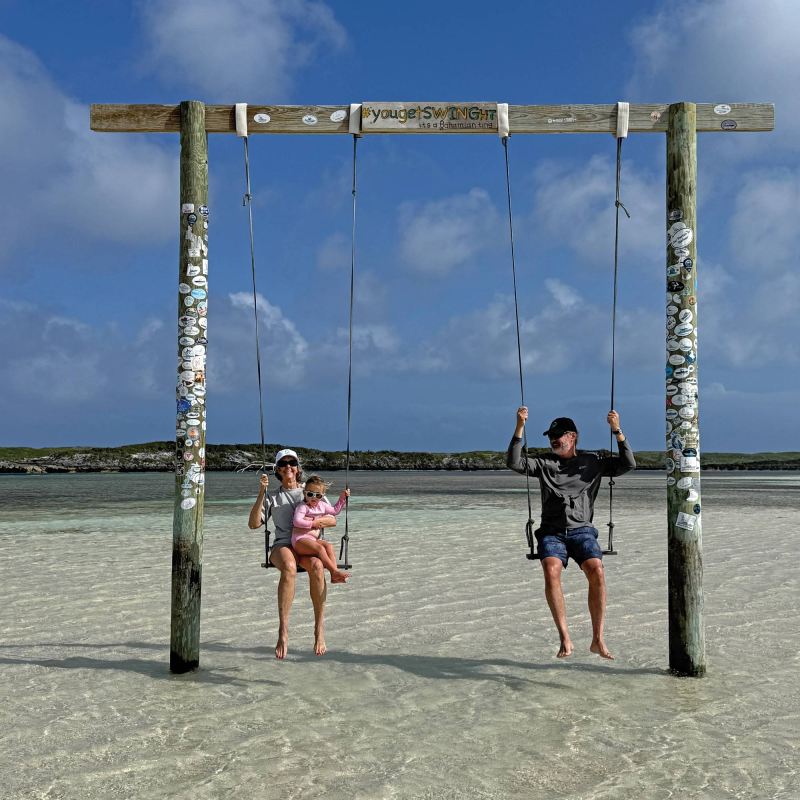
But the best moments of the charter were smaller. They were the afternoons spent combing the shoreline for sea biscuits and conchs, my daughter holding each one up for inspection with the focused gravity that toddlers bring to important discoveries. We watched her scan the horizon from the bow, and saw her ease into the unhurried pace that only seems to exist aboard a boat on a charter. She watched me shoot a mooring or set the hook with something approaching authority, and didn’t yet know that her mother had been waiting a decade to do exactly this.
Capt. Dad, for his part, finally managed something I’m not sure he’d ever fully achieved on a family charter: He completely let go. He sat in the cockpit, relaxed and enjoyed the trip.
I can’t wait for the day I pass the captain’s baton to my girl. Until then, I’ll keep showing her the ropes.
Next stop: the Exumas.
Two Ways Through the Abacos
What we planned, and what the weather had in mind.
As Planned
Day 0: Fly into Marsh Harbour; board at the Moorings base, Marsh Harbour Marina. Overnight: dock
Day 1: Skipper checkout sail to Guana Cay; optional lunch stop at Fowl Cay; dinner at Nippers or Grabbers. Overnight: Dive Guana mooring
Day 2: Sail to Green Turtle Cay via Nunjack Cay lunch stop; dinner at Pineapples Bar & Grill. Overnight: White Sound mooring
Day 3: Sail to Hope Town, Elbow Cay. Explore the village, stop at the playground, dinner at Cap’n Jack’s (casual) or Firefly (more formal). Provision here. Overnight: municipal mooring
Day 4: Sail to Little Harbour; en route snorkel stop at Sandy Cay/Pelican Cays. Dinner aboard. Overnight: Pete’s Pub mooring.
Day 5: Sail to Man-O-War Cay; browse Albury’s Sail Shop. Dinner aboard. Overnight: mooring or at anchor
Day 6: Early sail back to Marsh Harbour; disembark by 10 a.m.
As Sailed
Day 0: Fly into Marsh Harbour; board at the Moorings base, Marsh Harbour Marina. Overnight: dock
Day 1: Skipper checkout sail; hop to Hope Town, Elbow Cay. Explore the village, stop at the playground, dinner at Cap’n Jack’s Restaurant and Bar. Overnight: municipal mooring
Day 2: Morning ashore; short sail to Tahiti Beach/Aunt Pat’s Bay for lunch on the hook. Afternoon beach time. Overnight: at anchor
Day 3: Sail to Lynyard Cay; afternoon at Gilly’s Beach. Sandy Cay snorkel scrapped because of weather. Dinner aboard. Overnight: at anchor
Day 4: Morning ashore; enter Little Harbour at high tide; lunch at Pete’s Pub. Afternoon at leisure. Overnight: Pete’s Pub mooring
Day 5: Sail back to Marsh Harbour; Man-O-War Cay stop scrapped due to weather. Overnight: dock
Day 6: Disembark by 10 a.m.; morning at Abaco Beach Resort; lunch at Snappas Bar and Grill before departing for the airport.
Lisa Gabrielson McCurdy is a former SAIL magazine editorial intern, Sailing World editor and founder of Wing on Wing LLC, a sailing-focused marketing consultancy. She, her husband and daughter are currently posted to the U.S. embassy in Nassau, Bahamas.