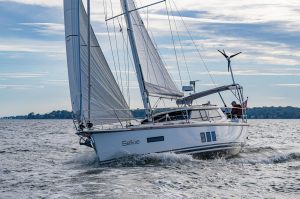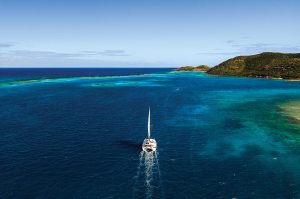
The anchorage at Man-O-War Cay tells you everything you need to know about the state of entry-level cruising catamarans. Swing into this Bahamian spot on a winter afternoon and count the monohulls. Then count the cats. The math has shifted decisively, and it isn’t hard to understand why. Space, stability, shallow draft and the ability to actually sleep offshore without being ragdolled against a bulkhead makes the case for two hulls nearly self-evident for first-time bluewater couples.
But the market can swamp those same couples before they ever leave the dock. Prices range from sensible to obscene, build quality from bulletproof to aspirational, And the used inventory has never been thicker with temptation.
What follows is not a list of the fastest or the flashiest. It’s a list of six cats—and one trimaran worth a hard look—that can give a first-time cruising crew the best combination of seakeeping, simplicity, value and the kind of forgiveness that keeps a new offshore passage from becoming an expensive lesson.
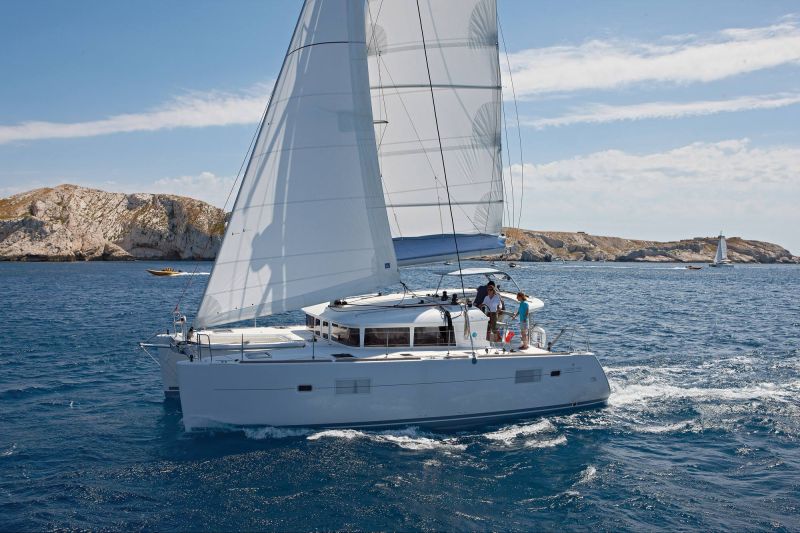
Lagoon 380/400: The Lingua Franca
If catamarans had a common language, it would be spoken with a French accent aboard a Lagoon. You’ll find the 380 and its successor, the 400, everywhere, from the Bahamas to the Mediterranean, and from the Caribbean’s Leewards to the Sea of Cortez. That ubiquity is one of these boats’ most underrated virtues. When a Beneteau-built Lagoon needs a part in Tortola or a rigger in Tahiti, someone nearby has sailed one or fixed one, or owns a drawer full of spares for one. For a first-time offshore crew, that support network is worth real money.
The sailing characteristics are deliberate rather than exhilarating. The 380 won’t win races, but it tracks well, handles comfortably in a steep chop, and forgives the kind of tactical imprecision that’s unavoidable when you’re still learning to think in two hulls. Salon volume is cavernous for the waterline length, and used examples in the $120,000 to $250,000 range remain plentiful.
If this is your first cat adventure, you could do considerably worse than buying the most common boat in every anchorage you’ll ever visit.
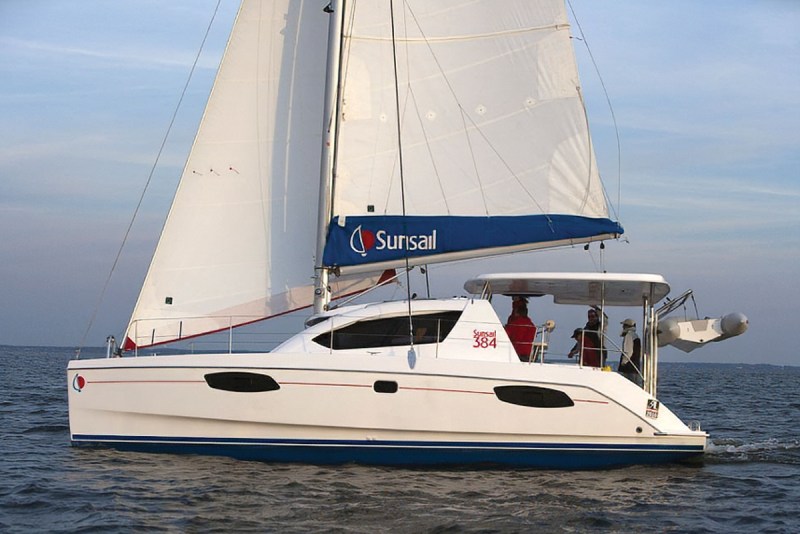
Leopard 38: The Charter-Proven Workhorse
Robertson and Caine didn’t build the Leopard 38 for charter fleets. The shipyard built it to be a genuinely capable bluewater cat that happens to tolerate them. Five seasons of BVI charterers is not a liability on the boat’s resume. It’s a stress test that most offshore sailors never put their own boats through. The 38 passes that test every time—which makes it nearly ideal for a first-time cruising couple still getting used to the platform.
All running rigging leads aft to a single helm station with excellent visibility. The cockpit is generous, social and well-shaded. The interior layout prioritizes natural light and ventilation—small things that matter enormously on a passage. The Sport variant sharpens the rig and adds performance without sacrificing livability.
Used 38s run between $150,000 and $280,000, parts are available globally, and resale value holds. This cat does everything reasonably well and nothing poorly.
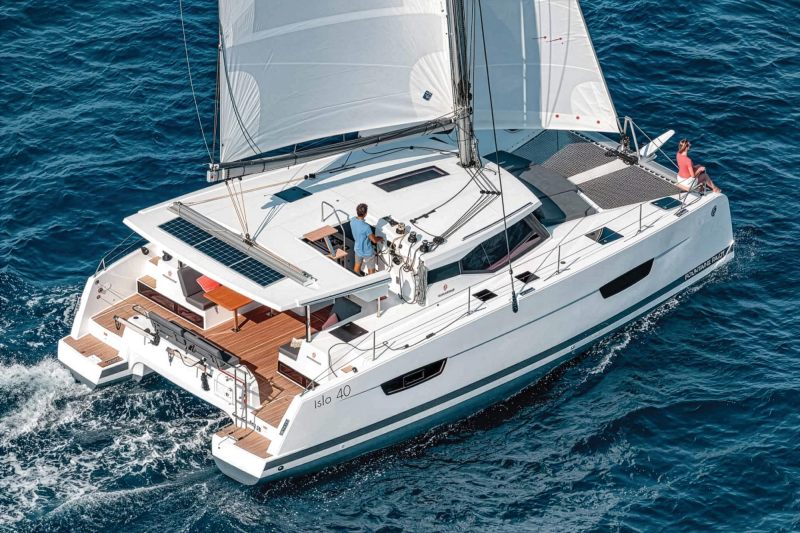
Fountaine Pajot Isla 40: Build Quality You Can Feel
Run your hand along a Fountaine Pajot hull, and you understand immediately why these boats cost more and hold their value longer than almost anything else in the class. The Isla 40, which evolved from the Lucia 40, is the French builder’s entry point into serious bluewater cruising, and it carries none of the compromises that “entry point” sometimes implies. Construction is meticulous, the rig is well-balanced for upwind work, and the salon-to-cockpit flow is the most seamless of any boat in this roundup.
The helm flybridge gives exceptional 360-degree visibility—a genuine safety advantage offshore, not just a lifestyle upgrade. Liveaboard comfort is tangible: good ventilation, thoughtful stowage and a navigation station that doesn’t make you feel like you’ve been folded in half.
Used Isla 40s fetch $200,000 to $350,000, and they earn it. If the budget allows, this is the cat you buy once and don’t sell.
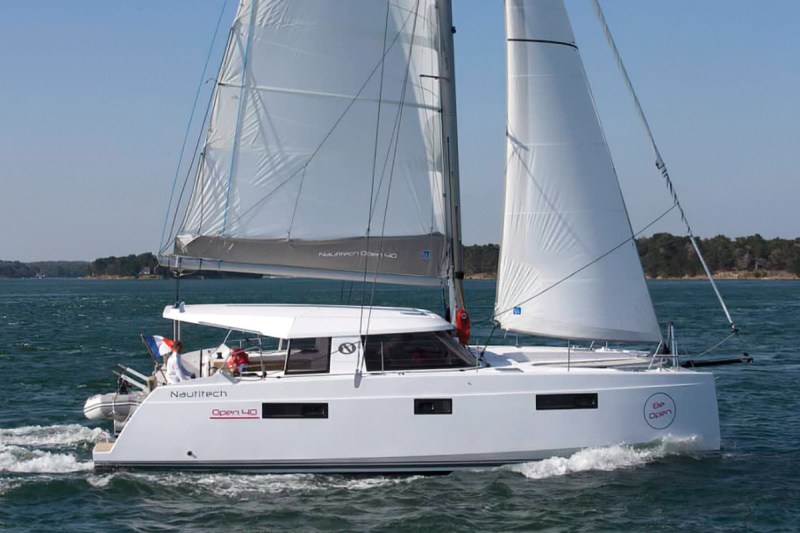
Nautitech 40 Open: The Undervalued Performer
Here is the boat that doesn’t get enough credit. Built in Bordeaux to standards that rival far more expensive French competitors, the Nautitech 40 Open introduced the “open transom” concept that’s now widely copied. Fold the aft doors flat, and the cockpit and salon merge into a single, light-soaked living space that erases the boundary between sailing and living aboard. On a warm night at anchor in the Exumas, there is nothing finer.
This boat sails with more purpose than its resortlike interior suggests. The rig is powerful, the hulls are slippery, and the boat rewards an attentive helmsman without punishing a tired one. And because Nautitech occupies less mental real estate than Lagoon or Fountaine Pajot among buyers, used examples trade at a discount that the quality doesn’t justify.
That gap is your opportunity. Budget $180,000 to $300,000, and look hard. You’ll find value here that the market hasn’t fully priced in.
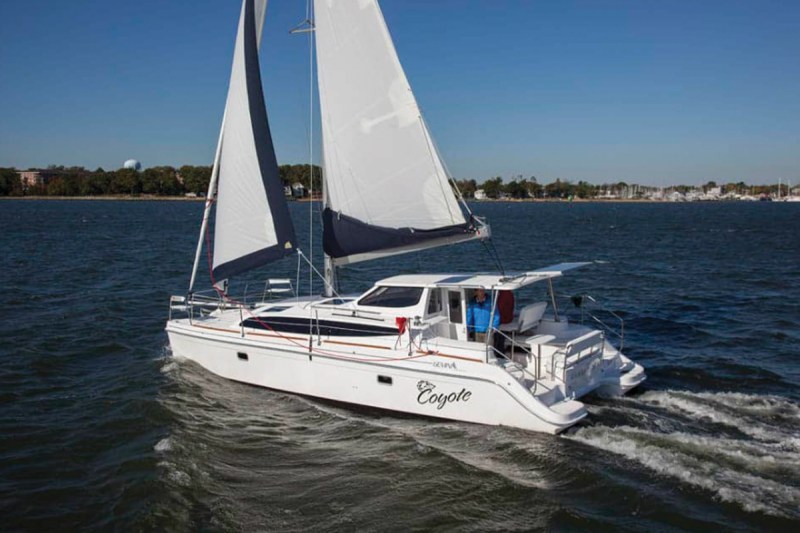
Gemini 105Mc: The Shallow-Water Contrarian
Everything about the Gemini 105Mc is a provocation to conventional catamaran thinking, and every provocation turns out to be correct. Originally built in Annapolis, Maryland, and later contracted to Catalina Yachts in Largo, Florida, the Gemini is narrower than its ocean-going cousins—narrow enough to fit in a standard marina slip and save you the eye-watering catamaran premium on slip fees every month.
With only 2 feet of draft, the Gemini floats in water that would strand a center console, which means the Abacos, the Chesapeake Bay and every shallow-water cruising ground that most boats can only admire from the channel are in play. At the same time, the interior is efficient, and the sailing character is lighter and nimbler than anything else on this list.
New sailing cat production from Gemini went quiet around the time of the pandemic, but with more than 1,200 hulls built across four decades, the owner community is large, vocal and genuinely helpful, and the 105Mc’s mechanical simplicity means a competent cruising couple can handle most repairs without a factory behind them.
For a couple doing coastal and Caribbean passages on a tight budget—used examples run $60,000 to $120,000—the Gemini is not a compromise. It’s a philosophy. Just go in with eyes open.
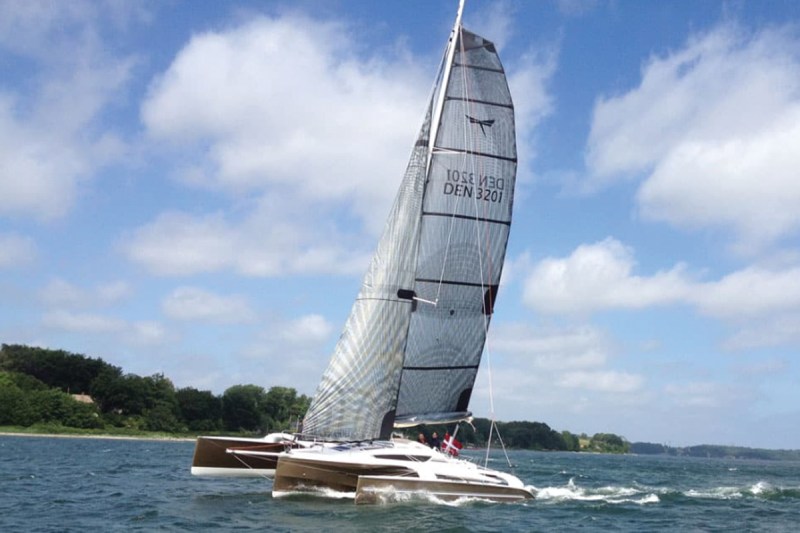
Dragonfly 32: The Trimaran that Changes the Argument
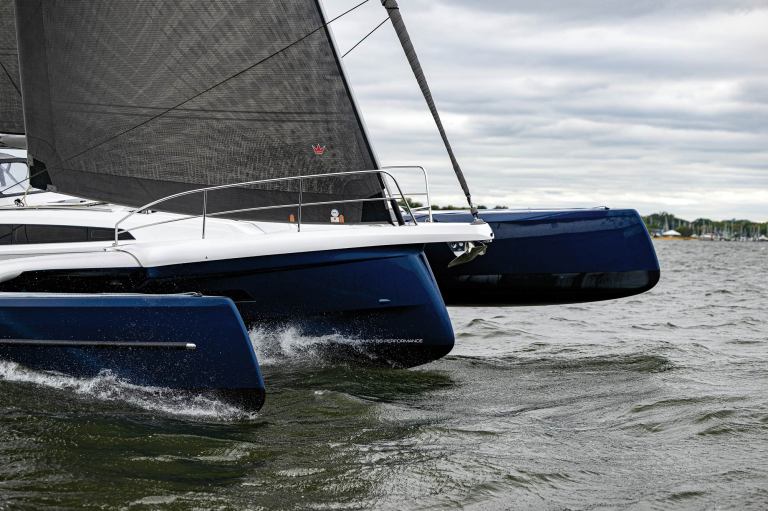
The objection to trimarans has always been practical: The beam is too wide for a slip, the amas are in the way, the marina won’t take you. The Dragonfly 32 from Danish builder Quorning dismisses every one of those complaints with an ingeniously engineered folding system that collapses the amas inboard, dropping the beam to roughly 8.5 feet and turning the boat into a normal marina citizen.
What emerges on the water is something genuinely different. This trimaran accelerates with ferocity, points higher and surfs downwind with the kind of controlled exhilaration that reminds you why you fell in love with sailing in the first place. The Dragonfly 32 is smaller and less capacious than the cats on this list, and it demands a more engaged helmsman. For performance-oriented, first-time multihull sailors who want to truly sail rather than simply cruise, no boat on this list comes close.
On the brokerage market, used boats are running between $100,000 and $200,000, and they are rarely on the market long.
The “Right” First Cat
There is no perfect entry-level cruising catamaran. There is only the one that matches your cruising ground, your budget, your marina situation and the honest conversation you’ve had with yourself about what kind of sailor you actually want to become.
Buy the Gemini if your heart is in the shallows and your wallet has limits. Buy the Lagoon if you want a community waiting for you in every anchorage. Buy the Leopard if you want a boat that earns your trust before you’ve even cast off the lines. Buy the Nautitech if you want the best-kept secret in the used market. Buy the Fountaine Pajot if you’re buying for keeps. And if you want to feel the sea the way you felt it the first time you ever went fast on the water, buy the Dragonfly, and don’t look back.
The anchorage at Man-O-War will be there whenever you’re ready.
Multihull Brokerage 2026: What the Data Shows
The pandemic did extraordinary things to used catamaran prices. From 2020 to 2023, boats that should have depreciated were appreciating, sometimes selling for more than their original purchase price a decade earlier. Inventory vanished. Surveys got skipped. Buyers paid whatever it took to secure a hull. It was a seller’s market in the most punishing sense of the phrase.
That era is over.
The post-pandemic bubble has deflated, and supply has flooded back into the market faster than demand has followed. For a first-time buyer who has been waiting patiently as prices climbed, this is your window.
The numbers tell the story. According to a U.S. sailboat brokerage market report that David Walters Yachts published this past October (drawing on transaction data from Boats Group), median sale prices eased to $330,500, down nearly 3 percent year over year. Time on market stretched to 172 days, up 15 percent, while median discounts from asking price expanded to roughly 7.26 percent.
This report’s assessment was unambiguous: Conditions are “favorable for informed buyers,” with the playbook being to “define must-haves, monitor candidates and be offer-ready when value appears, especially on listings aging past the median days on market.”
A mid-2025 multihull market analysis that Just Catamarans published noted that multihulls were holding up better than monohulls in the correction period, with seller discounts narrowing to around 6 percent compared to more than 8 percent for monohull transactions. However, the firm noted that its dataset represented a sample of the broader market rather than comprehensive industry totals. The cat market is softening, but it isn’t collapsing.
The real transaction volume in 2025 concentrated in mid-40-foot cruising catamarans priced under $500,000. That’s precisely where the boats on this list live, and where selection, leverage and value align most favorably for a first-time buyer.
Well-priced, well-maintained cats are still going to contract within weeks of hitting the market. The market correction hasn’t turned good boats into charity. The overpriced ones are sitting. Know the difference before you make an offer. And bring a catamaran-specialist surveyor who does too.
Bottom line: 2026 is the best buyer’s market for used cruising catamarans in nearly a decade. Move deliberately, survey everything, and know what comparable boats are actually selling for before you make your move.
Before You Sign: 10 Things to Look for at Survey
Always use a surveyor who specializes in catamarans. The structural dynamics, load paths and failure modes of a multihull are genuinely different from a monohull, and a generalist can miss what a specialist will find in the first hour. The fee difference is trivial. The difference in what they find is not. Make sure to look for all of the following problems, at minimum.
Osmotic Blistering: Catamarans carry enormous hull surface area below the waterline, twice the exposure of a comparable monohull. Have the surveyor tap every inch of both hulls. Moisture readings above 20 percent on a calibrated Sovereign or Tramex meter warrant a haul out and serious negotiation. A few blisters are cosmetic. A wet laminate is a winter project you didn’t budget for.
Bulkhead-to-Hull Bonding: This is the structural heart of a cruising cat. The transverse and longitudinal bulkheads carry the rig loads that a monohull’s keel and ballast absorb differently. Look for cracking, delamination or the telltale rust shadow of fasteners weeping through the glasswork. Soft or spongy feel underfoot near a bulkhead base is a red flag that should stop a deal cold.
Crossbeam and Bridge-Deck Integrity: The bridge deck takes a pounding offshore. Slamming in a short chop is a catamaran’s cardinal vice, and the structure pays the price over time. Inspect every crossbeam attachment, every bedding compound joint and the underside of the bridge deck itself for stress cracking. Water intrusion here is not a maintenance issue. It’s a structural one.
Rudder Bearings and Steering Systems: A cat carries two rudders, which means twice the opportunity for worn bearings, sloppy tiller arms or corroded pintles. Grab each rudder and check for play. More than a few millimeters of slop means replacement before departure. Cable-and-quadrant steering systems should be inspected for fraying and sheave wear; check hydraulic systems for weeping seals at the rams.
Rigging Age and Chain-Plate Condition: Standing rigging has a service life. Ten years is the outside limit for offshore use; seven is more honest. Ask for documentation. More important, have the surveyor inspect every chain plate for corrosion at the deck penetration, the hidden zone where stainless steel and moisture conspire. A broken chain plate offshore is a dismasting. There is no negotiating with that.
Engine Mounts and Saildrive Bellows: Most cruising cats run twin outboards or twin saildrives. Inspect both engines for hours, service history and motor-mount condition. On saildrives, the rubber bellows that seal the leg to the hull is a consumable with a hard service life. A cracked or aged bellows is a sinking risk at anchor. If the seller can’t produce replacement documentation, then budget for it immediately.
Trampoline and Deck Hardware: Trampolines are load-bearing crew platforms and sail-trim aids, not deck furniture. Check every lashing point, eyelet and the mesh itself for ultraviolet degradation. While you’re there, inspect every cleat base, stanchion and deck fitting for proper backing plates. A stanchion base fastened only into cored deck, without a proper backing plate, will pull free at exactly the wrong moment.
Watermaker, Electronics and Systems Integration: A sea trial is not the time to discover that the watermaker hasn’t made water in two seasons, or that the chartplotter has never talked to the autopilot. Request a full systems demonstration, including watermaker output, battery bank capacity under load, and autopilot tracking under power and sail. An aging AGM bank that reads 12.6 volts at rest can still be functionally dead. Bring a load tester or ask the surveyor to bring one.
Daggerboard or Centerboard Condition: Cats with lifting boards—daggerboards on performance models, centerboards on the Gemini—deserve close inspection of the board trunks for cracking, the boards themselves for delamination, and the lifting systems for cable wear or hydraulic integrity. A seized daggerboard offshore is an inconvenience. A cracked trunk taking on water is considerably worse.
The Smell Test: Open every bilge, locker and lazarette. Mold and standing water in a catamaran’s shallow bilges indicate drainage problems and possibly hidden delamination. The smell of diesel below a floorboard means a fuel-system leak that the seller may or may not know about. A boat that smells wrong usually is wrong. Trust your nose as much as your moisture meter.