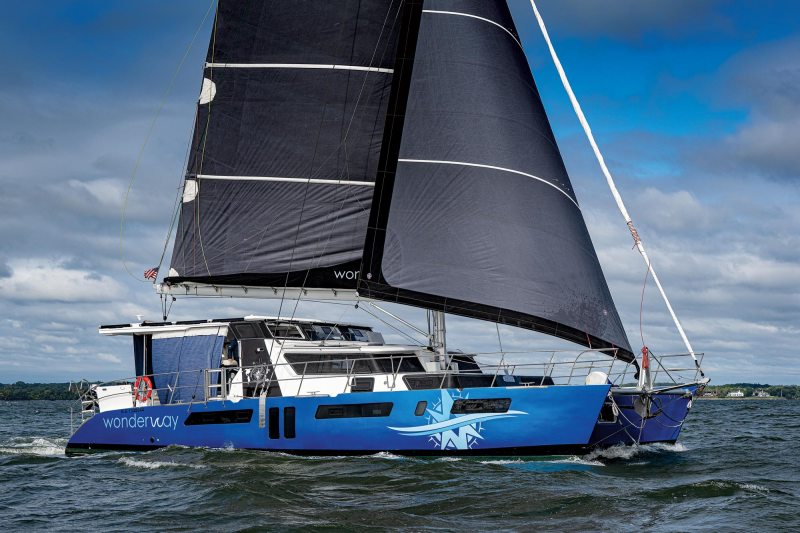
If we learned anything during this past fall’s testing for the 2026 Boat of the Year awards, it’s that the genie is out of the bottle. Which genie? The one that has coaxed more and more builders of production sailboats to ponder hybrid answers to questions regarding auxiliary propulsion, and battery charging and management. Nearly half the nominees were yachts with dedicated or optional hybrid systems incorporating electric-drive systems, including such brands as Balance, Dufour, HH and Leopard. Also joining the fray is the longtime South African manufacturer Royal Cape Catamarans, which entered its latest all-oceans cruising cat, the Majestic 530 Hybrid.
Royal Cape has been knocking out rangy cats since 2003 and these days offers 53- and 57-footers, with or without a flybridge. The company prides itself on craftmanship and customization—a stated selling point is “building around the owner’s vision”—as well as safety features and liveaboard capability. Royal Cape generally builds a couple of boats each year and just delivered to the Caribbean its 75th yacht, 18 of which were Majestic 53s. Of those, there’s now a second Hybrid model.
Our test boat was one of them, the floating residence to a family of four who’d taken the builder’s mantra to heart and commissioned a highly customized craft that had already logged some serious miles, from South Africa to the Caribbean to New York to the Chesapeake Bay.
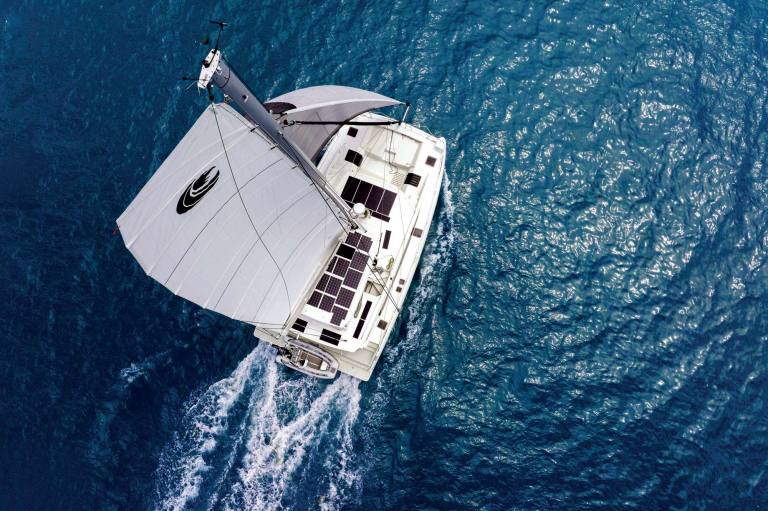
It would take a textbook to detail all the options and permutations in generating and regenerating power on the Majestic Hybrid, but the basics are formidable. Auxiliary power is generated by a pair of 80 hp Yanmar diesels in conjunction with a set of 20 kW electric motors (house demands are a rather staggering 40 to 50 kW daily). Atop the hard Bimini top is what can accurately be described as a solar farm: an “expandable” array of 16 panels when all are deployed (half can be stored like closed drawers when underway) that produce 6,400 watts at maximum output. A 10,000-watt inverter, in conjunction with a CZone digital-switching system, manages and distributes the various loads. The yacht can be operated under auxiliary diesel power, in silent electric mode or in a hybrid combination of both. That last mode lets owners opt for flat-out speed or charge the batteries via a spinning propeller (or two) in regeneration mode.
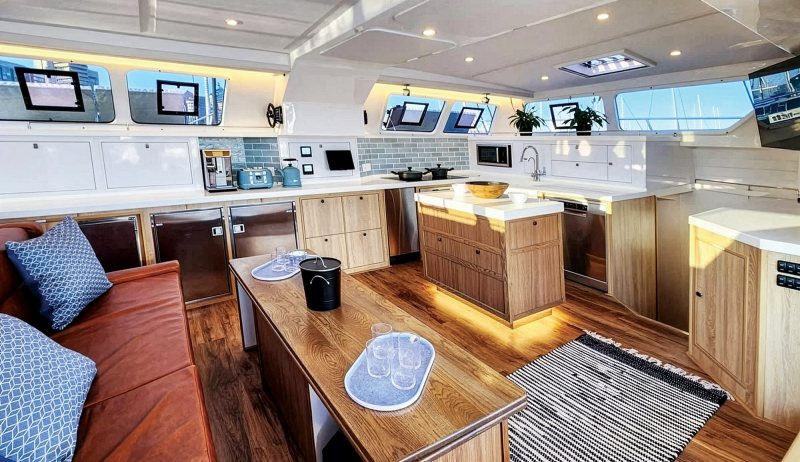
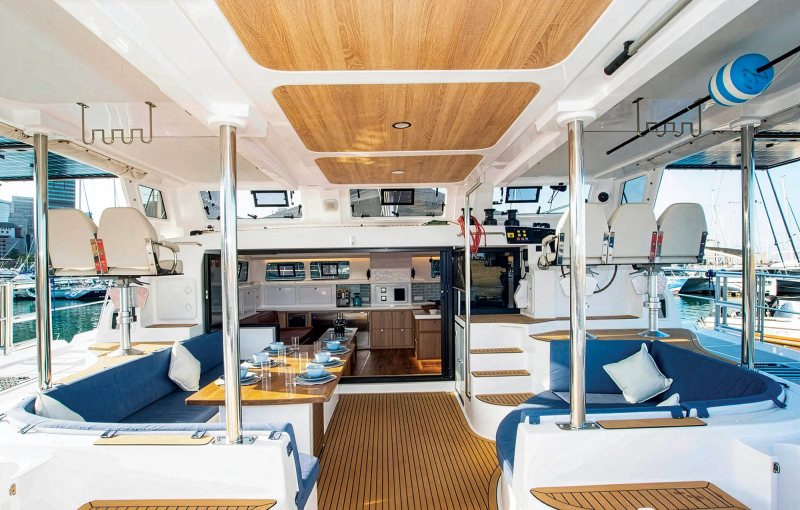
Aesthetically, this is a big boat with a big payload, displacing close to 50,000 pounds with over 1,500 square feet of interior space that can be allocated in four, five or six staterooms. The three-tiered profile offers plenty of deck space for kicking back. That solid Bimini top is also the roof over the cockpit, which can be completely enclosed, not unlike a back porch. It opens into the main saloon, which basically doubles as the living room. Regarding creature comforts, it really is hard not to compare the boat to a house. Excuse me while I toss something into the air fryer.
We tested the Majestic in all its various alignments, under sail, power and a combination of both. With one of the diesels turning over at 2,700 rpm, we made 5.5 knots and maintained the same speed with the electric engines at 12.5 kW. With both engines under power, we ramped up to almost 7 knots. Under full sail alone, on a close reach in about 10 knots of true wind, our speed was 6.4 knots.
This was a more than an adequate sailboat, but make no mistake: In this particular Hybrid version of the Majestic 530, one built with considerable input from its owner, a former software engineer who put a high priority on family comfort, the sailing was of secondary importance to the joys of anchoring in interesting places.
Taking into consideration the owner’s priorities, which included off-grid living with air conditioning for all the staterooms 24/7, Boat of the Year judge Ralph Naranjo had these observations: “It’s set up to excel at static liveaboard scenarios with power options galore. The system complexity outstripped all others in this year’s contest. The engineer owner is well suited to the challenges of this hybrid combination of 12-, 24- and 48-volt DC and 120/240-volt AC current that can be shape-shifted with the pull of a few switches.” He also noted that this cat might appeal to cruisers who favor a remote lifestyle and want to bring everything along.
Of course, a straightforward power package is available, as well. “The standard option comes with an 80-horsepower Yanmar,” said Royal Cape CEO Ken Bircher. “On the 57 with the flybridge, we’ve gone up to 110 horsepower with a V-drive. We’ve tried to avoid putting any mechanical noise, fume generation or heat inside the cabin areas. Everything is housed in the engine bay, including washing machines and tumble dryers. A standard generator is included, with options for brand preference. Owners can also choose between Volvo and Yanmar depending on where they’ll be based and what service network they prefer. We are typically now using 24-volt systems, but we’ve gone to 48-volt on some of the bigger versions. We’ve also designed for international travel, accommodating 110/230V and both 50 and 60Hz so owners can travel anywhere in the world.”
As I explored the yacht’s foredeck, I was surprised to come across something I’d never seen on a cruising sailboat: a steaming hot tub in a locker that would usually store fenders and dock lines. Bircher says it’s a feature they may incorporate on future builds. For the peripatetic family exploring the world on their Majestic 53 Hybrid, there truly is no place like home.