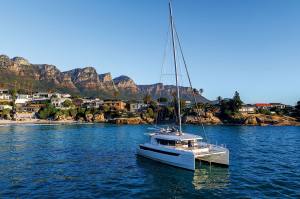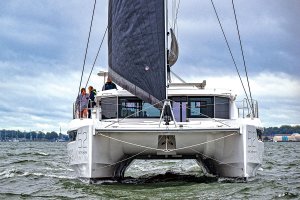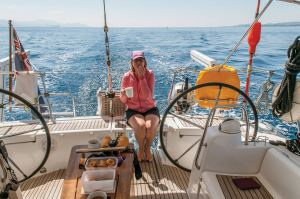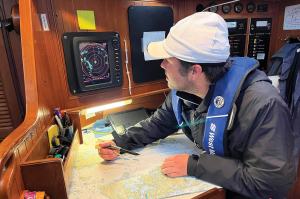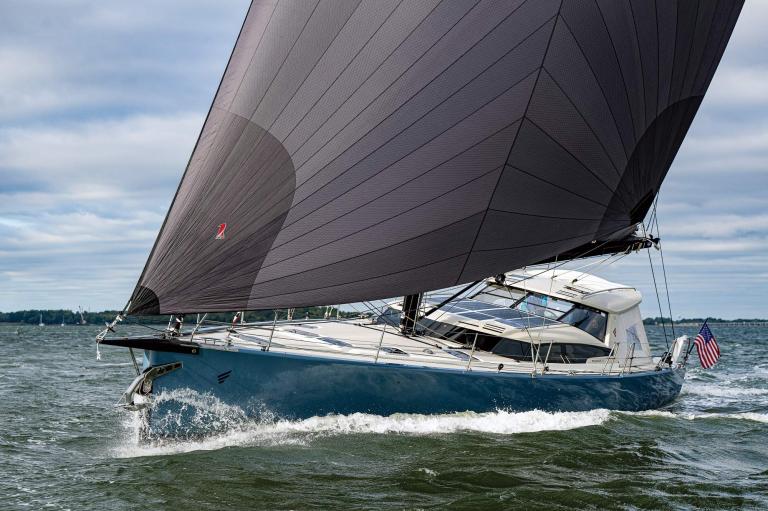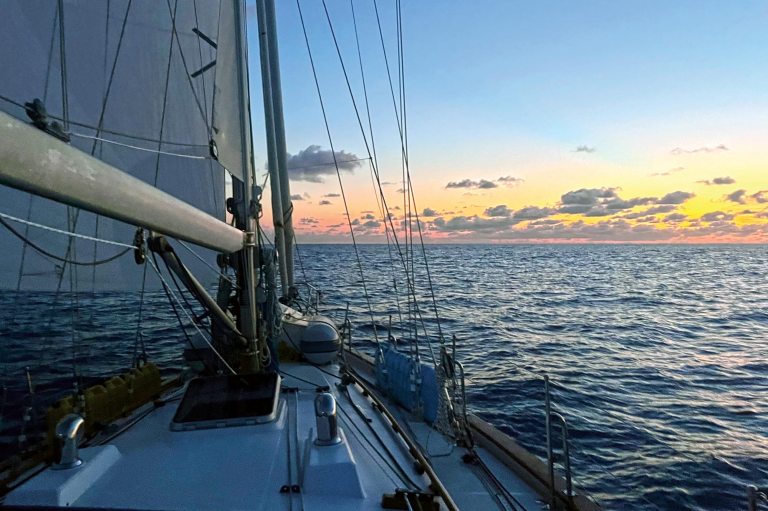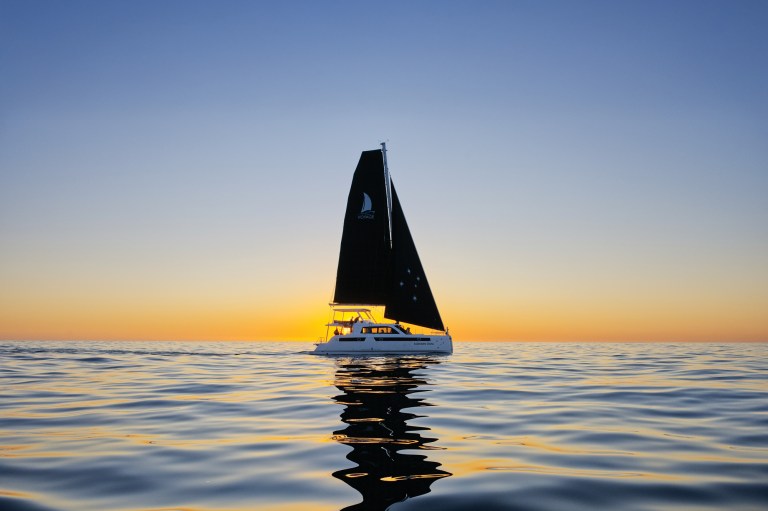
The gallop, followed by the heel into the sea after hoisting the main on our Allures 45.9, was every bit as exhilarating as the lift and swift glide of our Outremer when we raise the gennie. The salty wind stings my cheeks just the same, and I know neither boat is better than the other. They are simply two different kinds of wonderful.
So why, after 20,000 nautical miles and six years, did my husband and I switch from monohull to multihull?
The first reason was speculation. “If we had a faster boat, we’d already be there,” Michael mused on day 12 of our 2023 east-to-west Atlantic crossing. With our sails wing-on-wing since day one, monotony had crept in.
The second reason was opportunity. A week after landfall in Antigua, Michael spotted an Outremer anchored off our port bow. “That boat is for sale,” he said, incredulous. We bought it, sold our Allures, and regretted the decision for nearly a year.
At anchor, the catamaran felt immense. We longed for the cozy salon of our monohull, where everything—the galley, salon table and helm station—was within arm’s reach. On deck and in the cockpit, we missed the intimacy of being closer to the water. The larger size also increased our dockage and mooring fees to two times those of our monohull, making us think twice before leaving the boat for family visits in the United States.
Under sail, our growing pains multiplied. The cat’s bigger rig meant exponentially greater forces and, in turn, less margin for error. Worried I’d damage the boat or injure myself, I hesitated to handle the sails alone, something I’d done confidently on our monohull. The catamaran technique of “sailing by the numbers” required trust in our instruments, which I didn’t have, and speeds up to 17 knots that terrified me.
But our deepest regret came from unexpected maintenance issues. Every system, from plumbing to electrical to mechanical, demanded attention, draining our time and resources for an entire year. Only after completing the most grueling boat work and leaving a good chunk of stress behind did our attitude toward our multihull begin to shift.
At an average cruising speed of 8 to 10 knots, we were getting places faster. Day sails that once required overnights now seemed attainable, and we began to consider a range of possibilities. We decided to cross the Caribbean. Our Puerto Rico to Panama passage—about 1,100 nautical miles in five days—energized us.
My fear of capsizing our multihull was offset by the realization that less time in the open ocean increased our safety. Heck, with a new Starlink on board, we were fast enough to avoid foul-weather cells that we could see coming on our Windy app’s live satellite view. To my surprise, our inherently redundant (two engines, two rudders) and unballasted, practically unsinkable catamaran might have a legitimate advantage over our dependable monohull in a potential disaster situation. We felt increasingly confident in our boat and decided to cross the Panama Canal and, shortly thereafter, the Pacific.
It took us 16 days to reach Nuku Hiva. We still had fresh vegetables from Galapagos when we arrived. Free from the nauseating pendulum motion of downwind monohull sailing, I stayed seasick-free and enjoyed a 360-degree horizon view from the salon. Once anchored in the notoriously rolly Taiohae Bay, our steady multihull, with its sightline connection from the cockpit to the galley, was the perfect place to share sundowners with fellow cruisers.
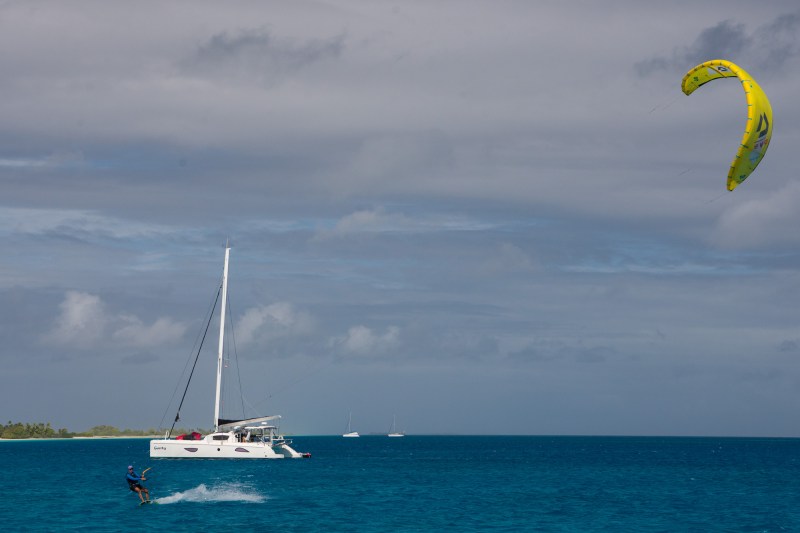
French Polynesia was the right choice for us and our catamaran. During the next 11 months, we sailed greater distances in shorter weather windows than we’d managed before. And as avid wind-sport enthusiasts, we made a habit of anchoring for weeks at a time behind reefs in 20- to 30-knot trade winds—conditions we previously considered wearing in our yawing monohull.
Still, nostalgia lingers. I miss evenings when friends squeezed shoulder to shoulder around our folding table, and the foul-weather nook under the dodger where I curled up on stormy days. I miss the pride of our 45-foot aluminum hull’s durability and sustainability compared with the fiberglass behemoth we now sail.
But when family visits, there’s no denying two heads are better than one and more staterooms are merrier.
Cruising 20,000 nm in an expedition monohull and 15,000 nm in a performance catamaran has given me a different perspective on the great sailboat class divide. In every way that matters—safety, speed, comfort, cost, size, complexity, performance—monohulls and multihulls are distinct. Even within these categories, boats vary enormously. Our Outremer is worlds apart from the heavy, luxurious condo-cats, just as our Allures differed from a stripped-down Pogo or a stately Oyster.
The right boat shifts with time and circumstance. Compromises are inevitable. Ultimately, the choice is personal.
So before you dig your heels into the sand of monohull or multihull loyalty, consider this: Your conviction, like ours, may wash away with the tide.
U.S. Coast Guard captain Jill Gallin traded a life ashore for 30,000 nautical miles of bluewater cruising. Since 2020, she has been exploring the globe with her family aboard their Allures 45.9, and then their Outremer 49, both named Gerty. Read more at svgerty.com.