My wife, Behan, and I used to enjoy backcountry camping. We’d hike into remote mountain woods carrying backpacks, make camp and enjoy nature. Driving home, we’d discover how very sore, soggy and smelly we’d become. That high camping line, a reference to tolerance for discomfort, slipped when we traded backpacks for a sailboat. Living on a sailboat is still camping compared to suburban living, but not exactly roughing it. Except, when it is.
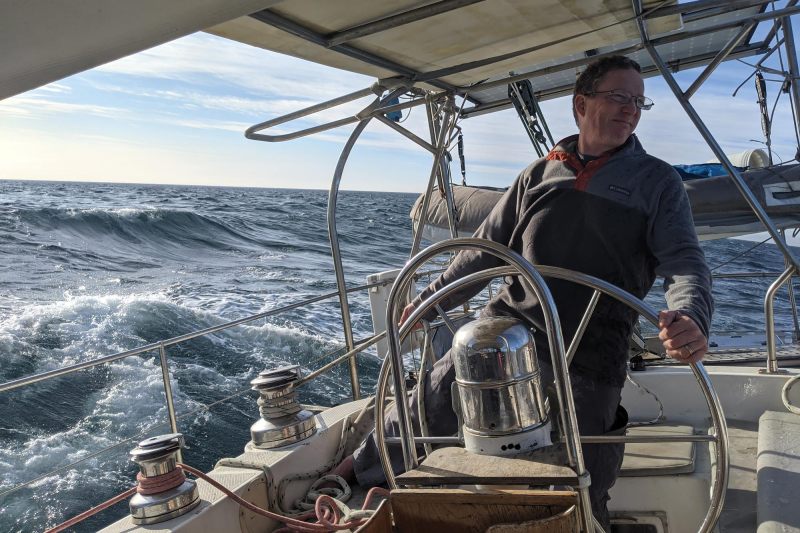
Our chosen sailboat is a 1982 Sparkman & Stephens-designed Stevens 47 that we named Totem. The model is a classic plastic bluewater cruiser with a reputation for sea-kindly motion. Rounding California’s Cape Mendocino in conditions misaligned to the forecast, Totem lived up to the reputation when 50-knot wind pushed up washy 15-foot seas. A year later, we raised anchor for an easy sail across the Sea of Cortez in mild conditions. Once outside the anchorage, we thrashed, bashed and buried the bow repeatedly. Why would a supposedly sea-kindly boat feel so miserable?
Various dictionaries define sea-kindly as a boat that moves easily in rough seas. In the log I recorded, “Nasty trip getting around the bottom of Isla Tiburon. Strong current and abrupt depth change made big, square and closely spaced waves.” It was very slow going through just 7 nautical miles of turbulence, but the experience did not fit the sea-kindly definition. How could we reconcile this against rough experiences when Totem did great? Was Totem flawed?
Boat designer Ted Brewer devised a mathematical formula “as a measure of motion comfort.” This so-called comfort ratio uses waterline and overall lengths, displacement and beam to assign a number representing faster or slower upward motion. Brewer wrote that faster motion is more upsetting to the average person. His low comfort ratio number represents fast upward motion and discomfort, like launching in a rocket. High numbers represent joy and peace with the ocean. The Stevens 47’s comfort ratio is 35.5, exactly the low- to middle-30s range that the designer calls the mark of moderate and successful ocean cruisers.
Since those early cruising days on Totem, referring to sea-kindly motion includes “sometimes,” a chuckle or both. Comfort ratio references require a broader discussion. The formula is helpful, but only in a narrow context. Used in a broader sense as a motion comfort it’s badly flawed.
Water plane is the area of a boat’s footprint at the waterline, as a flat plane. The messy right side of the comfort ratio formula is a modified version of water plane area. Length overall is added to account for increased water plane when heeling and pitching. Beam is penalized beyond its real contribution to area by raising it to the 1.33 power. Displacement is then divided by this fudged water plane number that lacks a relatable unit of measure.
Comfort Ratio
D / (0.65 × (0.7 LWL + 0.3 LOA) × B^1.33)
D = displacement
LWL = length of waterline
LOA = length overall
B = beam
The resulting comfort ratio represents boat weight relative to its footprint at the surface of the water. High numbers have a sluggish response to waves, which Brewer took to be more comfortable. Sometimes they are.
When we were in the Maldives, our kids had sleepovers on Totem with a buddy boat friend. She reported that the motion in the atoll was smooth compared to her bouncy catamaran. With low-lying atolls, anchored boats point into the wind waves that the uninterrupted trade winds create. This aligns with the comfort ratio’s high number for Totem, and its low, uncomfortable number for light, beamy, long-waterline boats like catamarans and production boats.
Later, in the beam-on swell wrap of a Seychelles anchorage, Behan and I clutched dinner bowls and evening beverages while adjusting to constant rolling. Our kids on the adjacent catamaran played a board game in their stable salon. That was at anchor, not at sea, so maybe that difference doesn’t count?
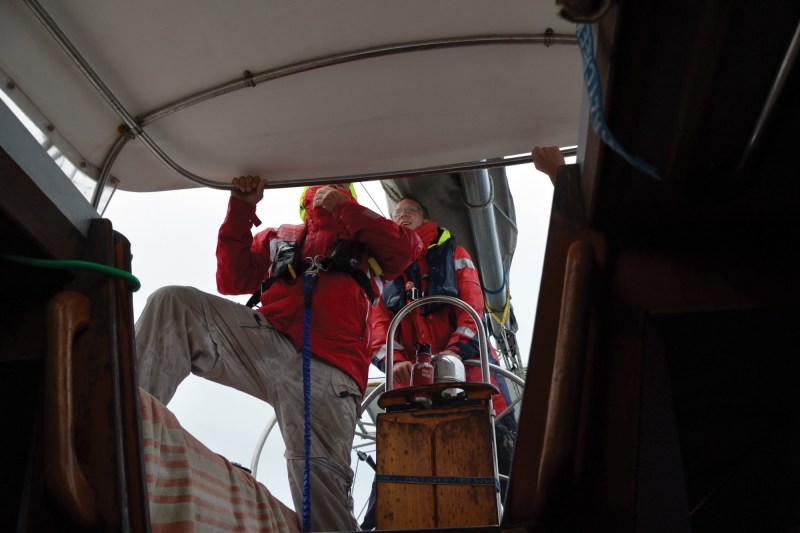
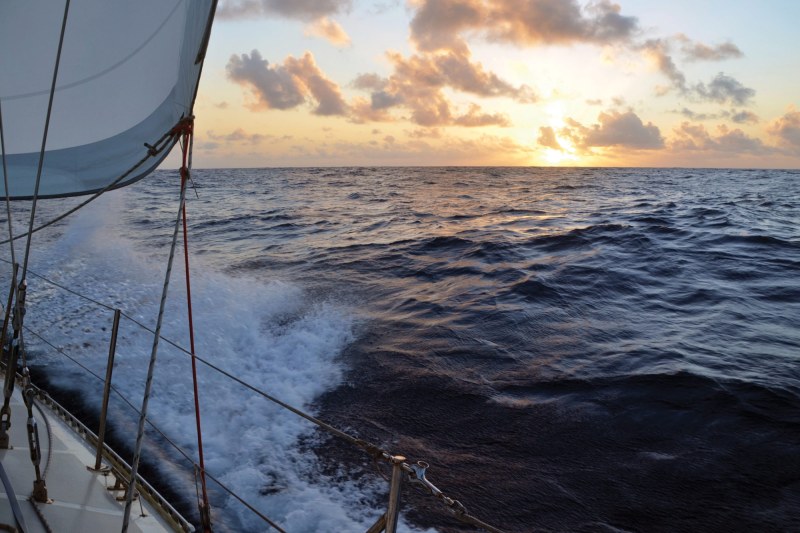
In 2024 and 2025, Behan and I crossed the North Pacific from Mexico to Japan. Most of those passage miles were dead downwind, wing and wing. Wind waves follow wind direction, each lifting Totem’s transom and sliding past. With decent boat speed, the upward motion was gentle. However, the waves were not perfectly aligned to our direction. Instead, subtly irregular wave angles and shapes induced side-to-side roll. Wing-and-wing sails sliced across the wind rather than creating lateral resistance to stabilize the rolling.
Totem’s rockin’ comfort ratio had us rolling 15, 20 sometimes 25 degrees in each direction. We could’ve adjusted to broad reaching and jibed back and forth, but the increased distance added days of passage time. What features could be more comfortable?
Many of the modern production boats that score poorly on the comfort ratio, pounding upwind in chop, are more comfortable in seas from other directions. Production boats shaped like pizza wedges with flat bottoms, for example. The wide beam and aft section along with the flatter bottom shape spreads out the waterplane area farther from the fore-aft centerline roll axis. This is called form stability, and it is better at resisting roll.
Deeper ballast, lighter standing rigging, centered water tanks and higher boat speed, to a point, all contribute to a more comfortable ride. I used to design sails, with a job benefit being that I sailed on many types of boats. Some of them were zippy. It was exhilarating to broad reach at 28 knots on a 60-foot pizza wedge as we passed a restored J Class America’s Cup boat like it was frozen.
Brewer’s comfort ratio should be understood in that context as it relates to the motion of similar size and style when pointed into waves. Importantly, it does not correlate to safety or offshore capability, although it’s frequently represented that way.
Robin Lee Graham began his circumnavigation when he was 16 years old, long before electronic navigation. Most of his voyage was on a Lapworth 24. Comfort ratio: 21.6. Laura Dekker is the youngest human to sail around the world solo. She did so in a Jeanneau Gin Fizz 37, the same model that John Kretschmer crossed the Atlantic twice on. Comfort ratio: 25.9. Webb Chiles completed his sixth solo circumnavigation in a Moore 24. Comfort ration: 10.3.
Those sailors have higher camping lines than most. Yes, their boats would pound upwind. I know the Moore 24 does, because I’ve sailed them. I’ve thought a lot about that short, nasty stretch crossing the Sea of Cortez. Totem isn’t flawed; the logic is. The math is incomplete. A sea-kindly reputation is too romantic.
Totem pounded into the Sea of Cortez waves because of a steeply raked bow, a narrow bow angle (top-down view) and a lot of anchor chain. This translates to a lack of bow buoyancy. In steep, closely spaced waves, our bow drops off the back of a wave, slamming down even with a rounded bottom that shouldn’t pound. The bow buries, scooping up green water rushing aft for the dodger to deflect it away.
Memo: Do a better job at forecasting waves than GRIB forecasts. Wave forecasts do not account for current, wind opposing current, or abrupt bottom and coastal contour changes. That sea state crossing to Baja didn’t have to be a surprise. I didn’t know how to understand it then, but I sure do now.
Also, a boat’s motion can be improved. We shaved 350 pounds from our bow by switching 450 feet of three-eighths-inch BBB chain to 425 feet of five-sixteenths-inch G4 chain. The weight savings means Totem’s sea-kindly bow buries one-third less “oh shits.” And yes, we’ve anchored in deep water with all that chain out.
In the 10 years since Behan and I started TRU Coaching to help launch people into cruising and support cruisers already out there, several hundred have asked for guidance to buy their boat. When the boat of choice is a monohull, a high comfort ratio is often one of the top criteria mentioned.
It’s ironic that while full-time cruising since 2008, I have yet to hear any active cruisers discussing comfort ratio.
Not even once.
Jamie Gifford is a former professional sail designer who now provides expert mentorship and TRU Coaching alongside his wife, Behan, through their long-running cruising site SailingTotem.com.