Since June 2011, my husband, James Burwick, and I have lived aboard and sailed full time with our family on light-displacement sailboats. Two adults, six children. Seven years on a monohull, and seven years on a trimaran. We started sailing with two kids on board and gave birth to four more along the way.
Over 14 years of voyaging, our choice of boat has prompted more questions than almost anything else about the way we live. Is there enough room? Why such a fast boat? Why with young children on board? Why are you making long passages in the high latitudes while pregnant? Isn’t that dangerous?
We understand the concerns. Fast, light boats carry a reputation as being for racers and risk-takers, not families. But these questions rest on an assumption we have found to be incomplete: that speed and safety are in tension. In our experience, and in James’ multiple decades of experience in the mountains and oceans, the opposite is closer to the truth.
Managed correctly, speed is not a risk factor. It is a risk-management tool.
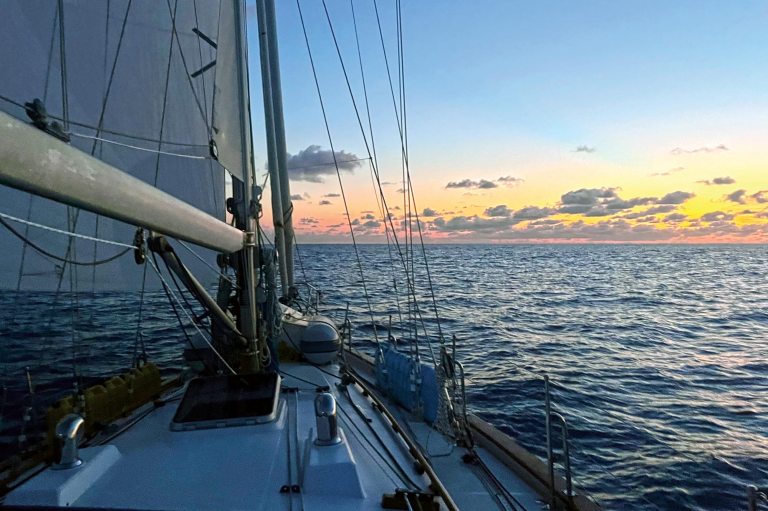
Our first boat, Anasazi Girl, was a Finot-Conq Open 40 that James had already used to complete a solo circumnavigation. Constructed of a prepreg carbon fiber hull, carbon-Nomex deck and fixed keel, it was built for single-handing and speed. It had a stripped racing interior and was essentially like living in an expedition tent.
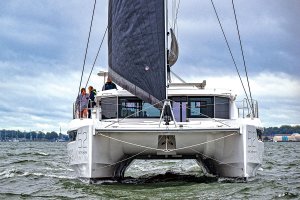
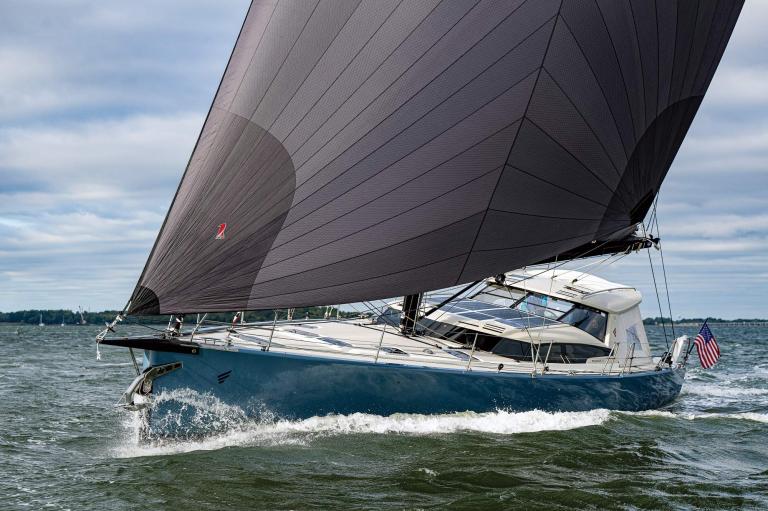
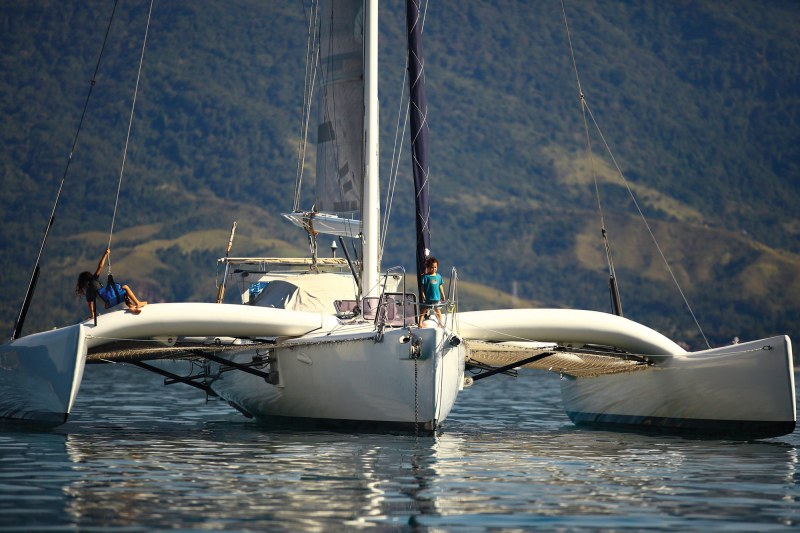
Our second boat, Thunderbird, which we are still sailing, is a Peter Bosgraaf 50-foot cruising trimaran built with Strongplank and epoxy, fitted with a cruising interior, and outfitted with foldable amas. At 7.5 tons, this boat is still lightweight, but has a roomier living platform for our family.
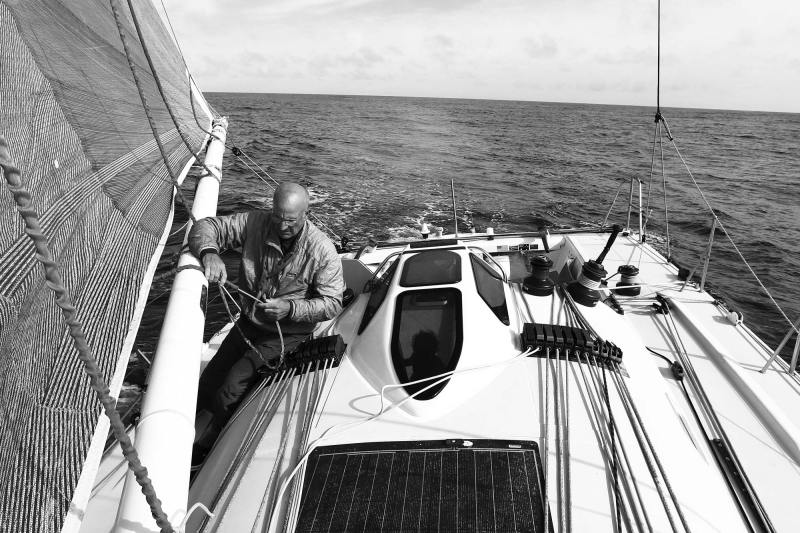
One governing philosophy has remained constant across both boats and all the miles between them: to sail light and fast, in the same way that a modern alpinist moves through the mountains. We aim to be light, precise and fast enough that the weather window we choose at the base is still open at the summit. We carry only what we need, move as fast as the wind allows, and leave every port ready to sail rather than motor.
If you ask James, he will describe himself as a climber who went sailing. He spent nearly four decades as an alpine mountain guide and boat captain where he was always climbing, skiing, doing avalanche rescue and recovery, developing adaptive sports programs, training search-and-rescue dogs to find cadavers and explosives, and flying in helicopter mountain rescues. Much of what he practices on the water is a direct translation of the risk management he exercised in those extreme environments.
There are two traditions in alpinism, and they mirror two traditions in offshore sailing. The older tradition is siege style: large teams, fixed ropes, multiple camps stocked over weeks, enormous quantities of food and fuel carried to sustain a slow, grinding ascent. The siege climber is built to endure. If the weather turns, they wait it out. If the route is harder than expected, they throw more resources at it. The emphasis is on resilience and the ability to absorb punishment and keep going. This style produced extraordinary mountaineers and got people to the summits of the highest peaks on earth. It also kept them on the mountain for weeks at a time, which is an invitation for everything that can go wrong to do so.
The modern alpine style emerged as a direct response to that logic. Instead of enduring the mountain, the modern alpinist moves through it. Fast, light and precisely timed. A small team, minimal gear, a carefully chosen weather window, and the fitness and skill to move quickly enough that exposure is brief. The objective is not to be strong enough to survive a storm on the face. It is to be fast enough to be off the face before the storm arrives. Speed is the mechanism of safety. And the discipline that makes it possible is minimalism: the ruthless, practiced elimination of everything that slows you down.
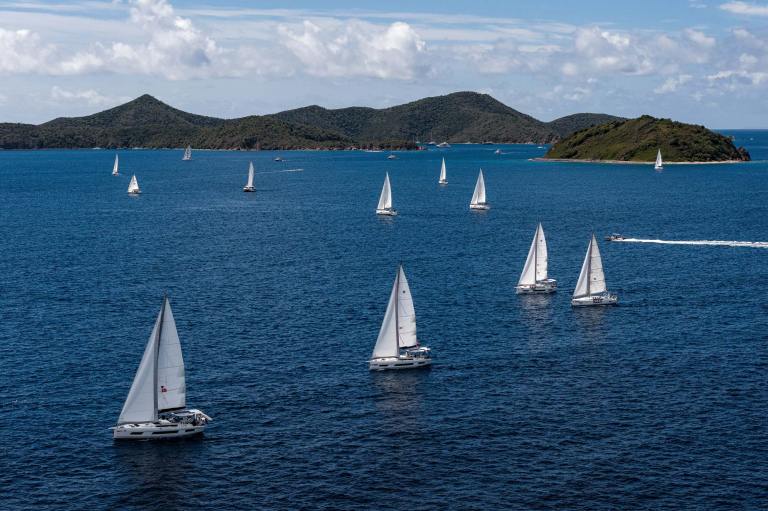
The siege sailor, like the siege climber, trusts equipment and mass to absorb punishment. The alpine sailor trusts speed, timing and minimalism to avoid it. A heavy-displacement cruising boat loaded for every contingency, built to heave to and wait out whatever comes, is the siege camp. A light-displacement boat, sailed by a disciplined crew on a carefully chosen window, is the alpine ascent.
It’s a different approach entirely, one that treats time on the water as the primary variable to be minimized, with speed as the tool that minimizes it.
The Maybe
Every passage we’ve ever made has started with the same conversation. Not about the forecast; about the maybe. A forecast is a model. It is the best available interpretation of atmospheric data at a given moment, run through imperfect algorithms, extrapolated into a future that has not happened. We respect forecasts. We also do not confuse them with reality.
What we plan for is the maybe. What if the system moves faster than predicted? What if the window closes six hours early? What if we are slower than expected because we loaded too much, or the wind goes light, or the sea state builds? The maybe is the gap between the forecast and the reality, and every passage plan we make has to have an answer for it.
This is where speed enters the conversation, not as performance, but as margin. A boat that can make 8 to 10 knots in 12 knots of breeze has more answers for the maybe than a boat that struggles to make 6. Weather systems in the mid-latitudes move at 15 to 30 knots, and a frontal depression typically lives three to seven days from formation to dissipation. A front sitting 1,500 miles from your destination at departure arrives there in roughly four days. The fast boat has been in port for a day when it arrives. The slow boat is still at sea.
A boat with double-digit speed capability, sailed conservatively at 7 to 8 knots, transforms the mathematics of passagemaking. A 50-mile coastal hop becomes a day trip. Leave at 0300 and you arrive with time to enter a new port in daylight, with few dark hours at sea. That is a seamanship argument, not a racing one. This does not mean outrunning weather systems at 300-plus miles per day. What is realistic, and what changes everything, is the more modest version of the same principle. The fast boat has options the slow boat simply does not have.
James plans for the worst speed, not the best. Our planning speed is 6 knots, below what we typically make, but honest about what happens when things do not go as expected. We carry provisions for that number, and anything better is margin. That margin is safety.
The Open 40
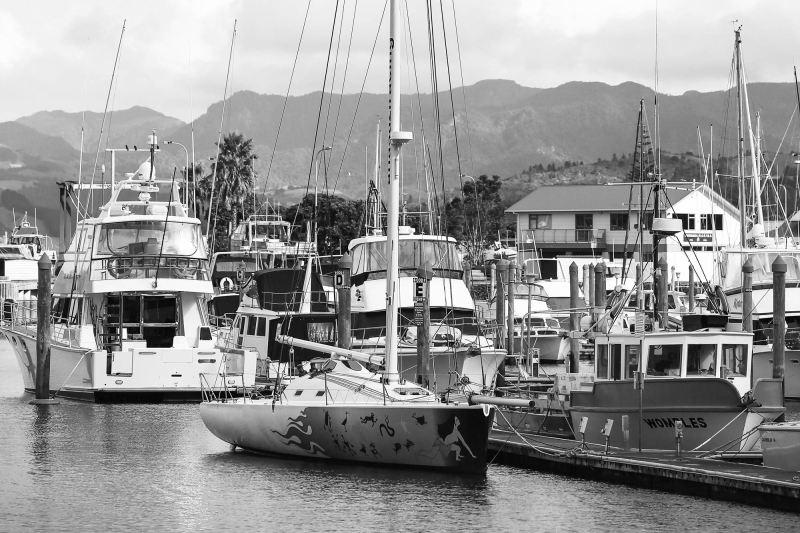
Our first offshore boat was stripped to almost nothing. Two cups, two spoons, an alcohol stove, a 20-liter jug of water, ¾-inch closed-cell foam on the quarter berths instead of mattresses. We left with our two oldest children, then ages 3 years and 9 months. Many people thought we were insane. Some said so directly.
We were not waiting for the perfect boat or the right timing. Time is the one resource you cannot recover. On that boat, we made passages of 4,000 to 6,000 nautical miles nonstop. At those distances, you cannot carry enough food or water to be slow. Speed is what makes the passage possible. The Open 40, kept light, sailed in conditions where a heavier boat would have been motoring. Sailing the great historical trade routes does not require an engine or a high-performing racing boat. It requires a boat kept light enough to move in the wind those routes were designed to use.
What we understood even then was that the weight you carry is not just physical weight. It is cognitive weight, maintenance weight, decision weight. Every piece of gear requires attention, stowage and energy that, on a passage, belongs to watchkeeping and rest. The less you carry, the more of yourself you have available for what actually matters.
Carry only what is essential, know the function of everything you bring, and repair before you replace.
The Trimaran
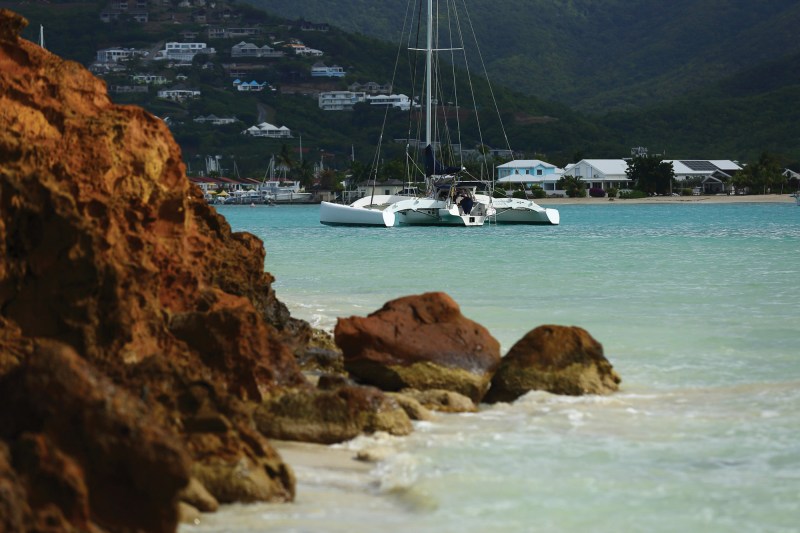
Seven years ago, we moved to a 50-foot trimaran. The platform changed everything about how we experience passages, but the philosophy did not change at all.
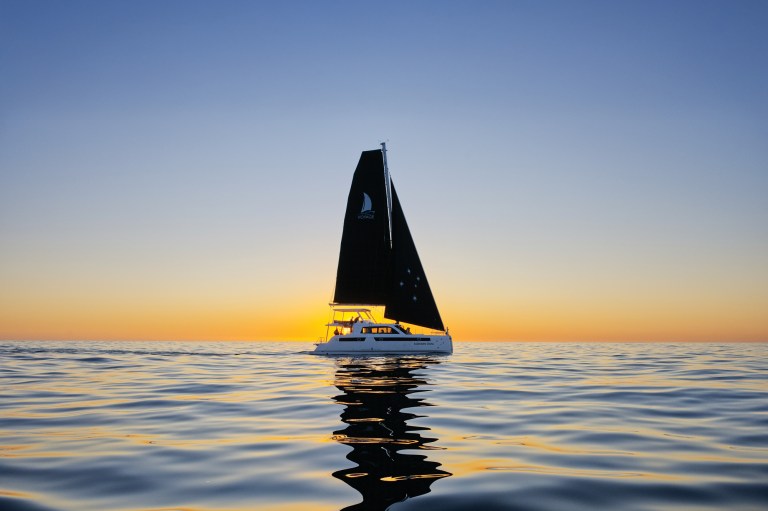
The trimaran averages 10 to 12 knots when we sail. The amas provide stability no catamaran can match at the same weight, and the single hull keeps the living space narrow enough to stay light. At sea, the boat is remarkably level, which means rest periods off-watch are genuinely restorative. The shallow draft means we clean the bottom ourselves, swimming down once or twice a week, with no haul outs or tide-window schedules to manage. The boat’s motion opens up anchorages that a deep-keeled boat cannot reach. We carry a large dinghy to explore. The whole point of cruising is to get away from the dock, and a light multihull is what makes that possible.
The alpinist parallel holds here too: A climber who descends to a proper camp at a lower altitude recovers differently from one who builds a temporary shelter on the face. The platform matters as much as the hours of rest. Rest that actually restores produces a different crew at the end of a passage than rest that merely interrupts fatigue.
Sleep science makes this explicit. After 17 to 19 hours of sustained wakefulness, performance on speed and accuracy tasks is equivalent to a blood alcohol concentration of .05 percent. By 20 to 21 hours, easily reached on a second night watch, impairment reaches .08 percent, the legal driving threshold in most jurisdictions. Fatigue erodes judgment before it affects physical capability. A tired sailor feels capable, while their ability to assess risk is already compromised. They can still trim a sail. What they cannot do reliably is decide whether the conditions ahead justify the sail plan they are carrying.
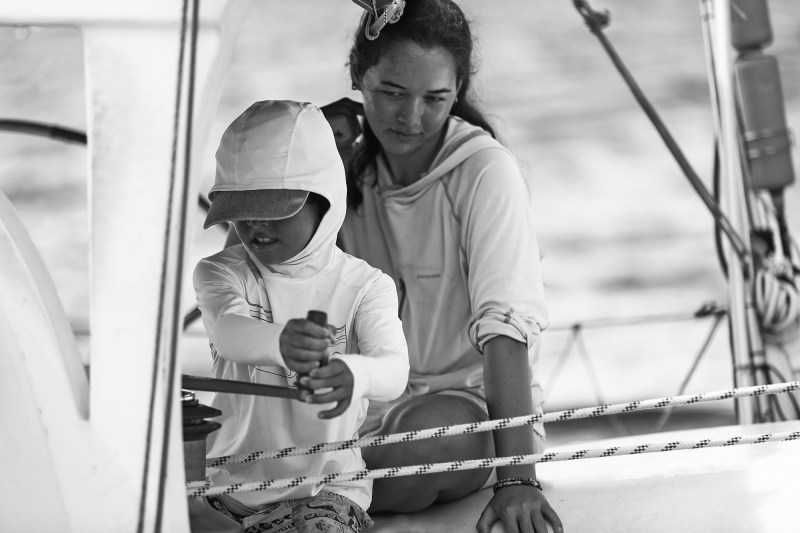
Emotional regulation degrades too. Fatigue makes crews harder to lead and quicker to conflict, precisely when agreement under pressure matters most. James watched this dynamic play out in the mountains for decades. Altitude degrades judgment the same way fatigue does at sea: progressively, invisibly, in ways the sufferer is the last to notice.
A shorter passage on a stable platform is a direct intervention in that process, but the trimaran’s speed only delivers its safety benefits when the boat is kept light. We have learned this the hard way. Coming up the coast of South America, post-pandemic and post-cancer treatment for James, we carried an accumulation of winter clothes, surfboards, skateboards, extra provisions and extra spares, alongside a sail plan that was already compromised. A delaminated main cut off at the third reef, and a jib too small for our sail plan, left us underpowered. The boat still moved, but the responsiveness was gone. The margin was gone.
When we finally got to the Caribbean and emptied the boat, the response to even small sail trim adjustments was immediate and dramatic. We had gradually given away our safety margin 1 pound at a time and had not noticed until we got it back.
Sailing by the Numbers
The sail plan on a light multihull does not need to be complicated. We carry three sails: a main, a roller-furling jib and a moderate gennaker. We are currently sailing with a used main sail, which is equivalent to a full one cut to the size of the first reef. It has worked well because the number of times you fly a full main while cruising is limited, and a smaller main is a lighter boat. Faster passage times mean half the food, water and diesel of a slower crossing. The lighter the boat gets, the smaller the sails required to maintain 7 to 8 knots.
The virtuous cycle runs in one direction only: down. Downwind in light air, a light boat sails. A heavy boat motors, which means carrying more diesel, going even slower and spending more time on engine maintenance. That is not sailing at all.
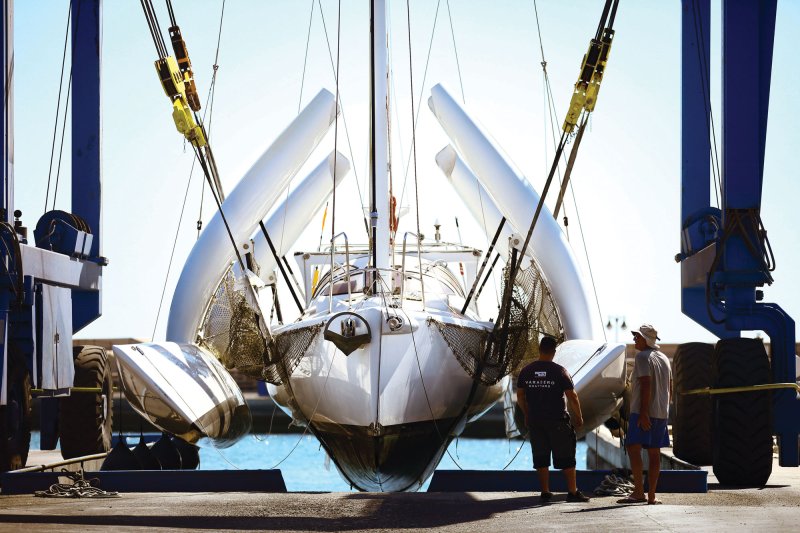
On a trimaran, you cannot feel speed the way you do on a monohull. The platform is too stable, the motion too smooth. You can be doing 15 knots and the boat will feel calm and comfortable. This means you have to sail by the numbers: instruments, not sensation. We reef early, always. Not because the boat feels overpowered, but because the numbers say it is time. This is the same discipline James practiced in the mountains. You do not wait until you feel cold to put on a layer. You put it on before you need it, because by the time you feel it, you are already behind.
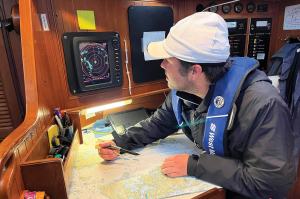
High speeds also demand a higher standard of watchkeeping. On a boat covering ground at 12 to 15 knots, closing speeds on ships, fishing vessels and floating debris compress the time available to identify and react to a threat. We stand watch, not sit. We have a Class B AIS with a low-loss coax cable and antenna at the masthead, not a cockpit-mounted unit with compromised range. We recommend using a modern radar capable of picking up small targets. This may not be how most cruising sailboats are outfitted, but then again, being a thousand miles offshore at 20 knots is not for most people.
The way we sail is what the alpinist means when he talks about moving fast and light through a dangerous environment: not to show off, but to minimize the time the environment has to act on you. The ocean, like the mountains, is entirely indifferent to your survival. The question is not whether you can endure it. The question is how little time you need to spend in it.