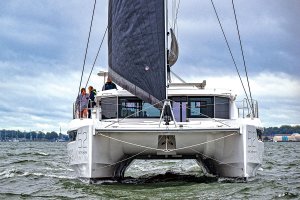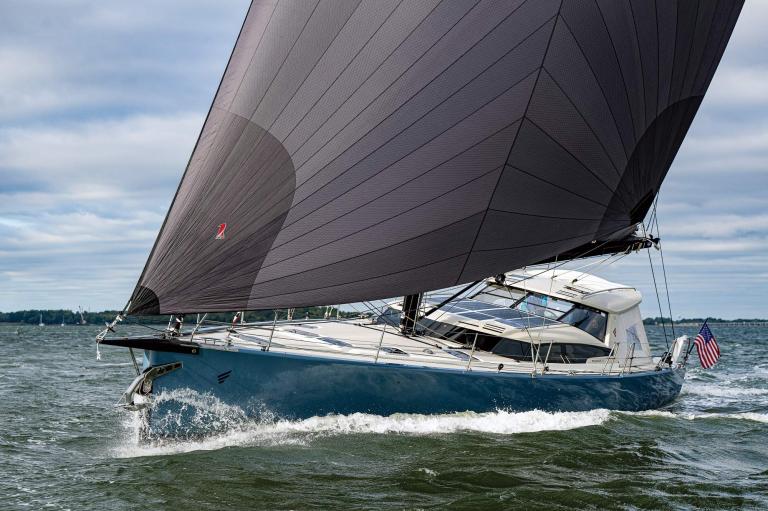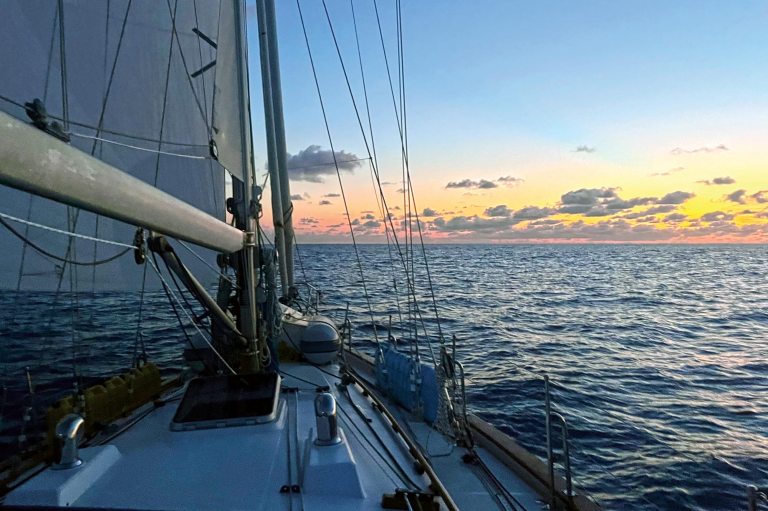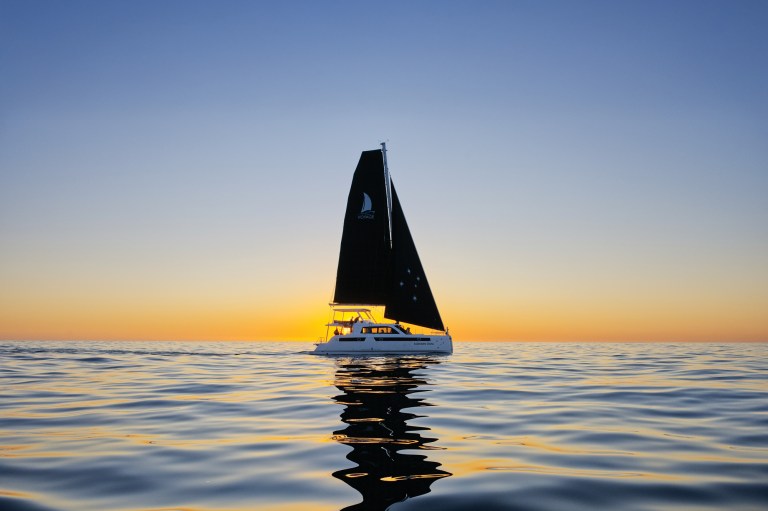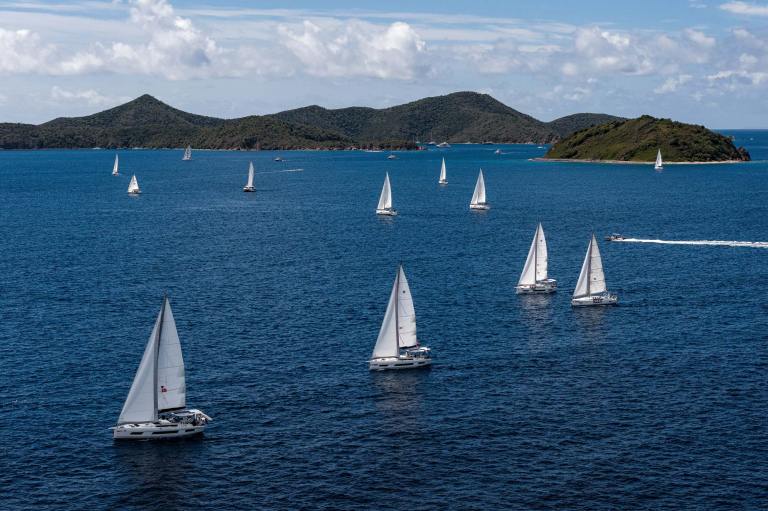
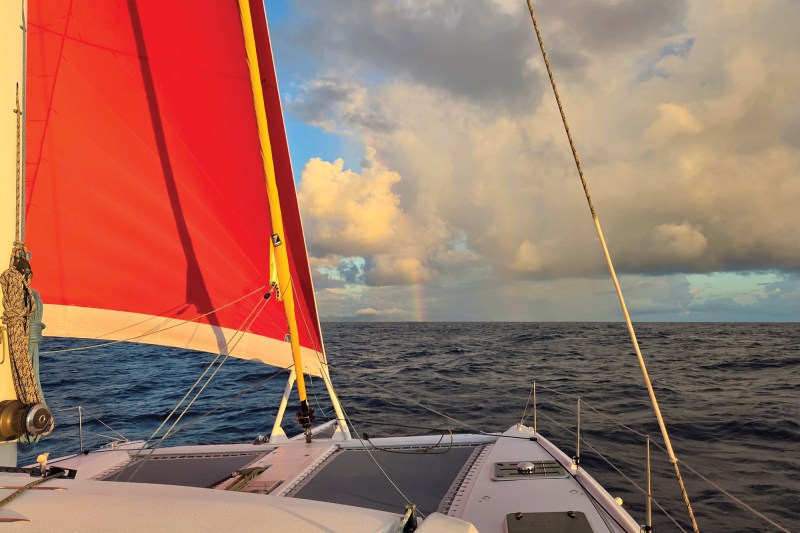
In January 2022, we set the jib and the main wing-on-wing about 5 nautical miles west of Cape Verde. We didn’t change the sail plan for 13 days. We had it all: an Allures 45.9 bluewater boat, steady trade winds blowing 15 to 18 knots on the starboard aft corner, and following seas. Our east-to-west Atlantic crossing is what every cruiser hopes for.
Yet, it was far from our favorite passage. With time and reflection, we formulated an answer to the “why” of our discontent.
It turns out that we prefer crossing latitudes over longitudes. For us, experiencing the Earth’s dynamic nature makes all the difference. Besides, the relentless downwind sway, known as yawing, makes me seasick.
When you sail along a parallel, the stars stay largely the same. They simply arrive a little later or earlier each night. But when you sail north or south, the celestial sphere shifts. Your progression is evident in your changing perspective of the sky.
En route from Panama to the Galapagos, the Southern Cross acted as our cosmic progress bar. We watched it grow brighter and climb higher in the June night sky with every degree of latitude gained. Likewise, as we sailed north from the Virgin Islands, bypassing Bermuda in the boreal spring, the sun dictated the passage of time and distance. Each day was visibly longer than the last, the arc of the sun shifting its track across our boat’s deck.
By contrast, the act of resetting the ship’s clocks as we crossed Pacific longitudes from the Galapagos to French Polynesia felt forced—a bureaucratic necessity rather than a physical reality.
Crossing climate zones, the hallmark of meridian sailing, adds tangibility to a voyage. On a longitudinal crossing, you stay in the same “weather” for weeks. On a latitudinal one, distance is measured not just in degrees and minutes, but also by the layers of clothes you wear.
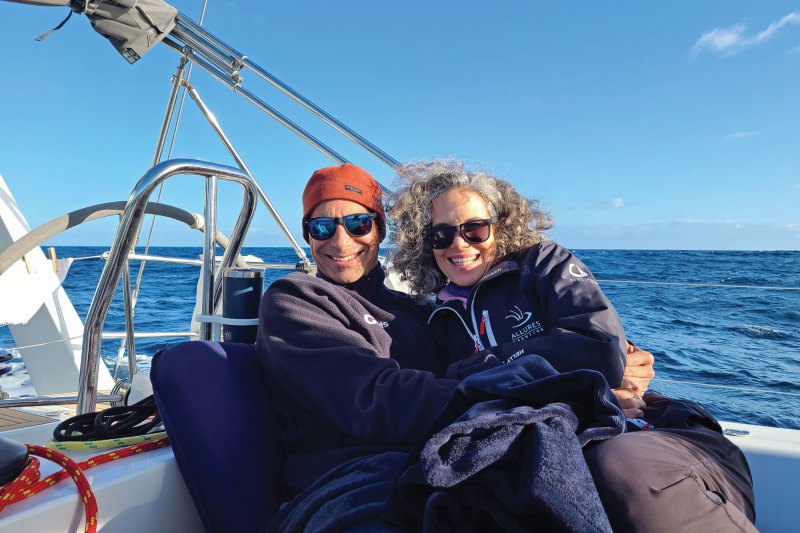
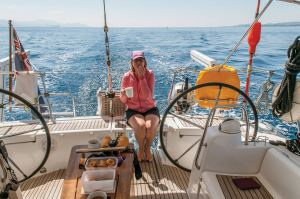
Departing in November from Virginia, we were encased in full foul-weather gear, shivering through watches as we cleared the coast. By the time we arrived in Antigua, we were barefoot and in bathing suits, the heavy Gore-Tex stowed deep in the lockers. We watched the reverse happen while sailing from Antigua to Newport, Rhode Island, in April—the gradual donning of fleeces and socks as we left the warm tropical air behind us.
It’s not only the temperature that marks our accomplishment, but also the shift in the climate zones. Sailing from the Caribbean to the Azores, we marveled at the eerie, glasslike high-pressure calm of the horse latitudes (30 degrees to 35 degrees north), only to find ourselves on our toes a few days later, dodging the lows of the temperate zone. Similarly, sailing across the equator, the hot, humid doldrums of the Intertropical Convergence Zone gave way to the tropical zone trade winds. We weren’t just moving across a map; we were moving through our living, breathing planet.
The ocean itself is dynamic, though it can feel monotonous on a long trade-wind run. Cruising across latitudes, we’ve enjoyed the dramatic evolution of the water. We’ve watched as the translucent turquoise of the tropics turned opaque and steely gray, then changed again into a deep, regal cobalt or a startling violet-blue.
The biology changes, too. Vast, golden deserts of sargassum eventually give way to the delicate, drifting iridescent sails of the Portuguese man o’ war. The bow-riding dolphins change species as the water temperature fluctuates, their patterns and behaviors shifting as we go. We love to watch the diversity of avian creatures throughout our journey, from soaring frigate birds to curious boobies, gannets, penguins and more.
Finally, voyaging across latitudes from one hemisphere to another adds a welcome technical challenge as well: the reversal of the Coriolis effect. The rotation of the Earth is responsible for the changing direction of wind and ocean currents, and crossing the equator means watching the physics of the weather flip. To us, experiencing this dramatic shift in atmospheric gears is far more exciting than staying tucked within a one-directional swirl.
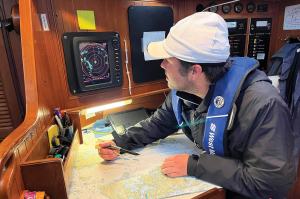
Switching hemispheres requires a dynamic sail plan and a constant dialogue with the elements. While some cruisers fear the unpredictability of the temperate zones, modern technology helps manage the risk. High-speed data and real-time satellite weather apps offer granular weather information, so we have confidence when venturing outside the “safe” tropical zones. The caveat, of course, is that it’s crucial on any bluewater cruise to have backups in place in case technology fails.
A cruiser’s course is typically dictated by seasonal weather, but human events can force our hand. The pandemic famously upended the traditional Milk Run. In May 2021, with the Pacific largely closed to visitors and Europe beginning to flicker back to life, we chose to sail the “wrong way”—northeast from the Caribbean toward the Mediterranean.
Much of the trip was a reach across latitudes, but it was the right move. To this day, making landfall in the Azores remains one of our finest moments. The passage’s dynamic nature and challenges made the sight of those lush, green volcanic peaks all the sweeter.
There is no doubt that heading west to chase the sunset is an experience most bluewater cruisers will cherish. What’s more, whichever direction you go, similarities abound. Things break. Squalls and seasickness happen. The captain and crew get doused by waves that unexpectedly jump from the sea. Suicidal flying fish litter the deck, and the chocolate supply eventually runs out. Night watches are simultaneously magical and lonely. Without fail, the ocean humbles us. Starry skies and sunsets make our jaws drop. Dolphins find us. And I, for one, hear the mermaids sing.
Indeed, there’s wisdom to be learned and grit to be earned on any ocean passage. Still, there’s a profound case to be made for making a meridian voyage. The journey is as transformative as the destination.
US Coast Guard captain Jill Gallin traded a life ashore for 30,000 nautical miles of bluewater cruising. Since 2020, she has been exploring the globe with her family aboard their Allures 45.9, and then their Outremer 49, both named Gerty. Read more at svgerty.com.