I will confess that my introduction to the cruising catamaran was not what you’d call a confidence-building exercise.
Late spring, Jost Van Dyke, a bareboat charter with friends through the British Virgin Islands. We’d moved from White Bay to Great Harbour by late afternoon looking for better protection, and found it. I then proceeded to spend a meaningful portion of the night wide awake on the flybridge, wondering whether I actually knew what I was doing.
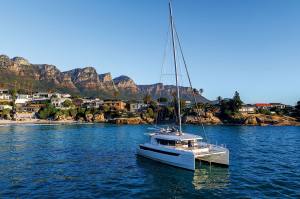
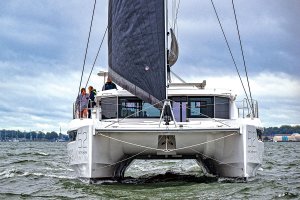
Not because anything went wrong. Nothing did. Instead, because the boat beneath me was 54 feet of power cat. It came with a beam I hadn’t fully reckoned with until we were committed to the anchorage. The gap between “I’ve sailed a lot of boats” and “I understand this particular boat” had revealed itself with some clarity. I’ve sailed on enough monohulls that I know, usually, what they’re telling me. This one was still introducing itself.
I vividly recalled that night while assembling this issue, because the sailors I kept talking to—bluewater sailors with real ocean miles behind them—were arriving at the catamaran from a completely different direction. They weren’t discovering the platform by accident on a bareboat charter. They were doing the math deliberately, passage by passage. What they keep finding is changing the way serious offshore sailors think about the choice.
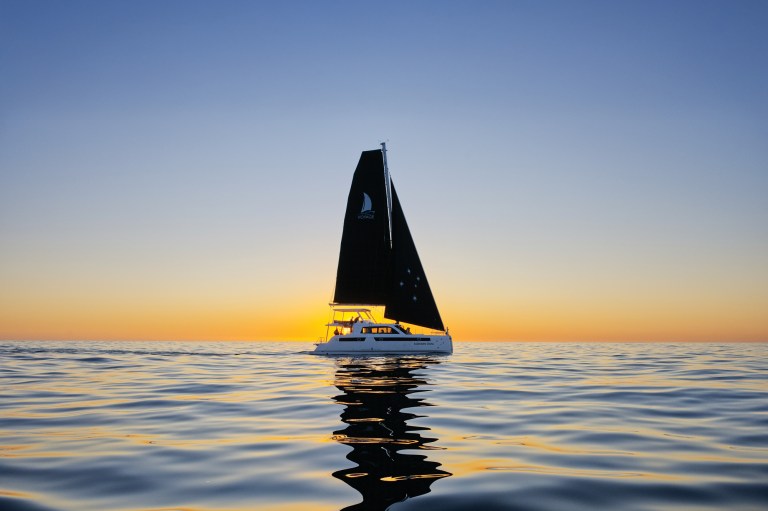
A modern cruising cat in the 45- to 55-foot range will average 2 to 4 knots more than a comparable monohull on most offshore passages. On a 3,000-mile Pacific crossing, that gap translates to days. It can be the difference between arriving ahead of a weather system and arriving inside one. For a shorthanded couple managing crew fatigue across consecutive passages, that arithmetic isn’t about performance in any recreational sense. It’s about seamanship.
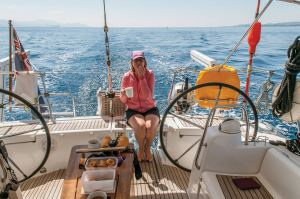
The motion argument compounds it. Fatigue is the primary risk on long passages, and the boat’s motion is what drives fatigue. A boat that sails flat, allowing its crew to cook, sleep, navigate and stand watch without being at 20 degrees of incline on a wet, moving surface doesn’t just feel better. It keeps people sharper offshore, and for longer. Somira Sao, who has spent 14 years voyaging full-time with six children aboard light multihulls, makes the case more precisely than I can: Speed, managed correctly, isn’t the risk. It’s the risk-management tool.
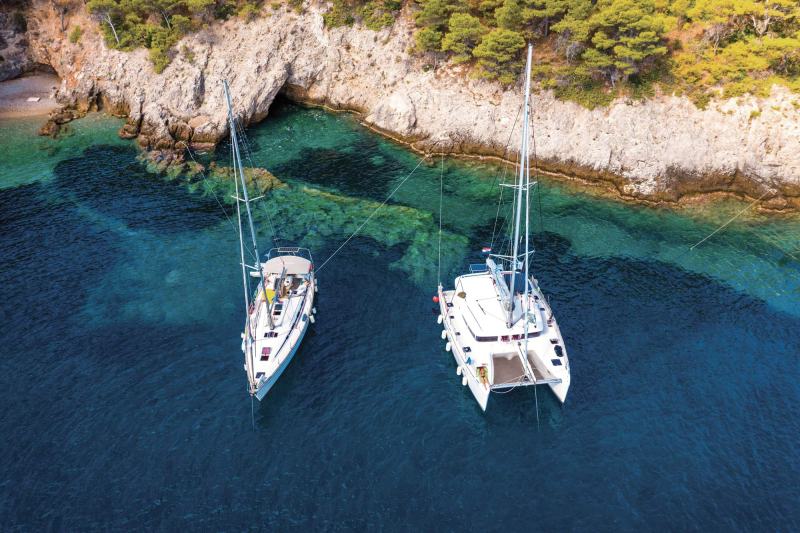
But I’ll be equally honest about what the platform demands, because the smartest sailors are the ones who’ve priced this factor in before the purchase rather than after. For one, marinas built in 1978 were not designed with a 27-foot beam in mind. Then there’s going to weather in a steep chop, where the monohull earns its keep in ways a cat cannot fully match. Also keep in mind that twin systems require more of the person maintaining them. These are real costs.
Still, what strikes me most about the offshore sailors who’ve made this transition is their specificity. They can tell you exactly what they traded away and exactly what they got in return. They did the math on their own terms. Herb McCormick, who has been watching this evolution unfold since a transatlantic record attempt on a 60-foot cat in 1986 would probably tell you the math has been getting harder to argue with for about 40 years now. He’d be right.
That’s the spirit in which we put this issue together every year. Not to make the case for any hull form, but to give you the information to make your own best choice.
The sailors asking the toughest questions about multihulls right now are some of the most experienced offshore sailors I know. That tells you something.
What you do with the information now is up to you.