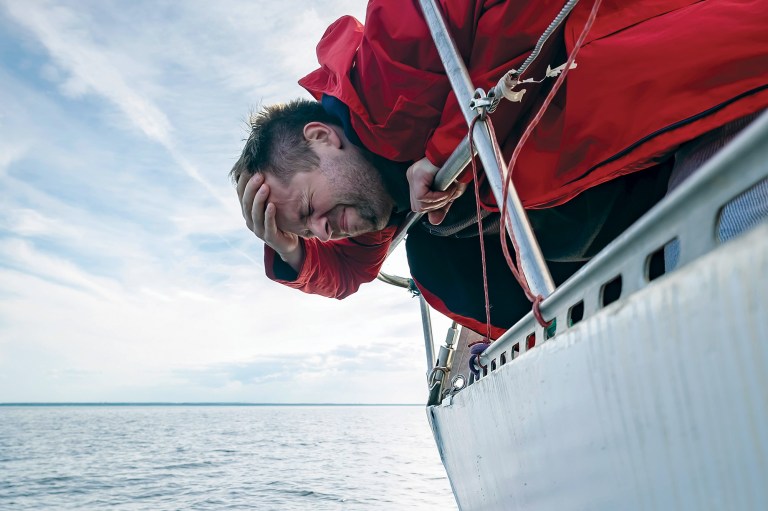
Jost van Dyke, late spring. We’d started the afternoon in White Bay: full anchorage, beautiful beach, the Soggy Dollar doing its usual brisk business. But by late afternoon, I didn’t love our exposure. I liked our swinging room even less.
We moved. Great Harbour, around the point, offered better protection. It also offered considerably less room to work with. Seven other people aboard a bareboat Aquila 54 (a power at, not a sail, though the principles mostly translated) and a crowded mooring field that rewarded advance reservations. The bridle was rigged—eventually, correctly, after a learning moment I’d rather not conjure up again.
But I still found myself doing the mental math on the swing radius of every boat within range, watching the anchor lights of our neighbors, listening for the particular sound that means something has changed. Seven friends sleeping soundly below. Me in the cockpit about once an hour, unwilling to commit fully to unconsciousness.
Everything was fine. We enjoyed an epic charter week. But that night in Great Harbour made it clear to me that a catamaran is a different animal than anything I’d managed in my monohull-dwelling world, and a tight anchorage has very little patience for folks who are still working that out.
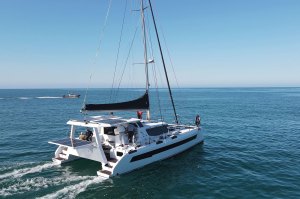
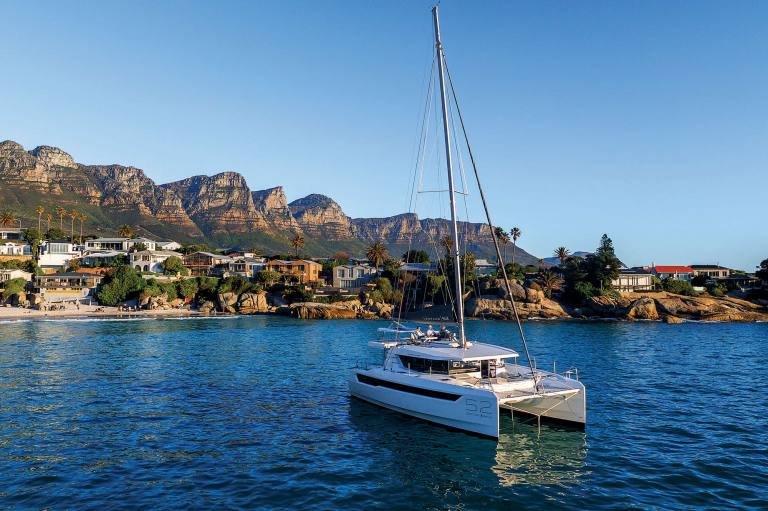
The case for the catamaran is well established, and the numbers back it up. The multihull market has expanded steadily for the better part of two decades, and the reasons are not hard to find. Stability that monohull sailors have to experience to believe. Shallow draft that opens anchorages a keelboat can only admire from the chartplotter. Deck space that makes offshore passagemaking genuinely comfortable for a full crew.
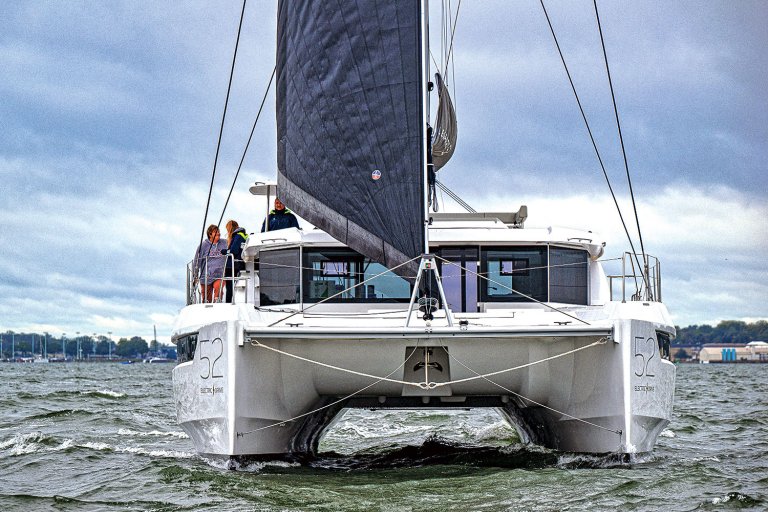
The newest generation of cats, such as the ones we tested in our Boat of the Year sea trials off Annapolis, Maryland, last October, carry solar arrays, watermakers, lithium battery banks and sail plans that move real weight at real speed. Established builders like Leopard, Lagoon and Fountaine Pajot have spent decades refining these boats into serious offshore cruising platforms. Sailors who make the switch describe it, consistently, as one of the better decisions of their time on the water.
The boats are also getting wider every model year. And the marina built in 1978 hasn’t kept pace.

One figure reorganizes a cat owner’s relationship with shoreside infrastructure: 22 feet. That’s approximately the beam above which a standard marina slip, designed in the 1970s and ’80s, stops being a practical option. A Leopard 46 stretches nearly 24 feet across. A Lagoon 50 pushes near 27. The boats have been getting wider for decades. Finger piers, by and large, have not.
The result is familiar to any cat owner who has called ahead looking for transient dockage. End ties and T-heads, the wide outer berths where a cat can lie alongside the face dock rather than threading her hulls between finger piers, fill on annual contract first and are rarely available on short notice in a busy port. They can also carry a meaningful premium.
In competitive markets like coastal California and the Pacific Northwest, waiting lists for cat-compatible slips stretch to multiple years. Experienced multihull brokers now routinely advise buyers to secure home moorage before finalizing a purchase agreement for the boat.
None of this is insurmountable. Most cat owners work around it the same way, using marinas selectively for fuel, provisioning and maintenance, while spending the balance of their time at anchor. A cat’s shallow draft reaches anchorages keelboats can’t touch. The stability makes a night on the hook quite comfortable in conditions that might leave a monohull rolling. Many cat owners find that they use marina facilities a handful of nights per season, and the arrangement suits them well.
The marina fee, reframed, is a service purchase. The infrastructure challenge is real but manageable for owners who plan ahead.
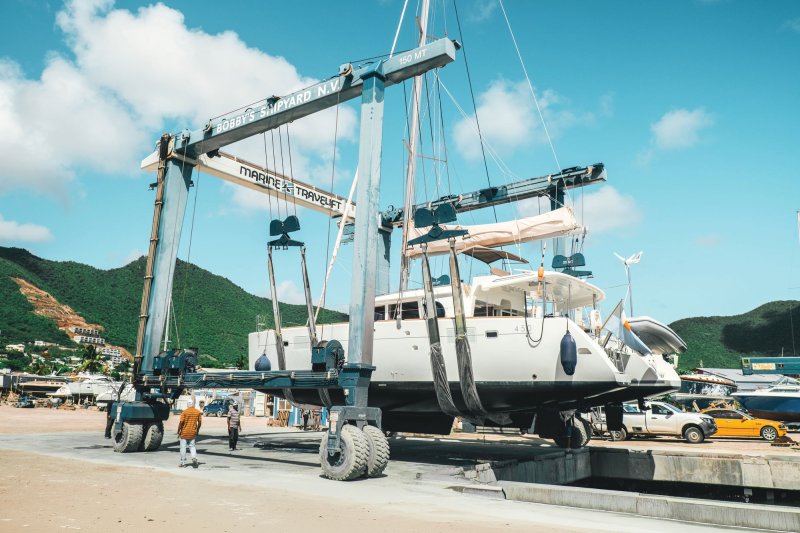
The haulout situation rewards the same deliberate approach. The standard Travelift found in the majority of American boatyards accommodates roughly 22 feet of beam, which is adequate for the production cruising cats of 15 years ago but limiting for much of what’s being launched today. A cat owner planning any serious cruise would do well to know where every wide-lift yard sits along the route, with alternatives identified.
All of that said, the coverage is improving. In Florida, Lauderdale Marine Center, Hinckley Yacht Services at Stuart, and Rybovich at Riviera Beach have all invested in equipment scaled to the modern cat’s beam. Grenada and Antigua have also expanded their multihull haulout capacity significantly in recent years.
But the distribution is still uneven enough that improvising is not a strategy, and for anyone cruising Florida or the Caribbean, the biology of warm water adds urgency to the planning. Hull growth at these latitudes is aggressive and consistent. Trust me. Down here in Fort Lauderdale, Florida, an annual haulout is widely accepted as an important part of regular maintenance.
What I began to understand in Great Harbour, and have come to terms with ever since, is that a catamaran requires a specific kind of situational awareness that takes time to develop. Without a bridle running from both bows to a midpoint on the mooring pendant or anchor rode, a cat has no lateral resistance to the wind. She moves. She swings. And in a crowded anchorage, she becomes a variable that the boats around her have to account for whether they know it or not. With a proper bridle rigged, she settles and holds, and the skipper in the cockpit at 0200 can actually get some sleep.
That’s the whole lesson, really. Not that these boats are difficult—they aren’t, in the hands of someone who has taken the time to understand them. It’s that they demand a kind of preparation that monohull sailing doesn’t always require in the same way.
The infrastructure gap is real, though it narrows every year as boatyards invest in wider lifts and marinas begin dedicating berths to the multihull fleet. But the gap does still exist. Find your slip before you sign the purchase agreement. Know your haulout yards as well as you know your charts. Rig the bridle before you turn in.
And then sleep. These are extraordinary boats. They’ve earned the trust.
Editor’s note: Are you a cat owner or charterer with a story to share? We’d love to hear from you. Email: editor@cruisingworld.com.