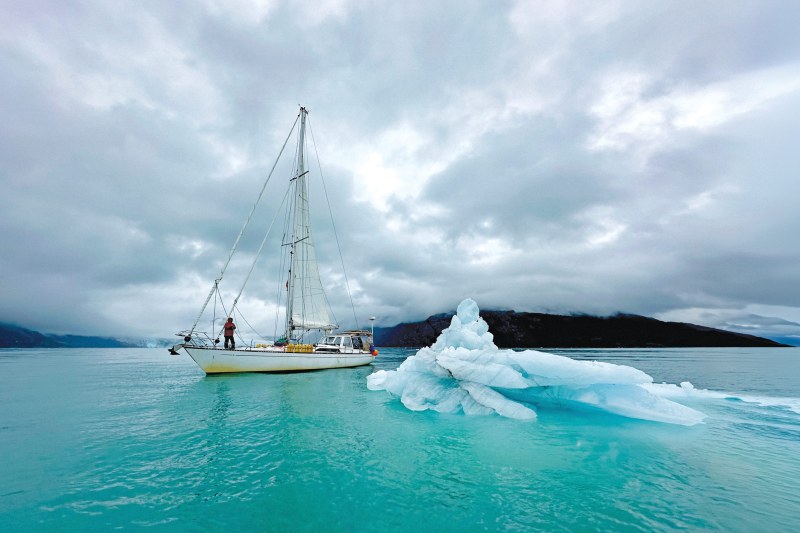
I am often asked, “How many miles has Quetzal sailed?” I reply politely, but evasively, “Quite a few.” For someone who loves navigation and mathematics, I can be vague about certain numbers. Or maybe, as the years and miles keep piling up, I don’t really want to know. I have always contended that it’s time at sea that matters. Days, hours, minutes and the stories they produce are more meaningful than a tally of miles.
Alas, the hardest history to outrun is your own, and with another major refit looming after a spate of serious sailing, a reckoning of sorts was due.
I take people to sea. That’s my job. I am Neptune’s ferryman, and along the way, I share bits of seamanship and stories that I have picked up from the front lines of a sailing life. I am pretty sure that when Quetzal, our hardworking Kaufman 47 cutter, eased alongside the customs wharf in Opua, New Zealand, after a nice sail south from Fiji last October, she was finishing her 200th training passage. With the passages averaging just over 1,000 miles, you don’t need to be much of a mathematician to calculate that she’s logged more than 200,000 miles. And that’s without counting all of our cruising miles, so it’s surely more. But 200,000 is a nice round figure, and there are plenty of miles and minutes yet to come as we keep pressing on year after year. This year, we are headed to Cape Town, South Africa, by way of Australia and Indonesia.
The story began in November 1985, when a fiberglass hull was lifted from a mold in Kaohsiung City’s Linyuan Industrial Park in southern Taiwan. An elegant teak interior was added, a diesel engine was installed, and a beautiful teak deck was schmooed and screwed in place. The boat was then hoisted onto a ship to ride piggyback across the Pacific.
After transiting the Panama Canal, she arrived in the port of Baltimore in April 1986. She was commissioned in Annapolis and christened Madrigal. She sailed locally for several years and raced to Bermuda at least once, but her owner lost interest in sailing and bought a motoryacht. She ended up being donated to a college sailing team that never sailed her.
In February 2003, I found her in a snowy field in Solomons, Maryland, and bought her a month later. While Madrigal is a lovely name, it would never work for someone as tone-deaf as I am. We renamed her Quetzal and the rest is, well, history.
Watching Quetzal being lifted out of the water at the Bay of Islands Marina in Opua, a flood of memories rushed through my mind. From Turkey to Malta, from Chile to Tahiti, Quetzal has been hauled out in 11 countries around the world. She’s had an array of refits too, big and small, and I couldn’t help but shake my head thinking of all the work, all the projects and all the people involved in her story. I followed behind as the Travelift operator searched for an open space to block her up. I was struck by just how different she looked from the boat I first sailed to Bermuda 23 years ago.
Quetzal and her many crews have accomplished some bold things over the years, but nothing quite as heroic as Theseus, the King of Athens. Theseus is famous for sailing to Crete to save the children of Athens who had been abducted by King Minos. Theseus entered the labyrinth, killed the minotaur and rescued the kids. He then sailed back to Athens by way of the island of Delos. Grateful Athenians preserved his ship and made a ceremonial voyage to Delos each year. Like all boats, it needed constant maintenance, and over the course of many years, every plank, oar, fitting and line was replaced.
Greek historian Plutarch mentions The Ship of Theseus Paradox in the first century CE. It’s a philosophical question that asks: At what point after constant change is something no longer what it once was?
Ancient philosophers from Plato to Aristotle had weighed in on the matter, with Aristotle claiming that the design, or “what it is,” doesn’t change when materials change. The question emerged again during the Enlightenment. Thomas Hobbes, writing in the 17th century but sounding like a modern-day politician, claimed that it might be and might not be Theseus’ ship. That old empiricist stickler John Locke claimed it would only be Theseus’ ship if every item removed was then replaced with the same item.
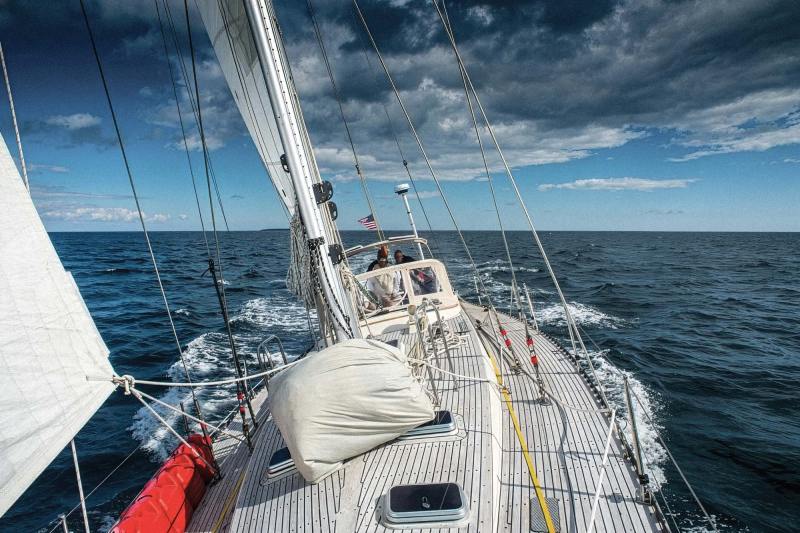
We blew out Quetzal’s mainsail on that first sail to Bermuda and the 135 percent furling genoa on the stormy sail back south later that fall. That started a rethink of the sail plan that has resulted in a very manageable plan we use today. The discovery of reefing off the wind was a revelation and changed the design of future mainsails. We abandoned full battens for a two-plus-two system, with the top two full length and bottom two partial. This, along with very slippery Selden mast cars and well-timed sheet control, allows the main to be dropped on a reach.
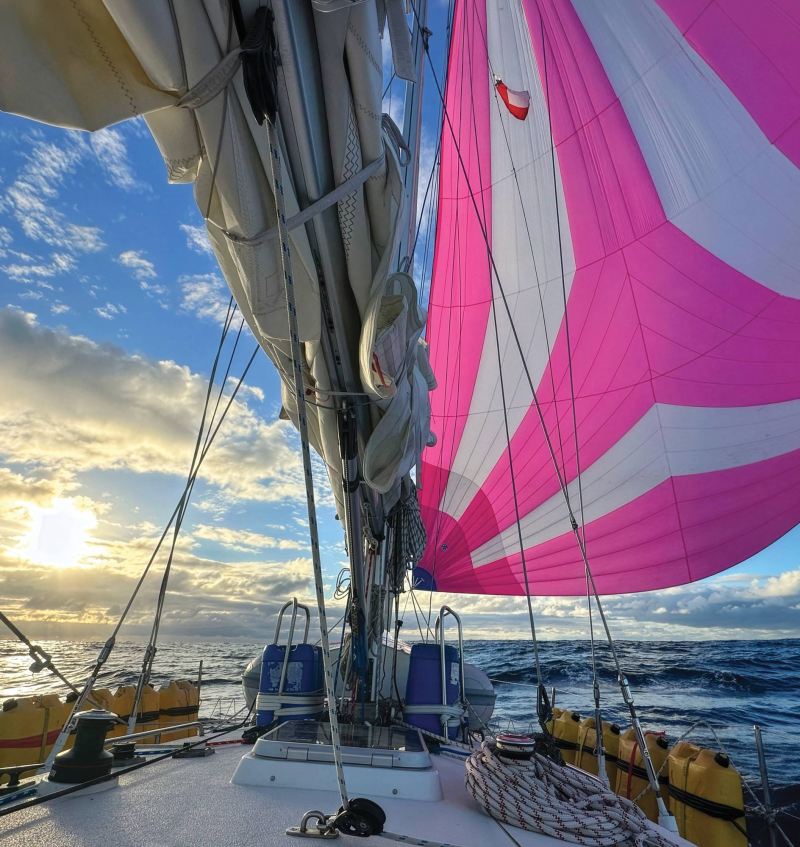
And our headsails have become progressively smaller. The new North genoa being built in Opua as I write is a high cut 115 percent. We also tend to sail almost exclusively as a cutter, and several years ago converted the staysail from hanks to a robust Furlex furling system. Along with an asymmetrical spinnaker and whisker pole (and spare headsails), it gives us a versatile inventory that keeps us moving on any point of sail and in nearly any condition. Our working sails are high-quality Dacron and are replaced every 20,000 to 30,000 miles, or every two to three years. New to newish sails just may be the most important safety gear aboard any boat.
A fateful trip to Trinidad 16 years ago is where Quetzal’s paradox began to take shape and taught me an important lesson: Don’t commission work to be done while you are away unless you have complete confidence in the yard and people doing the work.
We had the topsides painted, changing from a dull cream to fresh bright white with a navy boot stripe. I also commissioned a local chap to sand the teak decks lightly, because they needed attention, and to replace a few bungs and some caulking.
When I returned a month later, I was heartsick. I’d been a victim of teak terrorism. The guy had mutilated the decks, and it was only a matter of time before the decks would need to be removed. With the help of three dear friends and the professional crew at Spring Cove Marina, we did just that a few years later. The net result was a complete makeover with a relaminated deck, painted with white nonslip. It was a big job, to put it gently, and a completely new look for the boat.
I confess, having a sister and brother-in-law with a boatyard was one of my better moves, and Spring Cove became Quetzal’s home base when she was stateside. It’s where many major projects were completed. The next big job on the to-do list was the addition of a hard dodger. I was just about to order another new canvas dodger when my brother-in-law Trevor asked, sarcastically (at least I hope it was sarcastically), “How stupid are you? You have destroyed two dodgers in five years. Maybe it’s time for something new.”
My wife, Tadji, a big fan of staying warm and dry, also lobbied for a hard dodger. With serious high-latitude sailing on our schedule, they convinced me that it was time.
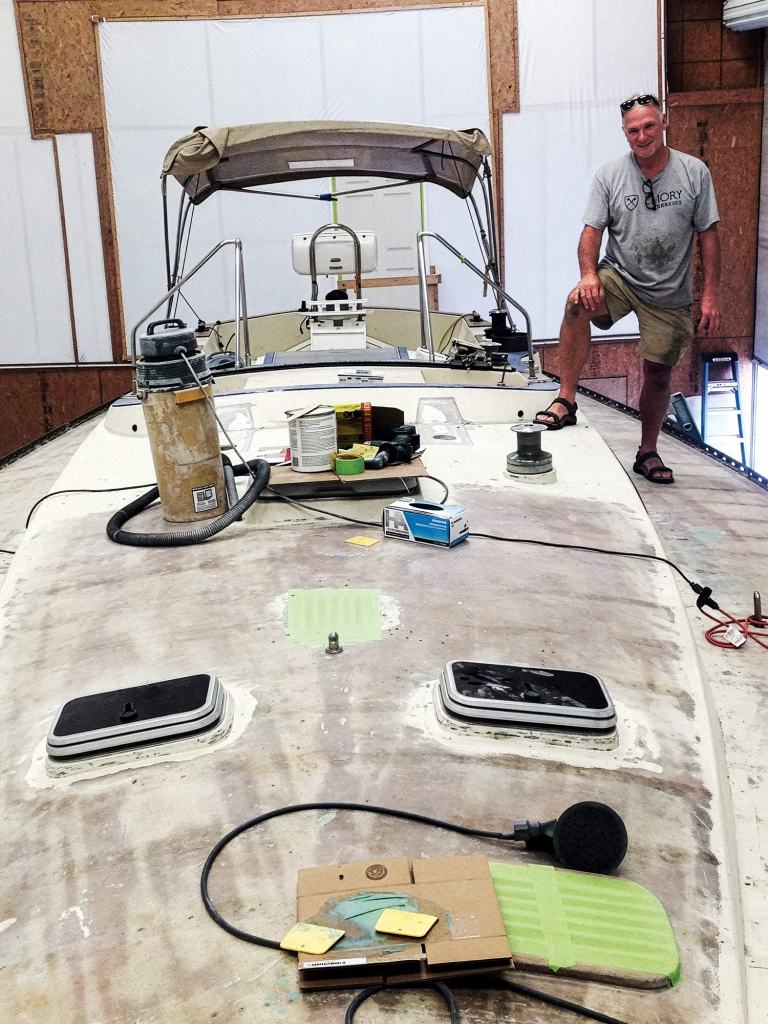
Still, I was reluctant. I didn’t want to destroy Quetzal’s sleek, low-slung profile and mar visibility by adding a permanent, boxy, fiberglass structure on deck. It was another project that would be completed while we were away, but I had complete confidence in Trevor and his crew. I gave them clear parameters. It had to be built to go away. The engineer who would build and install it groaned, but I was insistent. In the case of a knockdown or capsize, I didn’t want a failed fiberglass dodger ripping a gaping hole in the deck and compromising the boat.
The first step was to build a mocked-up plywood frame, not unlike a typical canvas dodger frame, and then weld up an anodized aluminum version. It was then bolted in place with just eight fasteners piercing the coaming. The dodger panels were made of Coosa Bluewater panels, which are closed-cell polyurethane foam that’s reinforced with multiple layers of fiberglass. They’re light, strong and waterproof. They were fabricated in the shop and then carried to the boat and mounted on the frame. Lexan windows completed the project.
My first reaction was that it was not quite as sleek as I had hoped, but it was brilliantly engineered and really strong. Eight years and several nasty storms later, I can’t imagine life without it. We also added a fixed aluminum Bimini-top frame with a Sunbrella overhead to complete the fullest of full enclosures.
Over the years, I had noticed a few hull blisters at each haul out. Eventually, a few became a lot, and by summer 2019, it was time to do something about them. We chose a cure that cut to the heart of Quetzal’s Paradox. We decided to peel the hull and relaminate it, in essence, to give Quetzal a new hull or at least a new outer hull. This was serious, almost like a heart transplant for the old girl.
We hired a strapping older gentleman whose shoulders and knees ached from 25 years of planing gelcoat and fiberglass off blistered hulls. It was loud, heavy, nasty work. The first peel removed all the gelcoat below the waterline, all the blisters and one-sixteenth-inch of fiberglass. He was surprised at the thickness of the hull and suggested we take another one-sixteenth off. The hull needed time to dry completely afterward, and for once, we had time. Tadji and I had organized a summer’s worth of charter expeditions all over the South Pacific. There was not a trace of moisture when we returned three months later. The paint and fiberglass expert at Spring Cove then added four new layers of S-glass with epoxy resin. We have not seen a blister since.
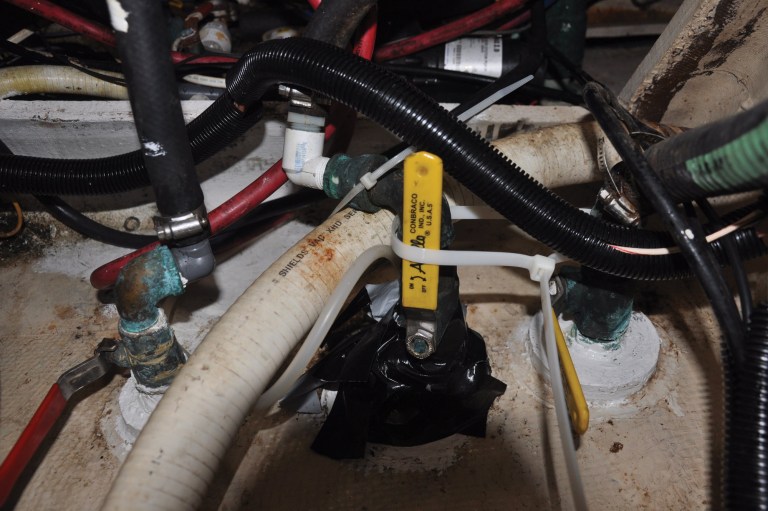
Along the way, we have repowered Quetzal twice, each time opting for a dependable 60 hp Beta diesel. Next to new sails, nothing breathes new life into an old boat like a new engine. We also added a diesel boiler and hydronic heating system, a project that required threading hundreds of feet of hose through the boat and squeezing into a small lazarette that became known as “the bad place.” It was one of our less-successful projects, as it’s never worked reliably.
Mixed between these big projects were countless smaller upgrades and repairs, from rewiring the boat and adding a new electrical panel to changing the plumbing and through-hulls, stove, sinks, lights, cushions and even sections of the cabin sole. On deck, we’ve added new winches and hatches, and we replaced most of the sailing hardware. We completely redesigned the chain locker hatch covers and added a rugged anchor roller system. And, of course, we’ve had our mast issues. We lost one in Italy during a freak tornado when Quetzal was on the hard, and another off Cabo Verde when a chainplate failed.
Sometimes I wonder if someone who sailed aboard Madrigal in 1986 would recognize Quetzal today. Is she the same boat? While the changes might shock them, I suspect the moment they took the wheel and felt her lift to the breeze and slice through the seas with her fine entry, inspiring confidence and dreams of far-flung landfalls, they would know it’s the same boat indeed. I stand with Aristotle.
A pro sailor and the author of Sailing a Serious Ocean, John Kretschmer leads offshore training passages and workshops. Contact him at john@johnkretschmersailing.com or via his Substack, A Serious Ocean.